When It Freeze In Florida So Do Your Plants....
The Midnight Scramble
Eleven twenty-three PM. Tuesday in January.
You're already in pajamas. Nearly asleep. Your phone lights up with the alert you've been dreading.
Freeze Warning in Effect from 2 AM to 9 AM. Temperatures Expected to Drop to 32°F.
Your heart races.
Not again.
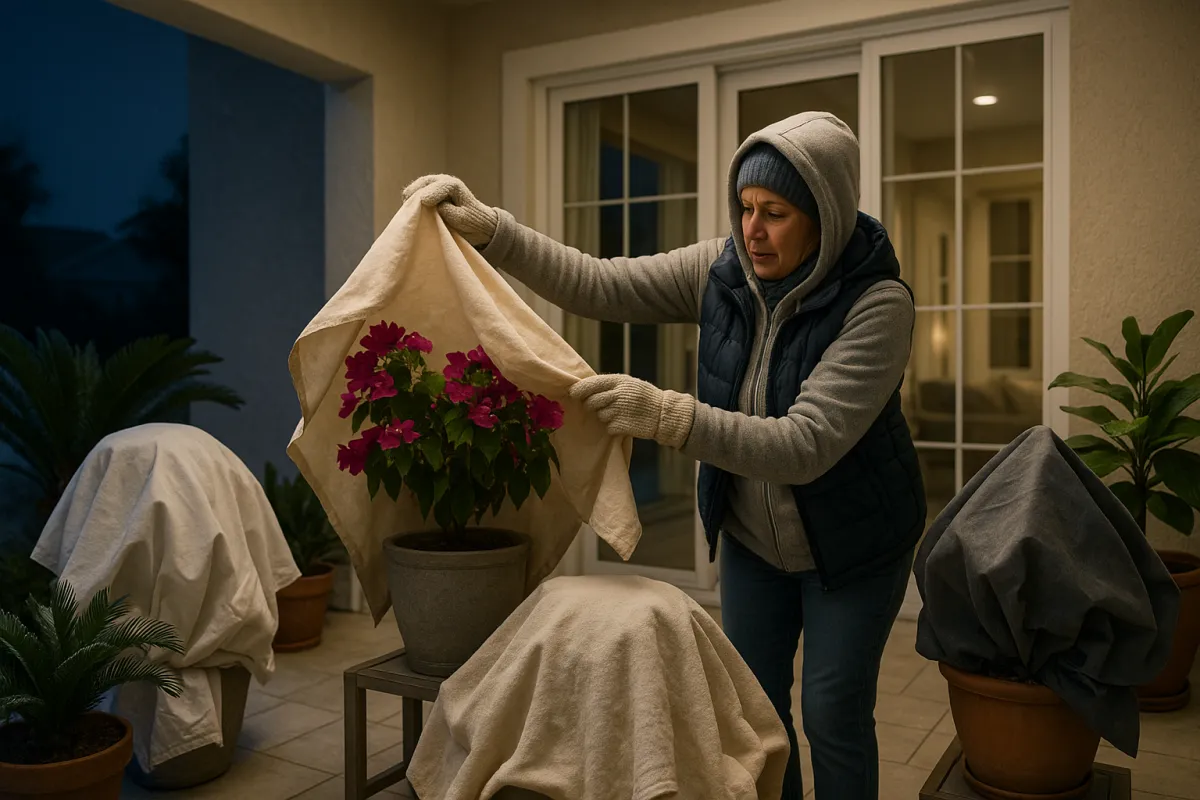
You throw on a hoodie. Head outside into forty-degree air. For the next hour, you're dragging sheets and blankets from the garage. Covering your prized bougainvillea—the one that took three years to establish. Wrapping your four-hundred-dollar sago palms in frost cloth. Moving potted hibiscus closer to the house. Draping tarps over your orchid collection. Hoping you've done enough.
Your neighbor's house? Dark and quiet.
Their motorized screens came down with a button press from bed. Their lanai plants are protected in a microclimate already eight to ten degrees warmer than your exposed patio.
By twelve forty-five, you're finally back in bed. Exhausted. Knowing you'll have to uncover everything by ten AM tomorrow or risk sun damage to the coverings.
There has to be a better way.
The Coastal Paradox
Here's what makes coastal Central Florida uniquely frustrating for gardeners.
The promise. Your climate is perfect for tropical landscaping. Bougainvillea. Hibiscus. Orchids. Bromeliads. Plumeria. Bird of paradise. All the gorgeous plants you see at botanical gardens. You can create year-round tropical paradise.
The reality. Flagler, Volusia, St. Johns Counties experience two to four freeze warnings every winter. Temperatures dropping to twenty-eight to thirty-five degrees. Cold enough to kill or severely damage tropical plants.
The cruel pattern. Ten months of perfection. Your tropical plants thrive. Grow beautifully. Bloom constantly. Two months of terror. January through February bring unpredictable freeze events. The aftermath. Five hundred to three thousand dollars in plant loss or damage per freeze event.
What's at Stake
Let's talk about what you stand to lose during single freeze event.
The big tickets. Sago palms: three hundred to five hundred each. Freeze damage causes frond death. Recovery takes one to two years. Severe freezes can kill them entirely.
Established bougainvillea: two hundred to four hundred plus three years growth. Dies back to roots in hard freeze. May or may not recover. Even if it does, you lose two to three years of growth.
Orchid collections: fifty to two hundred per plant. Many varieties die at thirty-five or below. No recovery. Total loss.
Bird of paradise: one hundred fifty to three hundred each. Foliage burns at thirty. Plants recover but look terrible for six-plus months.
Plumeria: eighty to two hundred each. Stem damage at thirty-three. Die-back requires cutting damaged sections. Lose one to two years of growth.
Bromeliads: thirty to eighty each. Freeze damage causes permanent scarring. Most don't recover.
The medium investments. Hibiscus: forty to eighty each. Severe die-back. Recovery possible but takes full season. Ixora: twenty-five to fifty each. Leaf burn and branch die-back. Slow recovery. Crotons: twenty to forty each. Leaves turn brown and fall off. Plants may survive but look awful for months.
The time investment. Beyond money, there's years of growth you lose. That bougainvillea that finally covered your arbor? Back to starter size. The orchid collection you've been building for five years? Decimated. The tropical garden you spent two years establishing? Needs complete replanting.
You can replace plants. You can't replace years.
The Solutions That Barely Work
You've tried everything coastal gardeners try.
Frost cloth. Two hundred to four hundred invested. Works if applied correctly. But it's eleven PM and you're trying to remember which plants are cold-hardy and which need covering. You're stumbling around in dark. Half the time you damage plants while covering them. And you'll need to uncover everything by mid-morning or risk sun damage to coverings.
Moving plants indoors for potted plants. Great in theory. Reality: you have thirty potted plants. Where are you putting them? They weigh forty to sixty pounds each. You're making fifteen trips at midnight. And they'll drop leaves indoors anyway from environment change.
Sheet and blanket method. You've raided your linen closet. Old blankets, sheets, tablecloths. Your tropical garden looks like ghost town. Sheets blow off in wind. Some plants are too large to cover effectively. And you're washing everything next day because it all got dirty and wet.
String lights and heat lamps. One hundred fifty to three hundred. Helps marginally. Burns a ton of electricity. Can cause fire hazard. Doesn't work if wind is strong.
Watering before freeze. This actually helps, but it's not complete solution. Wet soil retains heat better than dry soil. But it only provides two to three degrees of protection.
Hope and prayer. Check extended forecast obsessively. Hope freeze warnings are wrong. Plan emergency covering strategies. Still lose plants.
The Real Cost Over Time
Let's calculate true cost of freeze damage.
Conservative scenario. Minor freeze, basic landscaping. Event frequency: two freeze warnings per winter. Plant loss per event: four hundred. Replacement costs: eight hundred yearly. Ten-year cost: eight thousand.
Realistic scenario. Multiple freezes, tropical garden. Event frequency: three to four freeze warnings per winter. Plant loss per major freeze: twelve hundred. Annual replacement and recovery: two to three thousand yearly. Ten-year cost: twenty to thirty thousand.
Worst case scenario. Hard freeze, extensive landscaping. Event frequency: one to two hard freezes per decade. Catastrophic loss: five to eight thousand in single event. Plus annual minor losses: fifteen hundred yearly. Ten-year cost: twenty to thirty-five thousand.
And this doesn't include time spent covering and uncovering plants—fifty-plus hours per winter. Stress and sleep loss from midnight scrambles. Aesthetic loss. Damaged plants look terrible for months. Emotional toll. Watching years of work destroyed overnight.
What Actually Protects
Linda and Robert, Palm Coast.
They'd spent four years creating stunning tropical lanai garden. Orchids mounted on trees. Bougainvillea cascading from roof. Bird of paradise in corners. Bromeliads everywhere. Over four thousand invested plus hundreds of hours.
January twenty-twenty-four. Hard freeze. Twenty-eight degrees for four hours.
They lost sixty percent of their plants in one night. Twenty-four hundred worth. Years of growth destroyed.
December twenty-twenty-four. They contacted Florida Living Outdoor and installed MagnaTrack motorized screens.
January twenty-twenty-five. Same freeze conditions. Twenty-eight forecasted.
What happened. Eight PM: screens deployed with one button press. Eleven PM: small space heater turned on. Two AM—coldest point: outside temp twenty-eight, inside screened lanai thirty-nine. Plant damage: zero. Not a single leaf affected.
The result. Twelve thousand screen investment protected four thousand in plants. But more importantly, protected four years of growth and care.
The Science
The greenhouse effect. When you enclose your lanai with screens, you create greenhouse-like environment that naturally retains heat. Solar heat gain during day. Screens trap warmth from afternoon sun. Radiant heat retention at night. Enclosed space holds heat that would otherwise escape. Wind protection. Screens block cold wind that accelerates heat loss. Minimal heating required. Just small space heater can maintain safe temperatures.
Florida Living Outdoor specializes in both Fenetex and MagnaTrack systems—both engineered to create these protective microclimates for your tropical plants.
The math. Outside temperature: thirty-two—freeze warning. Screened lanai with no additional heat: thirty-eight to forty—marginal protection. Screened lanai with small heater: forty-two to forty-five—complete protection for most tropicals.
Critical thresholds for common coastal plants. Orchids: damage at thirty-five. Bougainvillea: damage at thirty. Hibiscus: damage at thirty-two. Bird of paradise: damage at thirty. Sago palms: damage at twenty-five.
With screens plus minimal heating, you easily maintain forty to forty-five. Safe for virtually all tropical plants.
The Flexibility
Motorized screens give you options traditional freeze protection doesn't.
Perfect weather with no freeze risk. Action: screens stay retracted. Result: full airflow, open growing environment. Plant benefit: maximum light, natural rain, optimal growth.
Freeze warning forecasted. Action: deploy screens evening before freeze. Result: gradual temperature stabilization. Plant benefit: no shock from sudden temperature change.
Hard freeze below twenty-eight. Action: deploy screens plus add small heater. Result: microclimate ten to fifteen degrees warmer than outside. Plant benefit: complete protection without individual covering.
Morning after freeze. Action: leave screens down until temps rise, then retract. Result: gradual warming prevents shock. Plant benefit: safe transition back to normal conditions.
Year-Round Benefits
Motorized screens don't just protect against cold.
Summer storm protection. Hurricane-rated screens protect plants from wind damage. Reduce rain pummeling of delicate blooms. Prevent salt spray damage during tropical storms.
UV protection. Solar screens reduce intense midday UV. Prevents leaf burn on sensitive species. Extends blooming period for orchids and other flowers.
Pest management. Physical barrier against many flying insects. Reduces pest pressure on plants. Easier to maintain healthy garden environment.
Humidity control. Enclosed space retains moisture. Reduces watering frequency. Better environment for humidity-loving tropicals.
What They Wish They'd Known
Carol, Flagler Beach: "I lost three years of bougainvillea growth in one freeze. Next year, I installed screens. That same plant has been thriving for four years since. No freeze damage. Best decision I ever made for my garden."
Thomas, New Smyrna Beach: "My orchid collection was my pride and joy. After losing eight hundred worth in single freeze, I got motorized screens. Now I sleep through freeze warnings knowing my orchids are safe."
Linda and Robert, Palm Coast: "The screens paid for themselves in two years just from avoided plant replacement costs. But honestly, the peace of mind is priceless. No more midnight panic attacks."
The Conversation
Neighbor: "How did your plants survive that freeze? Mine are destroyed."
You: "Motorized screens. One button press and my lanai stays above forty even when it's freezing outside."
Neighbor: "What about airflow? Don't plants need fresh air?"
You: "They're only enclosed during freezes. Maybe ten to fifteen nights per winter. Rest of the time, screens are retracted and plants get full sun and rain."
Neighbor: "I just lost twelve hundred in plants. What did screens cost?"
You: "Less than what you just lost. And they'll protect my plants for the next twenty years."
Your Garden Deserves Protection
You didn't spend years establishing tropical paradise to watch it die in one freeze.
You didn't invest thousands in beautiful plants to panic every January.
Your coastal garden deserves protection that lets it thrive year-round. Not just survive.
One installation. Decades of protection. Zero midnight scrambles.
Stop covering plants at midnight. Start protecting them automatically.
Ready to protect your garden? Contact Florida Living Outdoor to schedule your free consultation. We'll show you the protection possible with MagnaTrack and Fenetex motorized screen systems.
Serving Flagler, Volusia, and St. Johns Counties
P.S. The guide: "How Coastal Homeowners Save Thousands in Plants." Plant temperature thresholds. Protection strategies. Microclimate science.