
Why Motorized Screens Fail: A Homeowner's Engineering Guide
Why These Failures Happen
Every failure mode above traces back to one root cause: a rigid track cannot accommodate the physics that a motorized screen is always living inside of.
The Rigid-Track Design Problem
Think about what actually happens when wind hits a deployed screen. The fabric catches air. The edge of the fabric pulls on the track. A rigid track has no give. It does not flex. It does not absorb. So the force — wind, thermal expansion, a branch against the weave — transmits straight into the mechanism. The screen tears at the edge. Or the track binds against the frame. Or the motor strains to run a screen through a track that resists. Rigid is the opposite of what the application needs.
For years, the dominant architecture was the zipper-track system — the previous generation of the category. It held the screen edge in place with a toothed rail and solved the wind-gap problem of the fixed track. But zipper architecture still shares the same underlying limitation. The screen is locked into the track, so any force applied to the screen has to go somewhere. Usually, that somewhere is the zipper teeth, the motor, or the fabric itself.
The Free-Floating Articulating Track Solution
Two engineering teams, working independently, arrived at the same answer. If the inner track can flex and reseat itself under load — if the track itself moves out of the wind's way and returns to true when the wind stops — the screen stops fighting its environment. The screen bends with the wind instead of resisting it. The motor runs inside its duty spec. The fabric is not torqued against a track that cannot move.
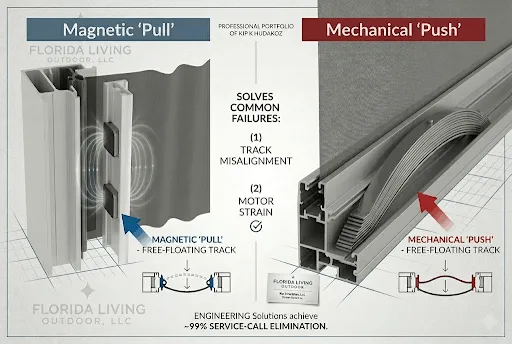
This is what "free-floating articulating track" means in plain language. One side of the category uses magnets. The other does it with springs. Both teams arrived at the same functional outcome through opposite physical principles. Those two solutions are what the rest of this post is about.
Solution One: Magnetic Pull (MagnaTrack)
MagnaTrack, manufactured by Progressive Screens (a Hunter Douglas Company, acquired in 2020), uses magnetic tension to solve the articulating-track problem.
How the System Works
Neodymium magnets are embedded at regular intervals along the side track assembly, beneath a snap-on cover. Under normal operation, the magnetic field holds the inner track against the outer track with enough force to keep the system aligned. When wind, debris, or thermal expansion pushes the screen outward, the magnetic bond releases just enough to let the inner track flex. When the force subsides, the magnetic field pulls the inner track back to its seated position. The screen remains attached to the track. The motor continues to operate inside its rated resistance. And the fabric is not asked to absorb forces it was not built to absorb.
This is a legitimate engineering answer to the category problem. The self-correcting behavior is real, tested, and documented.
Credentials
MagnaTrack is protected under US Patent 9,719,292 per the Progressive Screens 2023 Gen 4 CAD documentation dated 08.16.23. The hurricane-rated MagnaTrack Defender system holds Florida Product Approval F30798 — the regulatory credential required for hurricane-category installations in Florida. Progressive Screens was acquired by Hunter Douglas in 2020 — the kind of corporate parentage that tells you a product line is backed by a manufacturer with the reach to honor warranty and parts commitments. These are not small details. They establish MagnaTrack as a serious, engineered, and regulated product. Any homeowner shopping for motorized screen reliability will see MagnaTrack on the list, and MagnaTrack belongs there.
Solution Two: Mechanical Spring Push (OneTrack)
OneTrack, manufactured by Fenetex, solves the same problem through the opposite physical principle. Where MagnaTrack pulls, OneTrack pushes.
How the System Works
Precision mechanical springs embedded in the side track hold the inner track under constant tension. The springs are engineered to a specific spring rate — stiff enough to hold the track in alignment under normal load, compliant enough to allow the track to flex when wind or debris applies force. When the force subsides, the spring pressure pushes the inner track back to its seated position. The functional outcome matches MagnaTrack's: the screen self-corrects, the motor stays inside duty spec, and the fabric is not torqued. The physics of how it gets there is different. The result for the homeowner is the same.
Spring-based systems have an engineering pedigree across industrial applications that predates magnetic designs by a century. The springs have no electrical component, no field strength to measure, and no degradation curve tied to temperature cycling. They do one job — return to position under load — and they do it through a mechanism that has been well understood since the Industrial Revolution.
Credentials
OneTrack is documented in the Fenetex Design Guide v120253 — the engineering specification file every Fenetex dealer references during system design. The hurricane-rated Fenetex:
Why Motorized Screens Fail — and the Two Engineering Solutions Solving It
A homeowner in Delray Beach called us last April. Her lanai screen — installed six years earlier, not by us — had stopped cooperating. The first pull of the season bound halfway down. The motor strained. Something in the housing made a sound she described as "grinding, but slower." She was afraid to keep running it. She was also right to be afraid. That moment — repeated across thousands of Florida installations every spring — is what motorized screen problems actually look like. Most of them are preventable. A few are not. The difference lies in the engineering and in two specific solutions now competing in the category.
Motorized screens fail from four primary causes: track misalignment, motor strain, fabric binding in the track, and weather-seal failure. Two engineering solutions — free-floating articulating track systems that allow the inner track to flex and re-seat itself — eliminate approximately ninety-nine percent of these failures. Here is how each works.
The Common Failure Modes of Motorized Retractable Screens
The failure pattern arrives in a recognizable order. The track goes first. The motor suffers second. The fabric gives out third. And the housing — the part most homeowners never think about — decides whether the whole system survives a decade or dies in year five.
Track Misalignment
This is the one homeowners describe with their hands before they describe it with words. The track drifts. The screen hangs just slightly crooked. The motor fights against something that should not be there. In a rigid-track system, the inner track has nowhere to go when the aluminum expands in August heat or when wind pushes the fabric sideways. So the track binds. Or the screen torques. Or both at once.
Most homeowners notice it first in year three or four. The screen works — mostly — but the rhythm is off. It runs slower on one side. It hesitates at the same spot every time. Those are the early issues with motorized retractable screens worth taking seriously.
Motor Strain and Premature End-of-Life
Every motorized screen motor has a duty cycle. Rated at twenty-second cycles against a specified resistance, a quality motor should deliver fifteen thousand cycles or more across its service life. That is roughly fifteen years of normal use. True, though, only if the resistance stays inside the spec. When a rigid track binds or a screen fabric catches, the motor does not refuse — it works harder. Harder work burns bearing life. A motor rated for fifteen years of easy cycles can be exhausted in four under sustained strain. This is one of the most common motorized screen failures we are called to service, and it is almost always secondary to a track problem the homeowner never noticed.
Fabric Binding
The fabric-to-track interface is where most of the visible damage shows up. Misalignment compounds into fabric wear. The fabric edge is drawn through a gap that is no longer within its tolerance, and the reinforced edge begins to fray. Homeowners blame the screen fabric itself. Most of the time, the fabric is the casualty, not the culprit. The cause is upstream, in the track.
Weather-Seal and Housing Failure
This is the slower, quieter failure. Weather seals at the top of the housing degrade over time — UV, salt air, and daily thermal expansion all take their toll. Water finds its way in. The motor electronics take damage they were never designed to take. By the time the homeowner notices, the repair is often larger than the problem would have been if it had been caught early. An aging system flagged for seal wear can often be stabilized with a housing service call in year seven or eight. A system that has been ignored for the past ten years is frequently beyond economic repair. Housing failure is almost always the end-of-life event for an older motorized retractable screen.
MaxForce system holds Florida Product Approval FL8637, the same regulatory credential MagnaTrack Defender carries, issued by the same Florida authority. Fenetex's warranty is the other important document in the OneTrack credentials file. The lifetime aluminum warranty is written with specific contract language tying coverage to parts compatibility across product generations — a backward-compatibility commitment I will have more to say about in the posts that follow. These credentials make OneTrack the peer, not a knockoff.
What This Means for Motorized Screen Reliability
Here is where most comparison articles oversimplify, and here is where honesty matters most.
The Service-Call Elimination: Both Systems Achieve
Progressive Screens reports approximately 98% service-call elimination for MagnaTrack. Fenetex publishes approximately ninety-nine percent for OneTrack. Both figures are defensible. The reason both figures are defensible is that both systems solve the category problem through the same underlying engineering architecture: obstacle-detection motors that halt the screen when something is in the way, free-floating articulating tracks that self-adjust on the roll tube, and self-refeeding track alignment so the screen does not wrap unevenly even if it is briefly dislodged. Both products do all three of these things. Both products perform as promised. The one-percent difference in published figures is statistical noise inside the real-world reliability band — not the deciding factor for a homeowner.
What a Florida Dealer Has Observed Installing Both
We have installed both products for years. Florida Living Outdoor carries MagnaTrack as our featured hurricane brand, and we also install OneTrack for daily-use applications. The service-call record on both is rare. Rare enough that when a call does come in, it is usually not about the track mechanism at all — it is about a power-line interruption resetting a controller, or a remote pairing that drifted, or a storm debris strike that bent a weight bar. The tracks on both products do what the engineering claims they will.
Which means the question of "which system is more reliable" is not really the right question. Both are reliable. The right question is which one fits your application, your ownership horizon, and the specific trade-offs each engineering approach carries. That is the conversation the rest of this series addresses.
How to Choose Between the Two Systems
Application-First — Daily Use vs Storm Protection
Both brands offer daily-use systems for shade, insect control, UV reduction, and privacy. Both offer hurricane-rated product lines built to different standards for storm-category protection — MagnaTrack Defender and Fenetex MaxForce. Both hurricane products carry Florida Product Approvals. For a homeowner making a decision, step one is deciding what the screen is for. A daily-use insect-and-shade application on a covered lanai is a different conversation from a storm-category screen on an exposed second-story balcony. The engineering tradeoffs that differentiate MagnaTrack from OneTrack show up most clearly in the daily-use category — which is the subject of Post 2 (push vs pull, in engineering detail) LINK PENDING — Post 3], and Posts 6 through 8 (material efficiency, service calls, and fifteen-year total cost of ownership).
Questions to Ask Before You Sign
If I were a homeowner at the shopping stage tomorrow, here are the five questions I would ask any motorized screen installer before signing:
What is the aluminum warranty—lifetime —and is it prorated?
What is the warranty on the electronic controls — how many years?
What is the parts availability commitment at year ten?
Which engineering category does the track use — magnetic pull, or mechanical spring push?
What is the side track width, and what does that tell me about material mass and load?
The answers to those five questions will tell you more about the system you are buying than any marketing brochure. They also set up the next seven posts in this series, each of which develops one of the five questions into the full answer the question deserves. Post 7 covers how both systems eliminate service calls — and what happens in the last one percent [LINK PENDING — Post 7]. Post 8 closes the series with the fifteen-year total cost of ownership math [LINK PENDING — Post 8].
About the Author
Kip Hudakoz is the owner of Florida Living Outdoor LLC, a BBB A+ accredited, veteran-owned Florida outdoor services company specializing in motorized screens, retractable awnings, and pergola systems. Kip has spent twenty-six years in the Florida outdoor services industry, operating companies in Central Florida and South Florida. He is also the owner of Paramount Fencing and Custom Fence Orlando, and was a former co-host of "Ask the Experts" on News 96.5 Florida Home and Garden. Florida Living Outdoor was founded in December 2021 and earned its BBB A+ accreditation in October 2024. The company installs and services both MagnaTrack and OneTrack motorized screen systems, and carries both manufacturers' hurricane-rated product lines as featured brands.
Frequently Asked Questions
Why do motorized screens fail?
Motorized screens fail from four primary causes: track misalignment, motor strain, fabric binding, and weather-seal failure. Most of these trace to one root cause — rigid-track design that cannot absorb the wind, thermal, and debris loads a screen experiences in normal outdoor use.
How long do motorized screens last?
A well-designed motorized screen should last fifteen years or more. Systems built on free-floating articulating tracks — magnetic or spring-based — commonly reach that mark. Systems built on rigid or zipper tracks often fail in year four through six from accumulated track strain.
What is a free-floating articulating track?
A free-floating articulating track is a screen track system in which the inner track can flex and re-seat itself under load. When wind or debris applies force, the track moves with the force and returns to its position. The screen, motor, and fabric are spared from stresses they were not engineered to absorb.
Are MagnaTrack and OneTrack the same thing?
No. MagnaTrack, manufactured by Progressive Screens (a Hunter Douglas Company), uses embedded neodymium magnets. OneTrack, manufactured by Fenetex, uses precision mechanical springs. Both use the free-floating articulating track architecture. They differ in the physical principle that returns the track to position: magnetic pull versus mechanical spring push.
Which motorized screen system is more reliable?
Both achieve approximately 99% service-call elimination through shared engineering—obstacle-detection motors, self-adjusting tracks, and self-refeeding alignment. The difference in reliability is not large enough to be the deciding factor. Application fit, warranty terms, and parts-availability commitments are the more meaningful decision criteria.
Can motorized screens handle Florida hurricanes?
Yes, in their hurricane-rated product lines. MagnaTrack Defender holds Florida Product Approval F30798. Fenetex MaxForce holds Florida Product Approval FL8637. Daily-use motorized screens are not hurricane-rated and should be retracted ahead of named-storm events.
Are motorized screens covered by warranty?
Yes, with coverage varying by manufacturer. Verify before signing: aluminum coverage duration (and whether it is prorated), electronic-control coverage, parts-availability commitment at year ten, and fabric coverage across vinyl, shade, and hurricane fabric categories.
Ready to Talk About Your Own Motorized Screen Project?
To discuss a motorized screen system for your home, contact Florida Living Outdoor for a free in-home consultation in Central or South Florida. We install and service both MagnaTrack and OneTrack systems, and we will walk you through the engineering, the warranty differences, and the application fit — without a sales pitch.
Sources and Further Reading
Progressive Screens (a Hunter Douglas Company) — manufacturer of MagnaTrack. https://progressivescreens.com
Fenetex / OneTrack — manufacturer of OneTrack motorized screens. https://onetrackscreens.com
US Patent 9,719,292 — MagnaTrack magnetic track system. https://patents.google.com/patent/US9719292
US Patent 11,421,474 — MagnaTrack continuation patent. https://patents.google.com/patent/US11421474
Florida Product Approval F30798 — MagnaTrack Defender hurricane screen. https://www.floridabuilding.org
Florida Product Approval FL8637 — Fenetex MaxForce hurricane screen. https://www.floridabuilding.org
Progressive Screens 2023 Gen 4 CAD documentation (dated 08.16.23) — internal industry engineering reference for MagnaTrack side track specifications.
Fenetex Design Guide v120253 — internal industry engineering reference for OneTrack and MaxForce specifications.
Hunter Douglas acquisition of Progressive Screens (2020) — public corporate record. https://www.hunterdouglas.com
Florida Living Outdoor LLC — installer and service provider for both MagnaTrack and OneTrack systems in Central and South Florida. https://floridalivingoutdoor.com