
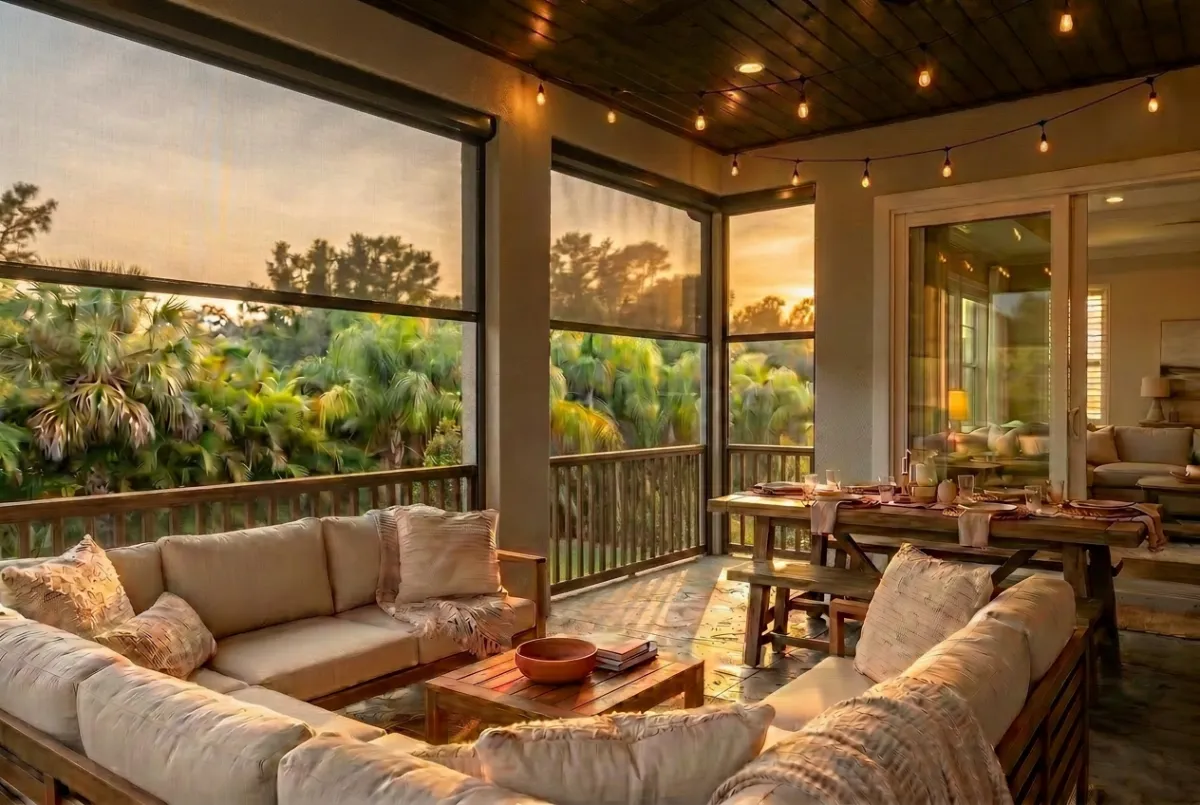
Why Your Covered Lanai Is Still Hot, and the Fix
Your Covered Patio Has a Roof. So Why Can't You Sit Under It?
It's the Fourth of July. Your plan is simple. You were up before the sun. Brisket on by six. Cooler packed, flag on the post, chairs wiped down on the covered patio you spent real money to build. All you wanted was to spend the whole day with the people you like and love.
But. By two o'clock, you were watching your lanai from the kitchen window, and the rest of the guests followed.
They followed you inside. Like you, they felt the burn as the lanai turned into a griddle. They felt the sweat running down their necks. Now. All you can do is watch the fly focus on a plate of potato salad left on the table. Frustrated, you ask yourself a simple question. I have a roof over your lanai, but yet I can't sit under it.
If that was your Fourth, you are not doing anything wrong. The patio is doing exactly what an open, covered patio does in a Florida summer. The good news is that the reason it fails is simple, and so is the fix. This is Post 1 of our Feeling the Burn series, and it starts with the space most people give up on first: the covered lanai that still cooks.
Quick Answer
Why is my covered patio still so hot even though it has a roof?
A roof only blocks rain and the overhead midday sun. It does nothing about the three things that actually make a Florida lanai unusable. It all starts with the sun. If it's not the scorching midday sun, it's the low morning and afternoon sunlight that slides in from the open sides. Regardless of direction, the lanai floor soaks up the UV rays and releases them back at you. Couple that with warm humid air that gets trapped under the roof with no way out, your lanai can feel like your dishwasher when you open the door halfway through a cycle. Add bugs, which walk in freely, and a covered patio can feel worse than the open yard. Closing the open sides with exterior screens handles the sun, heat, and bugs at once, and lets you keep the space open when the weather is kind.
A roof was built to stop rain, not a Florida afternoon
Here is what the salesman skipped when they poured your slab and framed your cover. A roof solves one problem well. It keeps the rain off. Everything else that ruins a summer day walks in from the four open sides, and this week it walked in hard.
A heat dome has parked over the Southeast for the holiday. Across Central Florida, the feels-like number has been running between 105 and 112 degrees, driven more by our humidity than the thermometer, and the dome has been shutting down the afternoon storms that usually give us a break. When the air itself feels like 108, four open sides and a shingle roof are no match.
Watch where the heat comes from, and it makes sense. In the late afternoon, the sun drops low and comes in sideways, right under the roofline and onto your chairs and your skin. The slab has been quietly storing heat since morning, and by three it is giving it all back like a warm skillet under your feet. There is no wall between you and any of it. Then the trapped, wet air just sits there because the roof holds it in place rather than letting it lift.
And the bugs. An open lanai is a roofed patio. You can burn a citronella candle to a nub and the mosquitoes at dusk, the gnats around the string lights, the fly on the potato salad, they all show up anyway. That is the whole problem. Not your patio. The sides you left open.
You built that space so your family would have somewhere to be together. Nobody should have to hide from a room they paid for. That is the part that stings, and it is the part worth fixing.
We have watched this same story for 26 years
Florida Living Outdoor has been building outdoor spaces across East and Central Florida for a long time, from Palm Coast down to Fort Lauderdale, and the summer call is always the same. Someone loves their covered patio for eight months of the year and abandons it for the other four. They are not asking for a miracle. They just want their evenings back.
We fix it the same way every time, because the physics of direct sunlight does not change. So. How do you fix sun-drenched lanai areas in Florida? The answer lies in the open sides, taking on direct sunlight. Simply close the openings with motorized shade screens to handle the sun, the heat, and the bugs at the same time.
The fix is the part you left open
Motorized shade and insect screens close the open spans of a lanai on demand. They drop when you want them and tuck up into a slim housing when you don't. That is the heart of the Fenetex OneTrack system we install, and it turns three separate headaches into a single button press.
So, here is a three-step plan to take back our overheated lanai:
One, screen the opening of your lanai with motorized solar shades. Two, drop them when the sun swings west, and the bugs come out. Three, open your house doors, take a seat, and let the space become a real room as AC fills the lanai. It's that simple.
Do the screens actually cool the patio down?
Yes, and the reason is timing. Exterior motorized solar and shade screens stop the sun's energy from entering the space before it becomes heat you have to endure. You feel it the moment the screen touches the ground. The glare goes flat. The bite comes off the air. Don't take our word for it. According to the U.S. Department of Energy, exterior shading is credited with cutting solar heat gain by up to 65 percent on south exposures and up to 77 percent on the brutal west side. Bottom line: Purpose-built sun-control mesh does more, can stop 65 to 97 percent of the sun's heat and glare before it ever becomes a problem.
Do solar and sunshade provide bug protection?
A tight exterior mesh does not negotiate with mosquitoes or no-see-ums. It stops insects. So. No more flies on the potato salad, the gnats at the string lights, or mosquitoes biting your arms and ankles at dusk. Bottom line, keep your screens down after dusk: The bugs outside, and the itch cream in the medicine cabinet.
If I close the solar or sun shades, will my AC escape if I open the doors to my lanai?
Short answer is no. The screens will act as a barrier. When the motorized, tight-weave screen is deployed, you can slide the doors open between your living room and the patio. The AC will creep out, and the screens hold the cool where you want it in your lanai. Bottom line, the lanai stops being a hostile zone you dash across between the grill and the kitchen. It becomes an extra room, and it borrows the comfort you are already paying to make indoors.
A covered patio keeps the rain off. A screened one gives you the afternoon back. Same slab, same roof, completely different summer.
Where the money gets wasted
Motorized screens are an investment, so here is the part that decides whether you love this or regret it. The screens are only half the story. The other half is who installs the screen, and how. We get called in every year to look at work from the low-bid crew and price it over the phone. A crew showed up with a one-size-fits-all scenario, and leaves behind screens that bind in the track, sag in the middle by August, or peel loose the first time a real gust rolls off a summer storm. It looked fine on install day. It always does.
A screen you can trust comes down to things you cannot see in a photo. The track has to hold the fabric taut and quiet, rather than letting it rattle in the wind. Every opening has to be measured individually because a lanai is rarely square. The motor and housing have to match the span. And the company that installed it has to still be around, with the right parts, when you call in year eight.
That last point is why we hold every product we sell to a standard we call Dealer Confidence. Do the orders come through accurately? Is the warranty something we can actually stand behind and honor? Can we still get parts years down the road? If a system fails those tests, our name does not go on it. It is not a slogan. It is 26 years of watching which products earn a homeowner's trust and which ones quietly cost them twice.
Picture the same afternoon, screened
Come back to today. Same brisket, same guests, same 108 in the shade. Only now the screens are down on the west and south sides. The glare is gone. The slab is not throwing heat at your ankles. You slid the living room doors open an hour ago, and the cool air has settled over the whole lanai. There is not a mosquito in sight. Nobody has drifted indoors. The potato salad is safe. And you are sitting in the space you built, on the day you built it for, doing exactly what you pictured when you signed the paperwork. That is what shade is supposed to buy you. Not a cooler house. A usable life outside of it.
Frequently asked questions
Will motorized screens really make my covered patio cooler?
Yes. Because they are mounted on the outside, they block sunlight before it reaches the space. The U.S. Department of Energy credits exterior shading with reducing solar heat gain up to 65 percent on south exposures and 77 percent on west-facing ones, and sun-control mesh can stop 65 to 97 percent of the sun's heat and glare.
Do the screens keep bugs out?
Yes. A tight exterior insect mesh closes the open sides of the lanai and keeps mosquitoes, gnats, love bugs and flies out while still letting the breeze through.
Do the screens block my view?
You keep your view. The mesh is woven to maintain outward visibility while cutting glare and heat, and darker fabrics provide the clearest outward view along with daytime privacy.
Can I open my house doors onto a screened lanai?
Yes, and many homeowners do. With the openings screened, you can open interior sliding or French doors and let your air conditioning extend onto the patio, which turns it into a comfortable extra room.
Do you serve my area?
Florida Living Outdoor installs across East and Central Florida, from Palm Coast to Fort Lauderdale, from our home base in Oviedo.
Sources: U.S. Department of Energy, Energy Efficient Window Attachments (solar heat gain reduction: up to 65% south, 77% west). Phifer Inc., Exterior Sun Control fabrics (65 to 97% of the sun's heat and glare). Professional Awning Manufacturers Association and the University of Minnesota Center for Sustainable Building Research, awning and shade cooling-energy study. The Skin Cancer Foundation, Sun Protection (seek shade 10 a.m. to 4 p.m.). National Weather Service and weather.com, July 2026 Southeast heat-dome and Florida heat-index conditions.
Coming next in Feeling the Burn: Post 2, The 3 O'Clock Retreat (the west-facing patio and Radiance Class Awnings) · Post 3, The Umbrella Huddle (the exposed patio) · Post 4, The Real Math of Shade. Inc.