
Why Your West-Facing Patio Bakes at 3 PM, and the Fix
Quick Answer
Why is my west-facing patio unbearable in the afternoon?
A west-facing patio takes the full low-angle afternoon sun for hours, right through the hottest and most intense part of the day. Because the sun sits low in the sky, it comes in sideways under any roofline, so overhead cover does little to stop it. The U.S. Department of Energy reports that west-facing exposures take the worst of the solar heat gain, and that exterior shading over them can cut that heat gain by up to 77 percent. A retractable awning extends out over the patio to block the sun at the hours you need it, then rolls back when you want open sky, which is the difference between a patio you abandon at three and one you use all evening.
Your Patio Shuts Down at 3 O'Clock. It Doesn't Have To.
Three o'clock is when your backyard closes.
You know the routine by now. The cookout is going fine until the sun clears the roofline and drops straight onto the west-facing patio. Twenty minutes later the concrete is too hot for bare feet, the drinks have gone warm, and the glare is low and right in everyone's eyes. So the party moves. Chips, drinks, kids, all of it, back into the kitchen.
And there it stays until about 8:30, when the sun finally slips behind the tree line, and somebody says what everyone is thinking. It's nice out now. So you all wander back onto the patio for the last hour of daylight, on the space you paid good money to build, having spent the best part of the evening standing around indoors.
If your patio faces west, this is your whole summer. In Post 1, we looked at the covered lanai that still cooks. This one is about the patio with no cover at all, the one that runs on the sun's schedule instead of yours. Post 2 of our Feeling the Burn series.
Why the west side takes the worst of it
Morning sun is gentle. It comes in high and soft, and by the time it would bother you, it has moved on. The afternoon sun is a different animal. It drops low, it lingers, and on a west-facing patio it points straight at you for the back half of the day.
The numbers back up what your skin already told you. The U.S. Department of Energy ranks west-facing surfaces at the top of the solar heat gain list and credits exterior shade with cutting that gain by as much as 77 percent, the highest figure it gives for any exposure. This week has been a live demonstration. A heat dome has parked over the Southeast for the holiday; feels-like readings across Central Florida have been running 105 to 112 degrees, and the afternoon storms that usually cool us down have been shut off. On a west patio with no shade, three in the afternoon is not a time to be outside.
There is a second cost most people never think about. Those same afternoon hours, roughly ten in the morning through four in the afternoon, are exactly the window the Skin Cancer Foundation flags as the most intense for sun exposure. So the price of the 3 o'clock retreat is not only a wasted patio. It is the burned forearms and the tight, pink face in the bathroom mirror that night.
You bought a house with a backyard, so your family could be in it. A patio should not keep office hours. And you should not have to plan dinner around a star ninety-three million miles away.
We hear the 3 o'clock story every July
Florida Living Outdoor has spent 26 years building outdoor spaces from Palm Coast down to Fort Lauderdale, and the west-facing patio is one of the most common calls we get. The homeowner is not asking for much. They want to grill at five without squinting. They want to feed the kids at six instead of eight-thirty. They want their afternoons back.
The answer is not to build a permanent roof and give up your open sky for the eight months a year the weather is perfect. The answer is shade you control.
The fix extends out over the patio, on demand
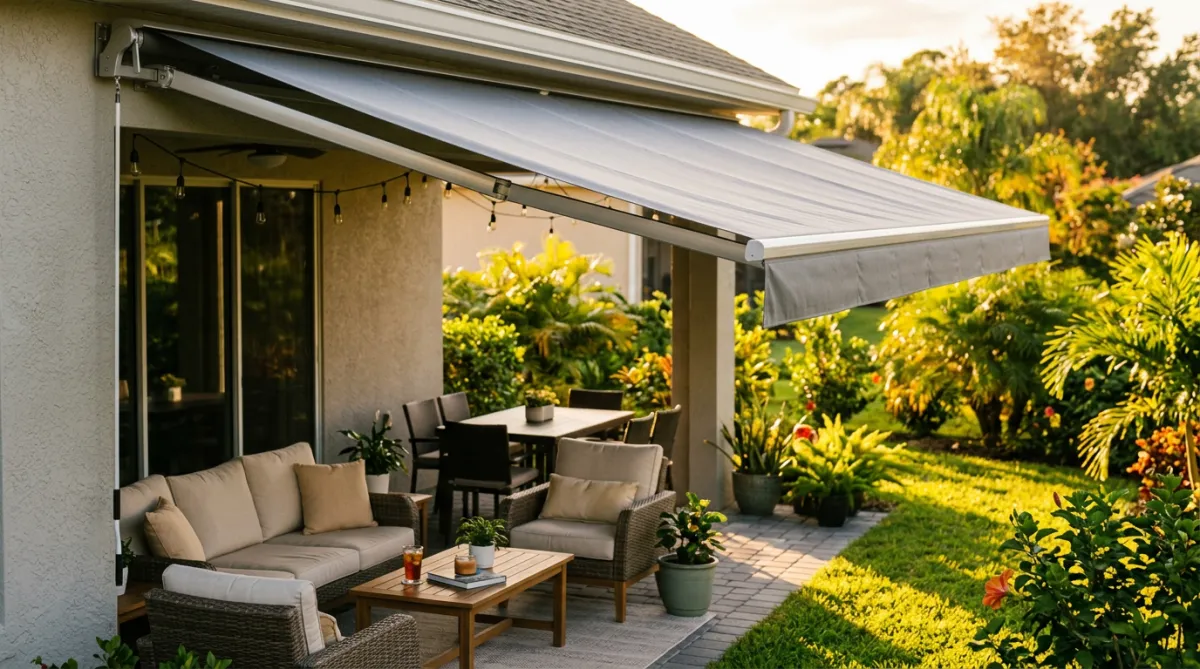
A retractable awning extends over your patio and provides a roof of shade exactly where the afternoon sun is landing. The one we install is the Radiance Class Awning with Sun Pro technology, and the whole point is that you run it, not the sun. The plan is short:
One, extend the awning when the sun swings west around three. Two, sit in the shade while everyone else is trapped inside. Three, roll it back when the sun drops and you want the open evening sky. That is the whole thing.
Does an awning actually block the afternoon sun?
Yes, and the west side is where it does the most good. Because the awning sits between the sun and your patio, it stops the heat before it ever reaches the surface. The Department of Energy credits exterior shading on west-facing exposures with cutting solar heat gain by up to 77 percent. That is the reading that matters for your patio, and it is why an awning beats an indoor blind by a mile. The Sun Pro fabric is built to take that direct afternoon load and hold up to it season after season.
Are awnings retractable?
This is the part a permanent roof or a pergola can never give you. The awning retracts. This way, on mild mornings or a clear night when you want the stars, you simply click a button and the awning retracts. Then, on those days when the sun is punishingly bright, you click the same button and watch it extend. You got shade. You are not trading one extreme for another. You get both, and you decide day by day.
How does an awning lower energy bill?
Most heat penetration occurs when sunlight penetrates windows directly exposed to the sun. A well-positioned awning on a west-facing patio does not just shade the patio; it shades the wall and the sliding doors behind it. The same glass that has been dumping heat into your living room all afternoon, making your air conditioner work overtime. A study funded by the Professional Awning Manufacturers Association through the University of Minnesota found that awnings used together with air conditioning can lower cooling costs by up to 25 percent and meaningfully cut a home's peak afternoon electricity demand in hot climates. The shade you put over the patio quietly pays you back inside the house.
Will an awning protect my patio furniture?
The sun that cooks you bleaches and fades your cushions, your rug, and the finish on that outdoor dining set. You have no plans to replace your furniture for years, but ultraviolet light is a leading cause of that fading. When an awning is deployed during direct sun, the furniture is protected in its worst hour. Simply put, an awning protects everything under it, when deployed.
A permanent roof blocks the night sky 365 days a year, when the problem that is causing it lasts a few hours a day. A retractable awning fixes the few hours and hands the sky back. That is the difference.
The same west-facing afternoon, with and without shade
What do I need to know so I don't waste my money on an awning?
This is Florida. An awning lives or dies on two things: the wind and the arms that hold it out. A retractable awning that is not rated for our gusts, or not paired with a wind sensor that pulls it in when a storm hits, is a sail waiting to be torn off your wall. We see it every year. The homeowner bought the cheapest unit online, mounted it themselves or hired the low bidder. By the second summer, the fabric is frayed, an arm is bent, and the whole thing rattles in a breeze.
The awning that lasts has arms and hardware built for real wind loads. A motor and a mount fastened into a solid structure, stud, not just stucco. Coupled with a wind sensor set up right, holds. Fabric matters. An awning that features Sunbrella Fabric will hold its color and strength for a decade of direct west sun. Other fabrics will become brittle in three years. Your only hope is that the company is still around and has the right parts when you need service.
That is why we hold every product we sell to a standard we call Dealer Confidence. At Florida Living Outdoor, we measure order accuracy. Next, is the warranty something we can stand behind and honor? Can we still get parts years down the road? If a product cannot pass those tests, our name does not go on it. After 26 years, we know which ones cost a homeowner twice.
Picture the same afternoon, shaded
Come back to three o'clock. Same west sun, same 108 in the shade. Only now you press a button, and the awning reaches out over the patio, and the glare goes flat, and the surface stays cool. The grill goes on at five with nobody squinting. Dinner is at six, outside, where you meant to have it. The kids never came in. And when the sun finally drops behind the trees around 8:30, you roll the awning back and sit under an open sky for the last of the light, on the patio you actually used all day. The sun stopped running your schedule. You took it back.
Frequently asked questions
Do awnings really work on a west-facing patio?
West-facing is where an awning works hardest. The U.S. Department of Energy credits exterior shading on west exposures with cutting solar heat gain by up to 77 percent, the highest figure it gives for any direction, because the low afternoon sun on that side is the most punishing.
Can I retract the awning when I don't need it?
Yes. A retractable awning extends when you want shade and rolls away when you want open sky, so you keep the full use of your patio in every season instead of trading it for a permanent roof.
Will a retractable awning hold up in Florida wind?
A quality unit, mounted into solid structure and paired with a wind sensor, is built to retract automatically before high wind becomes a problem. The failures we see are almost always cheap units, weak mounts, or missing wind protection, not the concept itself.
Does an awning save money on cooling?
It can. By shading the wall and glass behind the patio, an awning reduces the heat entering the house. A study funded by the Professional Awning Manufacturers Association through the University of Minnesota found awnings used with air conditioning can lower cooling costs by up to 25 percent.
What is the difference between an awning and motorized screens?
An awning gives you overhead and directional shade on an open patio, ideal for a west-facing space with no cover. Motorized screens close the open sides of a covered lanai to stop sun, bugs, and glare, which we covered in Post 1. Many homeowners use both: an awning for the open patio, screens where there is a roof to build against.
Sources: U.S. Department of Energy, Energy Efficient Window Attachments (solar heat gain reduction up to 77% on west-facing exposures). Professional Awning Manufacturers Association and the University of Minnesota Center for Sustainable Building Research (awnings used with air conditioning can lower cooling costs by up to 25% and reduce peak cooling demand). The Skin Cancer Foundation, Sun Protection (most intense sun exposure 10 a.m. to 4 p.m.). National Weather Service and weather.com, July 2026 Southeast heat-dome and Florida heat-index conditions.