

Cheap Motorized Screen Quote Florida: Hidden Cost Explained
Cheap Quote, Expensive Mess — What the Lowest Motorized Screen Bid in Florida Is Actually Costing You

The lowest motorized screen quote in Florida is almost never the cheapest motorized screen install. A bid that lands 30% to 40% below the rest of the field isn't priced lower — it's scoped lower. The structural blocking is missing. The motor is undersized. The permit disappears. The fabric-to-application match is wrong. Those gaps don't vanish; they reappear eighteen to thirty-six months later as a service call, a voided warranty, or a second install at full retail. As a MagnaTrack Authorized Dealer serving Central and South Florida, we spend a measurable portion of every year unwinding other installers' shortcuts. This blog is what those shortcuts look like — and how to spot them before you sign.
Why Cheap Motorized Screen Quotes Exist in the First Place
Motorized screen pricing feels opaque because the quote document rarely surfaces the variables that drive the cost. One dealer lists every step: the MagnaTrack unit by tier, the motor by grade, the fabric by manufacturer, the structural blocking, the electrical, the permit, the smart-home integration, the labor. Another dealer writes “MagnaTrack motorized screen — installed” on one line and a number next to it. The second dealer will always look cheaper. Usually by thousands.
Sometimes the cheap quote is legitimately cheaper because the dealer has lower overhead, or the opening doesn't need structural work, or the homeowner is a past customer. More often, the cheap quote is cheaper because the dealer has learned that homeowners shop on total price, not line-item scope — and the way to win on total price is to quietly remove what can be removed.
What gets removed is what matters most later.
Seven Things a Cheap Motorized Screen Quote Leaves Out
These are the seven line items that most frequently disappear from the low bid. If your cheap quote is missing three or more, you're not comparing apples to apples.
1. Structural blocking review
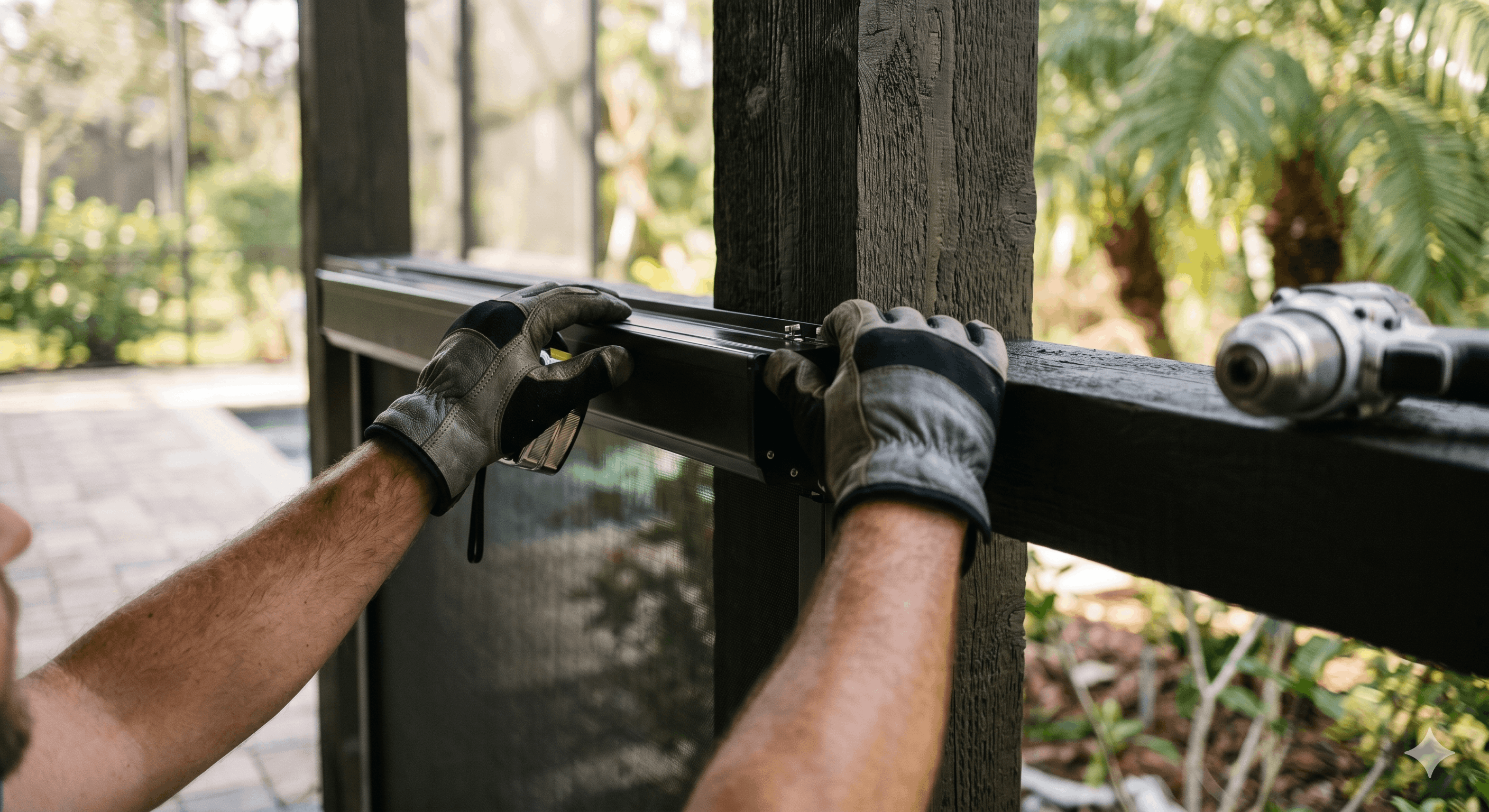
A motorized screen housing weighs between 40 and 120 pounds depending on span, cantilevered off whatever beam or header is already there. New construction with adequate framing may not need additional work. Retrofits, undersized headers, or installs into fascia rather than beam almost always do. A certified dealer walks the opening and quotes the blocking when it's needed. A low-bid dealer skips the walk, assumes the substrate is adequate, and writes the install up as a product drop. When the substrate starts to sag at month fourteen, the service call tells the real story.
2. The motor matched to your use
Progressive Screens offers multiple motor options. A coastal lanai that cycles once a day takes a different motor than a covered patio that cycles eight times during a busy summer weekend. The higher-grade motor runs about $400 more and fifteen years longer. A low-bid dealer specifies the cheapest motor across every job — works on day one, fails around year four. Replacement out of warranty: $900 to $1,400 per screen including labor. If the warranty is still intact, which it often isn't.
3. The right fabric for your application
MagnaTrack screens are specified with insect mesh, solar fabric at four opacity levels, clear vinyl in multiple thicknesses, or the Defender hurricane-rated fabric. The correct fabric is a conversation — south-facing exposure leans to higher-opacity solar, coastal openings often pair with UV coating, hurricane-zone installs may want Defender even when the primary pain is bugs. A low-bid dealer defaults to the cheapest fabric matching the stated pain and moves on. The homeowner gets insect mesh when solar was right. Or standard solar when Defender would have qualified them for My Safe Florida Home grant money they now can't access.
4. Flashing, sealant, and coastal corrosion detail
Every external-mount motorized screen on a Florida home touches the envelope of the structure. Housing bolted to fascia, housing embedded into soffit, housing face-mounted to a beam — all need flashing and sealant to prevent water intrusion. Coastal installs within roughly five miles of the ocean need a corrosion-resistant fastener spec because salt air eats standard hardware inside three years. The low-bid dealer finishes the housing install and leaves. The certified dealer flashes the penetration, beads the sealant, and upgrades coastal fasteners. The difference is maybe $400 in materials and an hour of labor. And ten years of water-intrusion-free warranty.
5. The permit
Motorized screens are a permitted install in most Florida jurisdictions, particularly in hurricane zones and HVHZ counties (Miami-Dade, Broward). A pulled permit means the install is inspected, documented, and on record with your county — which matters for insurance wind-mitigation paperwork, resale file, and any future dispute with the dealer. Permit fees run $150 to $600 depending on jurisdiction. The low-bid dealer skips the permit, saves the fee, and transfers the regulatory risk to the homeowner. When the opening needs to come off the home for a roof replacement ten years later, the missing permit becomes the homeowner's problem.
6. A calibration and full-cycle test
The MagnaTrack system runs on opposing-pole neodymium magnets in the side tracks that hold the screen flat against wind load. Install requires calibration: magnet alignment checked, deployment cycle tested start-to-finish at least three times, rewrap behavior confirmed, remote paired and range-verified, smart-home integration tested if specified. The low-bid dealer deploys the screen once to confirm the motor works and hands you a remote. When the screen starts hanging up at month nine, the homeowner has to call someone — usually not the original dealer, who has moved on.
7. A certification you can verify in writing
This one catches almost everyone. MagnaTrack Authorized Dealers are selected by Progressive Screens (the MagnaTrack manufacturer, a Hunter Douglas company) and trained in person in Florida or Texas before their first install. Authorized dealers have a direct warranty relationship with the manufacturer, access to the dealer portal for parts and support, and a name on Progressive Screens' records. Unauthorized installers — including subcontractors working under someone else's license, installers certified on a different screen system, and handymen who bought units on a secondary market — do not have any of that. They can sell you a real MagnaTrack unit and do a non-certified install. The product is genuine. The install isn't covered. When the install isn't covered, the warranty isn't either.
What Voids a MagnaTrack Warranty
The published MagnaTrack warranty runs to roughly three pages of legal language. Inside that language, a few patterns void coverage more often than all others combined.
Installation by a non-authorized dealer. Straightforward. If the installer doesn't have the certification credential and the warranty paperwork filed correctly, the warranty is not active on that install. A homeowner can sometimes get coverage retroactively reinstated by paying for a certified dealer to inspect, correct, and re-file — at the homeowner's cost, and not every install is correctable after the fact.
Unauthorized replacement parts. MagnaTrack units are modular. Motors, remotes, screen fabric, magnet strips, and weight bars can all be swapped over the system's life. The warranty only covers parts installed by an authorized dealer using components sourced through the Progressive Screens dealer portal. When a non-certified handyman orders a motor from a third-party supplier and installs it, the warranty chain breaks — even on parts that were previously covered.
Structural modifications to the housing or track. A dealer who fits a screen into an opening that's slightly off-spec sometimes shaves the housing, notches the track, or modifies the mounting bracket. Any of that voids coverage. The Progressive Screens spec is the spec.
Incomplete commissioning at install. A system never properly calibrated at install isn't covered for the consequences of that miscalibration. Magnet alignment drifting because it was never set correctly on day one is a commissioning failure, not a warranty event.
Short version: the warranty covers what Progressive Screens manufactured, installed by a dealer they selected, maintained by an authorized service relationship. Anything outside that chain sits on the homeowner.
The Real Cost of Fixing a Bad Motorized Screen Install
Three composite scenarios — not identifying any real customer, but representative of the work coming through our shop every season.
The undersized motor story. A homeowner installs four MagnaTrack solar screens on a west-facing lanai in year one, using a low-bid installer who specified the cheapest residential motor across all four. Years three and four, the motors fail one by one during the peak summer cycling window. Replacement out of warranty: approximately $1,100 per screen including labor and return visit. Total remediation: $4,400. The original install would have been $1,600 more to spec the correct motor — and covered by warranty when replacement did eventually come due in years twelve to fifteen.
The missing-permit story. A homeowner installs a large Defender hurricane screen on a covered balcony without a permit. Years later, the home goes on the market. The buyer's home inspector flags the unpermitted installation. The insurance carrier won't apply the wind-mitigation credit. Closing gets delayed while the seller pays a licensed contractor approximately $2,400 to inspect, document, and retroactively permit the install. The $300 original permit fee would have prevented all of it.
The warranty-void story. A homeowner's otherwise healthy MagnaTrack solar screen develops a fabric tear at year seven. They call the original non-certified installer, who has no dealer-portal access and can't order warranty replacement fabric. Progressive Screens confirms the install isn't in their records and therefore not under warranty. Replacement fabric at full retail, installed by a certified dealer to restore coverage on the rest of the system: approximately $2,800. Under an authorized install, the fabric would have been covered for fifteen years.
The pattern across all three: the amount saved on the original quote was smaller than the cost of the eventual fix. And the eventual fix was never the homeowner's fault.
How to Pressure-Test Any Motorized Screen Quote Before You Sign
Six questions to ask every dealer who puts a quote in front of you. Written responses only — verbal assurances don't hold up at warranty time.
1. Are you a MagnaTrack Authorized Dealer certified directly by Progressive Screens, or subcontracted under another dealer? You want the first answer, confirmed with a dealer portal reference or a Progressive Screens verification.
2. What motor grade are you specifying, and why? A real answer walks through expected cycles per day, exposure, and opening size. Vague “the standard MagnaTrack motor” usually means the cheapest option.
3. Is structural blocking included, or will my substrate carry the load as-is? Either answer is acceptable if the dealer walked the opening and made a determination. No determination means no walk.
4. Is the permit included, and are you pulling it? Permit responsibility needs to be in writing. Dealer pulls, homeowner signs.
5. What's your install warranty, separate from the MagnaTrack manufacturer warranty? A real dealer offers one to two years on labor. A missing install warranty is a signal.
6. Can you show me an install you completed eighteen months ago or more? This one filters. Dealers who don't have long-tenure installs to show either haven't been in the business long or have reasons they don't want the follow-up inspection.
The dealer who answers these six clearly and in writing is a dealer you can compare on price. The dealer who can't is one whose price isn't really a price — it's a starting position.
The Residential Calculator Runs the Certified-Install Number
The residential calculator runs your opening at certified-install scope. The number it shows assumes the job gets done correctly, not cheaply — structural blocking where needed, correct motor grade, permit pulled, proper fabric for your exposure, full commissioning. So when you compare the calculator number against a quote you've received, the difference tells you something specific: either the quote is honestly lower (rare, and you should verify why), or the quote is scoped lower (common, and you should ask which of the seven items is missing).
A $5,000 screen installed correctly is a fifteen-to-twenty-five-year asset. A $4,200 screen installed incorrectly is a $7,500 remediation waiting to happen. The calculator shows the honest number. The question of who installs it is the one that decides whether the number is real.
Frequently Asked Questions
How do I know if a motorized screen installer is a MagnaTrack Certified Dealer?
Ask in writing. The dealer should be able to provide a Progressive Screens authorization confirmation, a dealer portal reference, or documentation of their in-person training. You can also verify directly with Progressive Screens by calling their dealer network line. Dealers who hesitate at any of those verification steps usually haven't passed them.
What's the most common motorized screen install mistake?
Specifying the cheapest motor across every job regardless of the homeowner's use pattern. The second most common is skipping structural blocking on retrofit openings. Both show up three to five years after install and both are expensive to remediate because the housing has to come down before the fix can happen.
What voids a MagnaTrack warranty?
Installation by a non-authorized dealer, use of unauthorized replacement parts, structural modifications to the housing or track, and incomplete commissioning at install. The published warranty language governs the specifics. Request a copy before signing any install contract — a dealer who won't provide the warranty document in advance is flagging something.
Can I get a MagnaTrack warranty if my installer isn't certified?
Usually not, and not retroactively without cost. Some homeowners have paid for a certified dealer to inspect and re-file a previously non-certified install, which can restore partial coverage on some components. The inspection is at the homeowner's cost. Not every install is correctable after the fact.
How much does it cost to fix a bad motorized screen install?
Depends on what failed. Motor replacement out of warranty runs $900 to $1,400 per screen. Fabric replacement runs $2,000 to $3,500. Retroactive permitting runs $1,500 to $2,800. Complete removal and reinstall of a mis-specified system runs $6,000 to $12,000. In most cases the remediation costs more than the original savings.
Why are some motorized screen quotes in Florida 30 to 40 percent cheaper than others?
Because what's quoted isn't the same product. The cheap quote almost always removes structural blocking, specifies the cheapest motor, skips the permit, uses the cheapest fabric option, and omits the post-install calibration. None of those removals appear on the quote document. All of them appear later.
Is a permit required for motorized screens in Florida?
In most Florida jurisdictions, yes — particularly for hurricane-rated Defender installations, installs in HVHZ counties (Miami-Dade, Broward), and any install that modifies structural framing. Some inland counties are more permissive for non-hurricane-rated screens. The dealer should know your jurisdiction's requirements and pull the permit accordingly.
Florida Living Outdoor is a MagnaTrack Authorized Dealer serving Central and South Florida. Veteran-owned. Owner-operated. Run your residential calculator to price your opening at certified-install scope — no sales call required.