

Motorized Screen Cost in Florida 2026: Honest Price Guide
What Motorized Screens Actually Cost in Florida — and Why Every Quote Looks Different

In Florida, a MagnaTrack motorized screen installed by a certified dealer typically runs between $3,500 and $15,500 per unit, depending on screen type and opening size. That's a real range. Not marketing. The reason every quote you've collected looks different — sometimes by five figures on the same opening — isn't mystery, and it isn't markup. It's that motorized screens are built to spec, priced to spec, and installed to spec. What one dealer includes, another quietly leaves out. One dealer matches your motor load; another undershoots to win the bid. The spread is the whole story.
The Short Answer on MagnaTrack Motorized Screen Cost in Florida
Four screen types. Four price bands. Every band is driven by the same three variables — opening size, fabric specification, and motor grade — layered with installation scope. Here's where the numbers actually sit.
Screen Type
1. Insect mesh
2. Solar / shade
3. Clear vinyl
4. Hurricane Defender
Typical Per-Unit Range
1. $3,500 – $5,500
2. $4,500 – $7,500
3. $5,500 – $9,000
4. $8,500 – $15,500
Primary Application
1. Dusk bug control, lanai privacy
2. UV and heat reduction, furniture preservation
3. Weather enclosure, rain protection, three-season use
4. Cat-5 wind rating, code compliance, storm continuity
The numbers do not include shipping, permitting, structural modification, or electrical work on openings that need it. They also do not include the $300 to $900 in smart-home integration options most Florida homeowners choose within ninety days of their install. The residential calculator on the Florida Living Outdoor residential design page handles all of that for you — openings, types, options, smart-home — and returns a number within fifteen minutes.
Why Two Quotes for the Same Opening Can Differ by $8,000
Pricing feels opaque because the variables rarely surface in the quote document. Three gaps create most of the spread.
The scope-of-work gap
A MagnaTrack install is not a product drop. It's a small construction job. The dealer measures the opening, orders a custom-fabricated unit (MagnaTrack screens are built to the opening, never off-the-shelf), schedules a structural review where the substrate needs it, pulls the permit, runs the low-voltage wiring for the motor, mounts the housing, calibrates the magnets, tests the full deployment cycle, and walks the homeowner through operation. A quote that treats any of those steps as optional is a quote with a gap in it.
Where the spread shows up: flashing and sealant, structural blocking when the beam isn't adequate, soffit modifications, electrical rough-in, permit fees, and — on coastal installs — salt-air corrosion detailing. Each of these runs anywhere from $150 to $2,500, depending on the opening. Four of them disappearing on one quote is how a $12,000 honest bid becomes a $7,500 “deal.”
The motor-grade gap
MagnaTrack offers more than one motor. A residential lanai that cycles once or twice a day takes a different motor than an opening that cycles eight times daily through a busy family's summer. The higher-grade motor runs about $400 more. A certified dealer specs the motor to the expected use. A low-bid dealer specs the cheapest motor that functions on day one. The cheaper motor usually lasts three to five years in heavy residential use, against fifteen years for the correct spec.
You won't see the motor grade on a cheap quote. You'll see “MagnaTrack motorized screen.” Technically true. Also, the $400 you'll spend twice. For a full breakdown of what drives the price differences between screen types, how much MagnaTrack screens cost, and covers each tier in detail.
The certification gap
A MagnaTrack Authorized Dealer is hand-selected by Progressive Screens — the MagnaTrack manufacturer, now a Hunter Douglas company — and trained in person in Florida or Texas before the first install. If you're still weighing whether MagnaTrack screens are worth the investment before you get into quote comparisons, that question is answered separately. Progressive Screens maintains published dealer standards. The published MagnaTrack warranty — limited lifetime on the aluminum housing, fifteen years on the screen, five years on the motor, two years on the remote, one year on the vinyl — tracks parts compatibility and install quality. Work that skipped steps or used unauthorized parts does not fall under it.
Not every installer quoting a MagnaTrack product is a certified MagnaTrack dealer. Some are subcontractors. Some are certified on a different system and are learning yours on your opening. The warranty paperwork is where the difference becomes concrete. Read it before you sign.
The Four MagnaTrack Screen Types and What Drives Each Price
Same track. Same magnetic housing. Same weight bar. What changes between tiers is the screen fabric and — at the hurricane tier — the reinforcement channel and the aluminum grade.
Insect mesh ($3,500–$5,500)
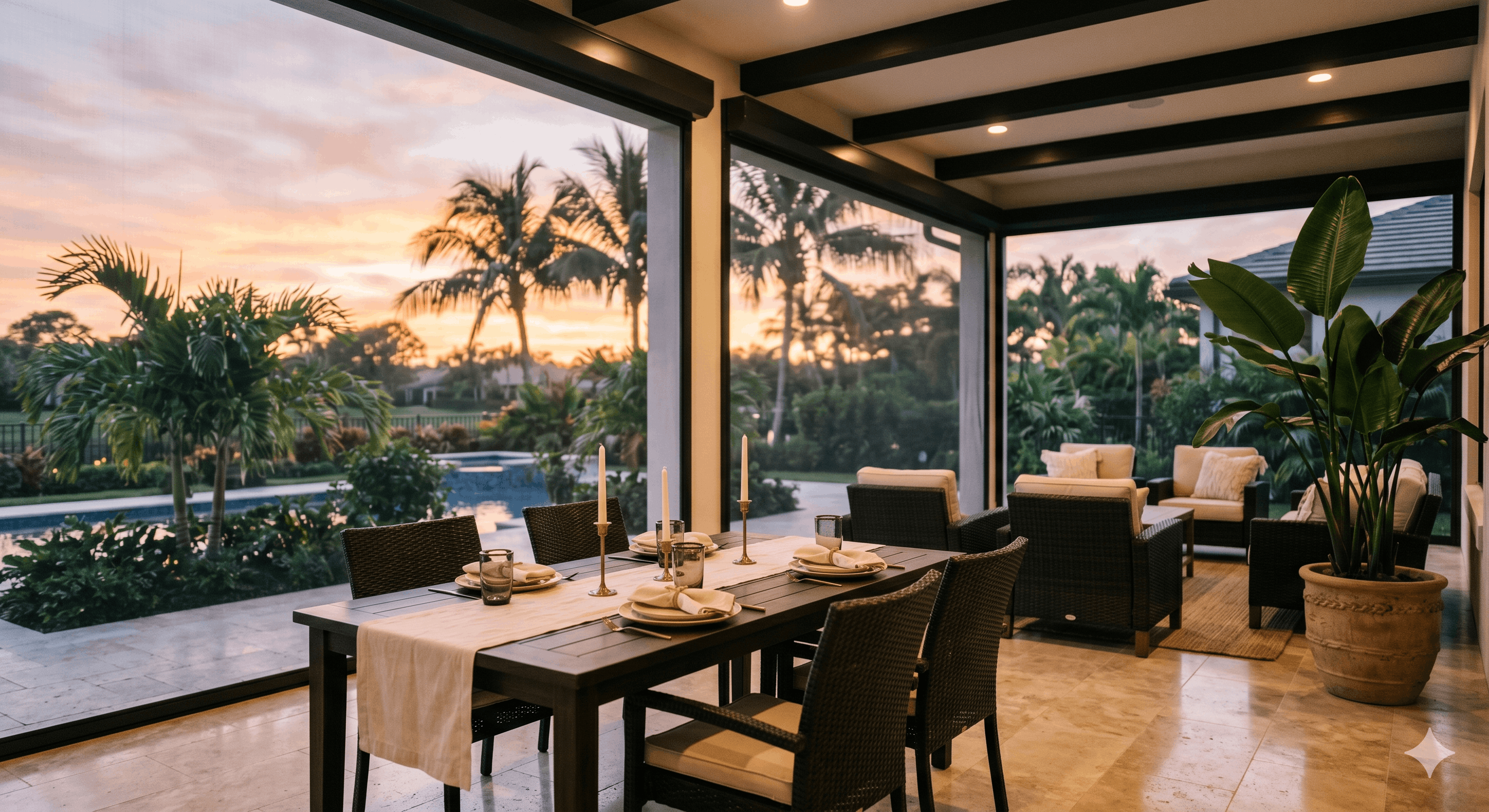
The entry tier. Polyester or fiberglass mesh designed to block bugs without cutting airflow or visibility. Most Florida homeowners start here because dusk mosquitoes are the trigger event that brought them to shopping in the first place. Insect-tier MagnaTrack is not “basic” — it still runs on the patented dual-pull magnetic track, still carries the fifteen-year screen warranty, still integrates with Alexa, Google Home, Lutron, Savant, Control4, and Crestron. What it does not do is block heat, block UV, or hold against sustained wind. Comparing all motorized screen options side by side before committing to a tier is worth the fifteen minutes.
Price drivers: opening width, fabric color match, motor grade, and whether the opening needs structural blocking.
Solar / shade ($4,500–$7,500)
The midsize tier. Same MagnaTrack hardware, woven solar fabric that blocks 80% to 97% of UV rays and reduces ambient temperature under the screen by ten to twenty degrees, depending on orientation and opacity. Solar mesh comes in opacity levels — 80%, 90%, 95%, 99% — so you can tune the tradeoff between heat rejection and outward view. South-facing and west-facing lanais benefit most. Solar tier also preserves outdoor furniture, which UV fades faster in Florida than most homeowners expect.
Price drivers: opacity, fabric brand (Sunbrella, Soltis, and similar sit at different price points), opening size, and color match.
Clear vinyl ($5,500–$9,000)
The three-season enclosure tier. PVC or reinforced vinyl panels that convert an outdoor space into a wind-proof, rain-proof room within the existing envelope. Clear vinyl is where the lanai stops being seasonal and becomes a year-round extension of the interior. The temperature inside a clear-vinyl enclosed space runs about ten degrees off ambient with no mechanical heating or cooling. Add a ceiling fan and a space heater, and the shoulder months become productive.
This is also the tier most commonly specified for restaurant patios. We cover commercial applications in the commercial track of this series.
Price drivers: vinyl thickness (standard versus heavy gauge), panel size, seam welding quality (radio-frequency welded seams outlast stitched), and the hardware tier paired with the vinyl.
Hurricane Defender ($8,500–$15,500)
The top tier. Progressive Screens' Defender Storm System uses a proprietary fabric — high-tenacity PET woven with Aramid (Kevlar) core yarns, encapsulated in vinyl — running on a reinforced MagnaTrack channel. It carries the Florida Product Approval number F30798 and meets or exceeds Miami-Dade and Florida Building Code hurricane requirements. Rated to withstand wind exceeding 156 mph. That's Category 5, with debris impact protection.
Defender qualifies as opening protection for insurance wind mitigation discounts. And — this is the part most homeowners miss — it qualifies as eligible opening protection under the My Safe Florida Home grant program when installed by a program-registered contractor. For eligible homeowners, that moves as much as $10,000 of state money against the project. We run the grant math in detail in the ROI blog later in this series.
Price drivers: opening size (spans up to 30 feet wide by 20 feet tall are achievable on a single zone), color match, motor grade, structural engineering review where the substrate requires it, and whether the opening needs reinforcement to carry the load.
How to Read a Motorized Screen Quote Like You've Done It Before
Three things separate a comparable quote from a confusing one. None of them is a brand name.
Line-item scope. The quote should list, separately: the MagnaTrack unit (by product tier), the motor (by grade), the fabric (by manufacturer and opacity), the housing color, any structural blocking, the electrical rough-in, the permit, the smart-home integration if specified, and the labor. If all of that is bundled into a single “motorized screen — installed” line, you cannot compare across dealers. You're guessing.
Warranty language. The MagnaTrack warranty is published — limited lifetime aluminum, fifteen years screen, five years motor, two years remote, and one year vinyl. A dealer's own install warranty (commonly one year on labor, two years on workmanship for coastal installs) sits alongside it. Any quote that promises beyond those published numbers is making promises Progressive Screens hasn't made — which means the dealer is the one on the hook, and the dealer's longevity determines whether that promise survives.
Certification confirmation. Ask, in writing: “Is your company a MagnaTrack Authorized Dealer trained directly by Progressive Screens, or are you subcontracted through another dealer?” The answer matters for your warranty, your install quality, and your service-call response speed when something needs adjustment.
A quote that survives those three questions is comparable. A quote that doesn't isn't priced lower — it's priced differently.
Your Honest Number — The Residential Calculator
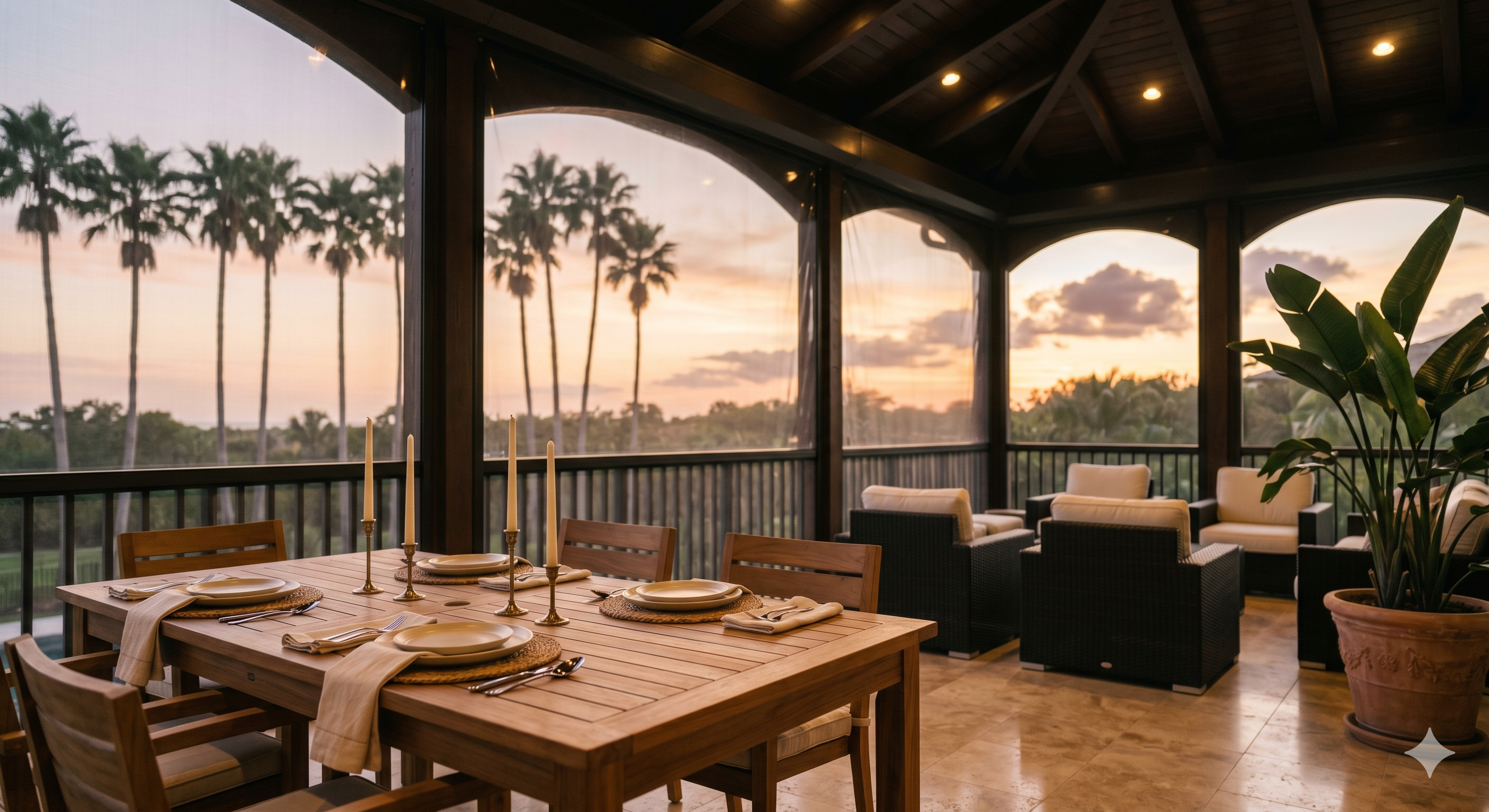
We built the residential calculator because this conversation shouldn't start with a phone call and a guess. Input your opening size, select your screen type, and add the options you want — it returns a budget range grounded in MagnaTrack's published pricing and a standard certified-install scope. No email required to see the number. No sales follow-up unless you request one.
It's the tool we wish had existed when we started quoting MagnaTrack installs in Florida. It answers the first question — “What should I expect this to cost?” — before the conversation. So the conversation, when it happens, can be about the things that actually matter: your opening, your pain, your house.
Frequently Asked Questions
How much does a motorized screen cost in Florida?
MagnaTrack motorized screens installed by a certified dealer run between $3,500 and $15,500 per unit, depending on screen type and opening size. Insect mesh starts at the low end. Hurricane Defender tops the range. Most residential single-opening installs land between $5,000 and $8,000.
Why are motorized screen quotes so different from each other?
Spec, scope, and certification. One dealer includes structural blocking, permit, electrical, and the right motor grade. Another quotes the screen alone and lets the homeowner discover the gaps later. The cheap quote is rarely for the same product.
What's the cheapest MagnaTrack screen?
Insect mesh on a small opening (eight feet wide or less) with a residential-grade motor and no structural modification. That package typically quotes $3,500 to $4,500 installed. Smaller isn't cheaper when the opening needs reinforcement, or the motor needs to be upsized.
Are motorized screens worth the money in Florida?
For most homeowners with a lanai or covered patio they want to actually use, yes — measured against the hours of outdoor living reclaimed, the home value lift, the reduced workaround spend (bug spray, replacement umbrellas, pool cage repairs), and the hurricane insurance offset on Defender-tier installs. The ROI blog later in this series runs the math in detail.
Does the My Safe Florida Home grant cover motorized screens?
The Defender Storm System qualifies as opening protection under the grant when installed by a program-registered Florida-licensed contractor. For eligible homeowners, the grant provides up to $10,000 against qualifying improvements, with a 2-to-1 state match for moderate-income applicants and no match requirement for low-income applicants. Eligibility requires a pre-2008 building permit, homestead, and an insured value at or below $700,000 (low-income applicants are exempt from the value cap).
What voids a MagnaTrack warranty?
Installation by a non-certified dealer, use of unauthorized replacement parts, structural modifications to the screen housing or track, and normal wear items not being treated as warranty-covered. The published warranty language governs. Read it before signing any installation contract.
How long do MagnaTrack screens last?
The aluminum housing carries a limited lifetime warranty. The screen itself is warranted for fifteen years, but frequently lasts twenty-plus in residential use when maintained. Motors are warrantied for five years and typically run ten to fifteen years before replacement is needed. Properly installed, a MagnaTrack system is a once-in-a-home-ownership investment, not a recurring one.
Florida Living Outdoor is a MagnaTrack Authorized Dealer serving Central and South Florida. Veteran-owned. Owner-operated. Run your residential calculator to price your opening without a sales call.