Motorized Screen ROI Florida: Hours, Value, Grant Math 2026
The Real ROI of a Motorized Screen — Hours Reclaimed, Home Value Added, and the My Safe Florida Home Grant Math
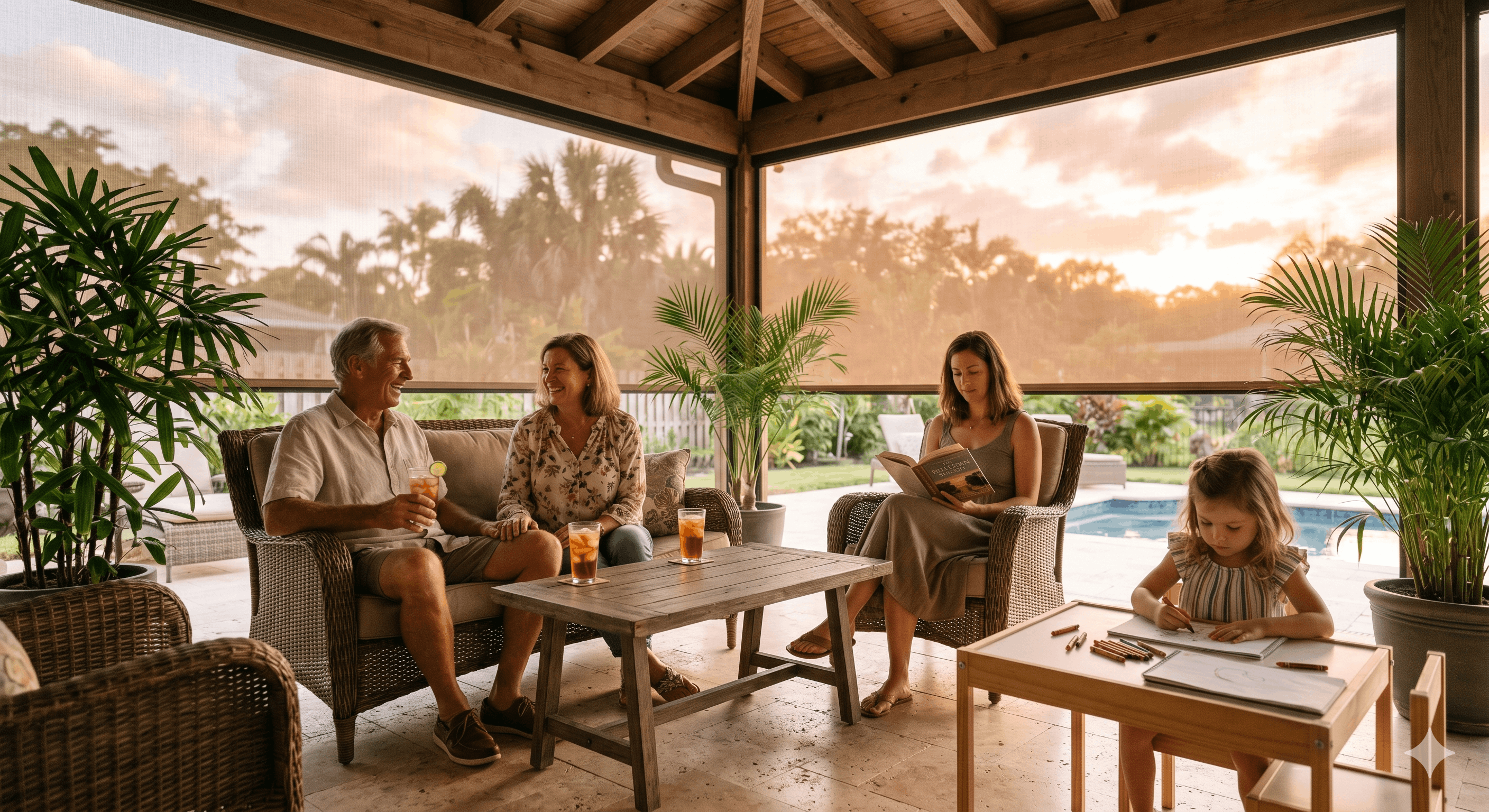
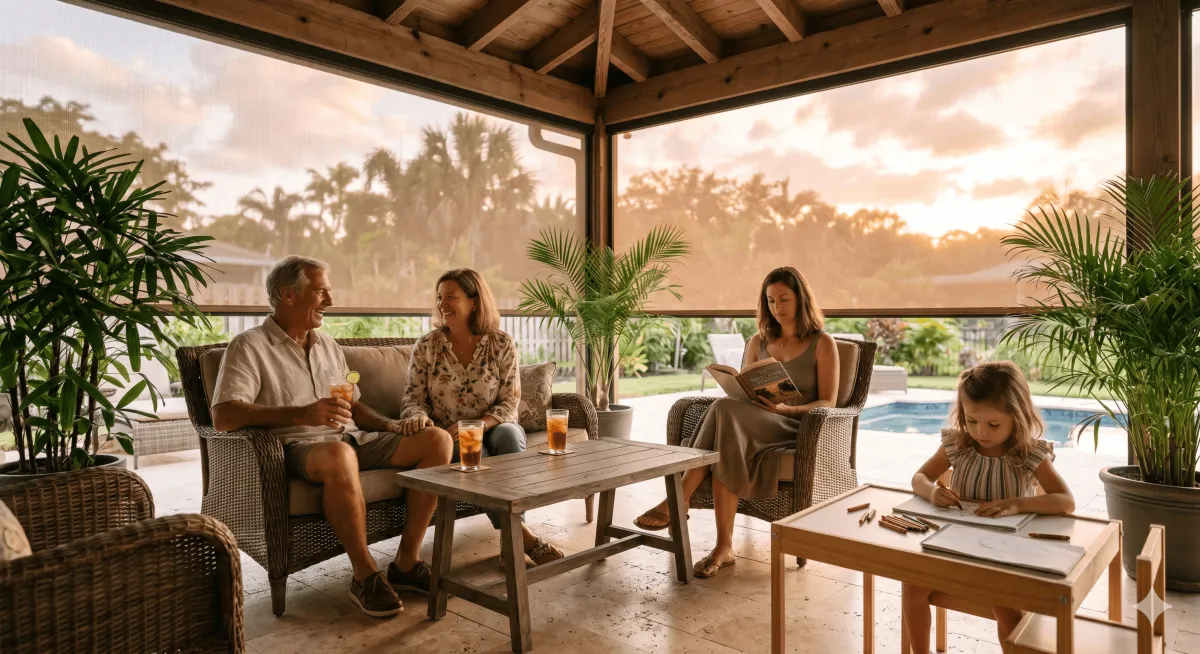
A MagnaTrack motorized screen in Florida pays back on four measurable dimensions: usable outdoor hours reclaimed, home resale value added, workaround spending eliminated, and — for hurricane Defender installs — insurance wind-mitigation savings stacked on top of a potential $10,000 My Safe Florida Home grant. For most homeowners, combined payback crosses the original investment between year four and year seven. For Defender installs that capture the grant and the insurance discount, effective payback can run under three years. This blog runs the math so you can see which of your numbers actually move, before you run the residential calculator and see your own.
The Four ROI Dimensions
Every motorized screen install in Florida returns value along at least two of these four dimensions. Most return on three. Defender installs in eligible homes return on all four.
1. Reclaimed usable hours. Your outdoor space becomes usable in heat, rain, bugs, and wind conditions it isn't now.
2. Home value lift. Outdoor living is consistently a top-ranked buyer priority in Florida real estate.
3. Workaround spend offset. Bug spray, candles, umbrellas, replacement furniture, elevated AC cost all reduce or stop.
4. Grant and insurance savings (Defender only). Up to $10,000 from the My Safe Florida Home grant, plus an ongoing wind-mitigation insurance discount.
The rest of this blog quantifies each one, then walks through a worked example so you can see how the numbers stack.
Dimension 1: Reclaimed Usable Hours
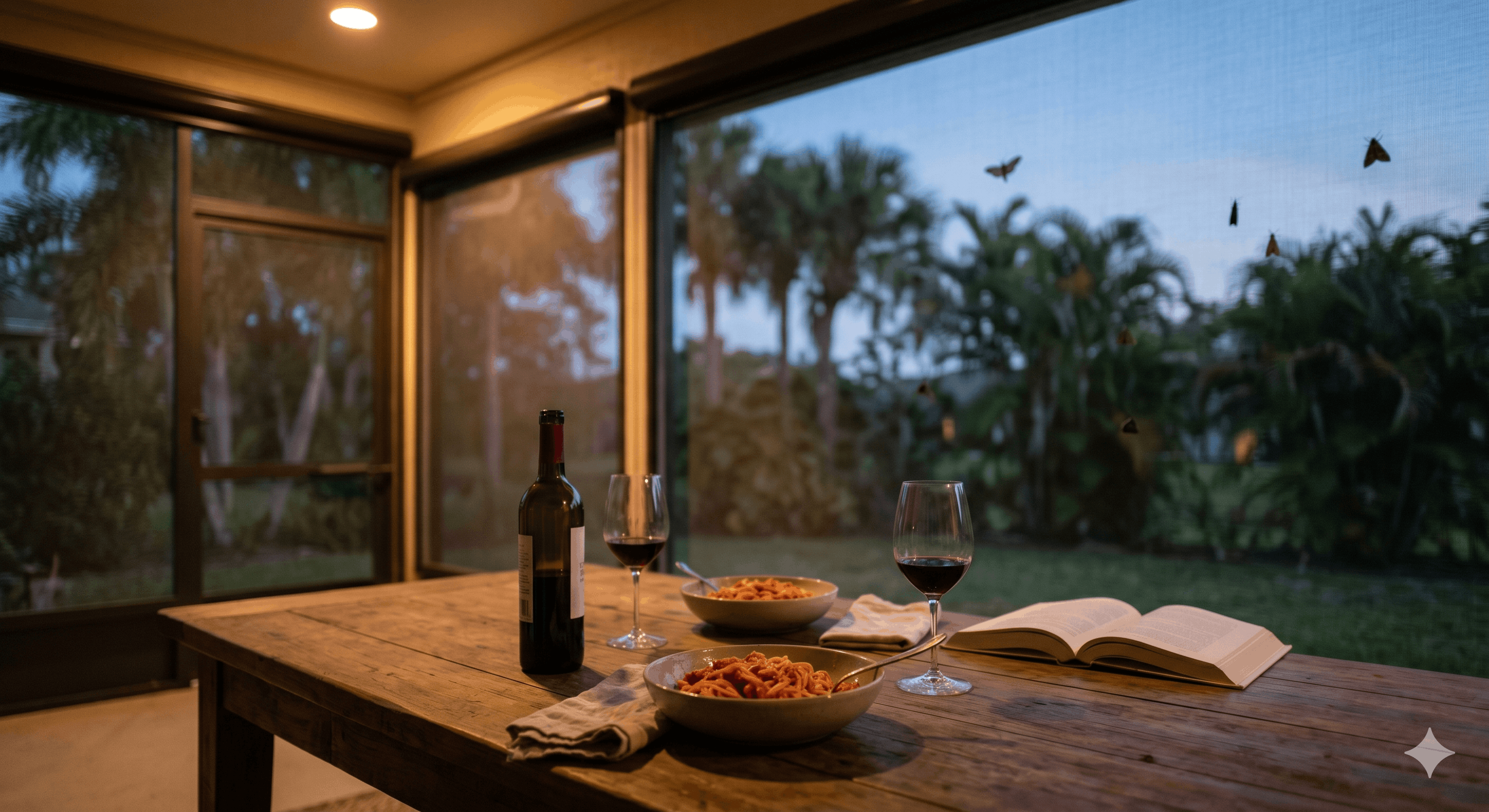
Most Florida homeowners believe they “use the lanai a lot.” When they actually count — subtracting the summer afternoons too hot to sit in, the evenings driven inside by bugs, the days closed by rain, the shoulder months too cool without a wrap — comfortable use often lands between 200 and 400 hours per year. Against a waking-hour budget of roughly 5,800 hours per year, that's 3% to 7% of the time you could theoretically be outside.
Motorized screens change the denominator. Insect mesh recaptures the dusk and evening hours lost to bugs. Solar recaptures the heat-exposed afternoons. Clear vinyl recaptures the rain and wind hours. Defender recaptures all of them, plus provides storm-season continuity. A well-specified install often doubles or triples comfortable outdoor-use hours — reclaiming 400 to 800 additional hours per year of space you already own.
The financial frame: if your lanai represents 15% to 20% of your home's livable square footage, and you're using that space for 5% of the year, the gap between what you paid for and what you're getting is measured in tens of thousands of dollars of underutilized real estate. Motorized screens close that gap directly. This is the dimension that rarely shows up on a quote spreadsheet but matters most to how the install feels in year two and beyond.
Dimension 2: Home Value Lift
Outdoor living space is consistently a top-ranked buyer priority in Florida real estate — particularly in the luxury and upper-mid tier where the lanai, pool deck, and outdoor kitchen are differentiators between otherwise comparable homes. Motorized screens are routinely listed as a featured improvement on MLS listings, and realtors across the state treat them as a material upgrade in marketing language.
Specific resale lift varies by market, property type, and which screen tier was installed. Insect and solar screens tend to add perceived comfort value without a clean dollar multiple. Clear vinyl installs that convert a seasonal lanai into a year-round room sometimes show in listings as “additional living square footage,” with the attendant appraisal effect. Defender installs carry the clearest value signal: wind-mitigation credits are transferable to the next owner, which lowers the buyer's projected insurance cost — a number that closes deals in a state where insurance is the leading home-affordability variable.
The practical framing: if you expect to stay in the home five-plus years, the value lift is a secondary return that shows up at exit. If you expect to sell within two years, the lift is partial — the insurance-credit transferability is the most bankable piece for Defender installs.
Dimension 3: Workaround Spend Offset
Most Florida homeowners spend more annually than they realize on the substitutes for motorized screens. A rough inventory for a typical family running a lanai in CFL or SFL:
Bug control. Bug spray ($50–$200/year), citronella candles and torches ($50–$150/year), professional mosquito treatments if the household runs them ($400–$1,200/year). Professional treatment alone can exceed $1,000 annually in SFL.
Sun and furniture protection. Patio umbrellas replaced every 3 to 4 years ($200–$600 per replacement). Outdoor cushion and furniture fabric replacement from UV fade every 5 to 7 years ($500–$2,000 depending on the set). Pool cage mesh replacement where applicable.
Increased AC load. An unshaded west-facing lanai radiates heat into the adjacent interior rooms, raising AC load through the adjacent windows and wall. Typical elevated cooling cost on a Florida home with substantial west exposure runs $200–$600/year. Solar or Defender screens mitigate this directly.
Totals. A conservative annual workaround spend for a moderate Florida household runs $800 to $1,500. A heavier household with professional mosquito service and significant west exposure often clears $2,500 to $3,500 annually. Over fifteen years, that compounds to $12,000 to $50,000+ in workarounds that a single round of motorized screens would have replaced.
Dimension 4: The My Safe Florida Home Grant + Insurance Discount (Defender Only)

This dimension applies only to Defender-tier installs. Insect, solar, and clear vinyl screens do not qualify for the grant or the insurance credit. The return size makes up for the qualifier — Defender installs in eligible homes often pay back under three years on the grant and insurance alone.
How the MSFH Grant Works
The My Safe Florida Home program is administered by the Florida Department of Financial Services and provides matching grants up to $10,000 per eligible homeowner for qualifying hurricane-mitigation improvements. The 2025-2026 funding cycle allocated $280 million statewide, with applications processed first-come, first-served within priority groups. The 2026-2027 budget proposes substantial expansion including backlog clearance, though final appropriations are pending at press time. Apply through the official program portal.
Moderate-income match. The state pays $2 for every $1 the homeowner contributes, up to a $10,000 state cap. A $5,000 homeowner contribution unlocks $10,000 in state funds for a $15,000 total project.
Low-income no-match. Homeowners qualifying as low-income under HUD county income guidelines receive up to $10,000 with no matching contribution required. Low-income applicants are also exempt from the $700,000 insured value cap.
Eligibility at a Glance
Single-family home or townhouse, primary residence with homestead exemption; building permit issued before January 1, 2008; active homeowners insurance; insured value at or below $700,000 (low-income exempt); installation by a Florida-licensed contractor registered with the program; improvements must be recommended on the program's wind-mitigation inspection report. The hurricane Defender screen qualifies as eligible opening protection under the Florida Product Approval F30798 designation.
The Insurance Wind-Mitigation Discount
Separate from the grant, installing Florida Product Approval F30798 Defender screens typically qualifies the homeowner for an opening-protection credit on their homeowners insurance policy. Reported savings average approximately $900 to $980 per year across the population of homeowners who receive the credit. The exact discount depends on the insurance carrier, home characteristics, and whether the home already carries other opening protection — comprehensive opening protection (all openings covered) yields the largest credit, partial protection yields a smaller one.
Over 10 years, this credit averages roughly $9,000 in compounded savings. Over 15 years, approximately $13,500. The credit transfers to the next owner of the home, which is why Defender installs show up as a line item on MLS listings and close deals in a market where insurance is the leading affordability variable.
A Worked ROI Example: Moderate-Income Defender Install
Consider a moderate-income homeowner in Broward County installing a hurricane Defender screen on a single 20-foot main lanai opening. Home built 2001 (qualifies for MSFH), homesteaded, insured value $425,000. Household qualifies for the 2:1 match but not the low-income no-match.
Line Item
1. Hurricane Defender install (single 20-ft opening)
2. MSFH grant (moderate-income, 2:1 match on $4,167)
3. Net out-of-pocket at install
4. Insurance wind-mitigation discount (annual, avg.)
5. 10-year insurance savings
6. Effective 10-year net after grant + insurance
Amount
1. $12,500
2. –$8,333
3. $4,167
4. –$900 / year
5. –$9,000
6. –$4,833 (net gain)
Before adjusting for the reclaimed usable hours (Dimension 1), the home value lift (Dimension 2), or the workaround spend offset (Dimension 3), this install is already net-positive inside ten years on the grant and insurance math alone. Stack the other three dimensions on top and the return is straightforward.
Low-income eligible homeowners — whose full $10,000 grant applies without match requirement — often achieve net-positive status inside the first three years. Homeowners above the moderate-income cap, or in homes that don't meet the pre-2008 permit rule, lose the grant dimension but keep all three others. The insurance discount applies independent of grant eligibility as long as Defender is properly installed and documented.
When the ROI Doesn't Work
Honest tradeoffs. The math above doesn't apply uniformly to every home or every homeowner. Cases where a motorized screen install returns less:
Short holding period. Homeowners planning to sell within 18 months capture less of the reclaimed-hours dimension and less of the insurance savings. The grant still applies if eligibility holds, and the resale value lift is still partial, but the full multi-year compounding return is cut short.
Minimal outdoor use. If the lanai or patio is genuinely underused for lifestyle reasons (not just because of bugs or heat), reclaimed-hour value is lower. Some homeowners install and then still don't use the space.
Ineligible homes. Homes built after January 1, 2008 don't qualify for MSFH, removing that dimension. Homes with insured values above $700,000 (for non-low-income homeowners) also don't qualify. Condos and mobile homes are excluded from the main program.
Non-certified installs. A cheap non-certified install voids the warranty, voids the insurance credit, and voids the grant — which collapses three of the four dimensions. This is the single biggest preventable ROI failure.
Your ROI — Run the Calculator
The residential calculator at floridalivingoutdoor.com/residential-design runs each of these dimensions for your specific opening, your screen type, and — if applicable — your MSFH eligibility. Input the opening, select the fabric, add smart-home options, and the output returns your budget number alongside a first-pass grant-eligibility check. It's the fastest way to put your own numbers into the math above without a sales call.
The honest closing thought: motorized screens work on ROI math in Florida. They work even harder for homeowners who qualify for the MSFH grant. And they work hardest for homeowners who install them early enough to compound the returns over a decade or more of ownership. The question isn't whether the math works. It's whose math.
Frequently Asked Questions
What's the ROI of a motorized screen in Florida?
Most motorized screen installs return on four dimensions: reclaimed usable outdoor hours, home resale value lift, eliminated workaround spending, and — for hurricane Defender installs — a potential My Safe Florida Home grant up to $10,000 plus ongoing insurance wind-mitigation savings averaging roughly $900 per year. Combined payback typically crosses the original investment between year four and year seven for standard solar or insect installs, and under three years for Defender installs that capture the grant and insurance discount.
Does the My Safe Florida Home grant cover motorized screens?
The hurricane Defender screen qualifies as opening protection under the My Safe Florida Home grant when installed by a program-registered Florida-licensed contractor. Insect, solar, and clear vinyl screens do not qualify. Eligible homeowners can receive up to $10,000 with a 2-to-1 state match for moderate-income applicants and no match requirement for low-income applicants. Eligibility requires a pre-2008 building permit, homestead, active homeowners insurance, and an insured value at or below $700,000 (low-income exempt from the value cap).
Do motorized screens add home value in Florida?
Yes, though the exact lift varies by market and property type. Outdoor living space is consistently a top-ranked buyer priority in Florida real estate, and motorized screens are routinely listed as a featured improvement on MLS listings in the luxury and upper-mid tier. Hurricane Defender installs add measurable value through wind-mitigation credit transferability to the next owner, which lowers the buyer's projected insurance cost — a factor in closing.
How much insurance discount can I get with hurricane motorized screens?
Homeowners who install Florida Product Approval F30798 Defender screens typically qualify for a wind-mitigation opening-protection credit on their homeowners insurance policy. Reported savings average approximately $900 to $980 per year, though the exact discount depends on your carrier, home characteristics, and whether your home already carries other opening protection. Comprehensive opening protection (all openings covered) yields the largest credit.
How much does the My Safe Florida Home grant give me?
Up to $10,000 total. For moderate-income homeowners, the state pays $2 for every $1 the homeowner contributes, up to the $10,000 state cap — meaning a $5,000 homeowner contribution unlocks $10,000 in state funds for a $15,000 total project. Low-income homeowners can receive up to $10,000 without matching funds required. The 2025-2026 funding cycle allocated $280 million statewide and applications are processed first-come, first-served within priority groups.
What's the payback period on a motorized screen in Florida?
For a typical solar or insect install, payback on combined workaround savings and reclaimed usable hours runs four to seven years, with home-value lift captured at resale as a separate return. For hurricane Defender installs that capture the MSFH grant and a wind-mitigation insurance credit, effective payback can run under three years — and under two in cases where the homeowner qualifies for the low-income no-match grant.
How do I apply for the My Safe Florida Home grant?
Apply through the official program portal at mysafeflhome.com. The process runs in three phases: register and complete a prioritization survey, receive a free wind-mitigation inspection from a state-approved inspector, then apply for the matching grant if the inspection recommends eligible improvements. Work cannot begin before grant approval. Installations must be completed by a Florida-licensed contractor registered with the program.
Florida Living Outdoor is a MagnaTrack Authorized Dealer serving Central and South Florida. Veteran-owned. Owner-operated. Run your residential calculator to see your budget, your grant eligibility, and your ROI in one run.