Restaurant Patio Screens Florida: Match Type to Dining Season
Clear Vinyl, Solar, Insect, or Hurricane — Matching the Screen to the Dining Season in Florida
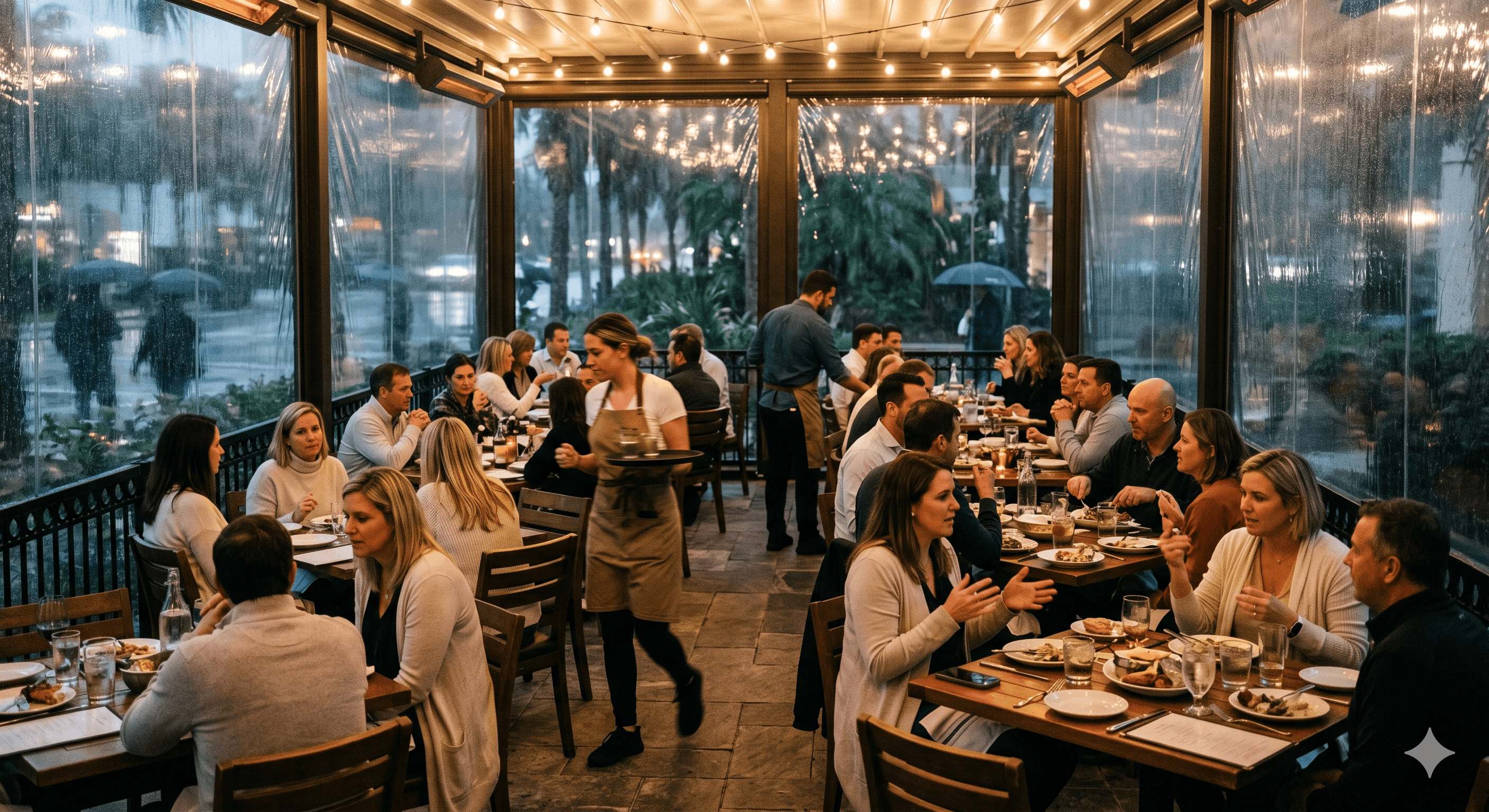
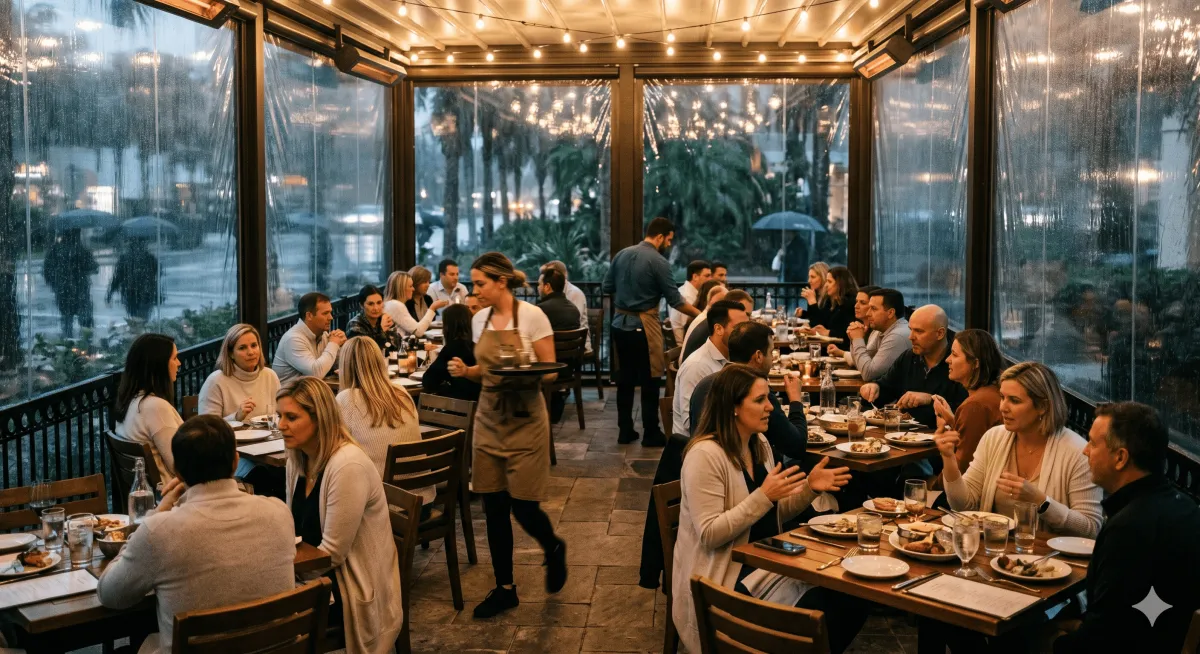
For a Florida restaurant patio, the right motorized screen type depends less on the product and more on which dining season you're protecting. Clear vinyl is the commercial workhorse — it converts the patio into a wind- and rain-proof room that operates through winter cold snaps, spring and summer rain, and shoulder-season wind. Solar handles summer heat for daytime service. Insect mesh covers shaded dusk patios where bugs are the only issue. Hurricane Defender provides Cat-5 storm continuity and code-compliant opening protection for coastal and HVHZ-county operators. Most Florida restaurants, after running the math, end up specifying two screen types across different openings on the same patio. This blog provides a framework for choosing the combination that best fits your concept's actual service pattern across the four Florida dining seasons.
The Four Florida Dining Seasons
Every Florida operator runs the same calendar, weighted differently by market. Coastal SFL concepts see heavier summer storm activity and less winter cold. Inland CFL concepts see more cold-snap evenings in January and February. Waterfront concepts see more wind exposure year-round. But the seasonal framework holds.
Dining Season
1. Winter (Dec–Feb)
2. Spring (Mar–May)
3. Summer (Jun–Aug)
4. Fall (Sep–Nov)
Primary Weather Risk
1. Cold snaps, wind, rain
2. Rising heat, early insects
3. Afternoon storms, heat, dusk bugs
4. Peak hurricane season, shoulder weather
Best Screen Tier
1. Clear vinyl
2. Solar + insect combination
3. Clear vinyl
4. Hurricane Defender
Secondary Coverage
1. Hurricane Defender for premium concepts
2. Clear vinyl for rain transitions
3. Solar for daytime heat, insect for dusk
4. Clear vinyl post-storm transition
Winter is the peak Florida dining season in most markets — tourist season in SFL, cool-weather patio appeal statewide, holiday, and snowbird traffic. Summer is the heat-and-storm challenge. Spring and fall are the shoulders. The screen that protects peak-season revenue matters more than the screen that protects any single weather event. A patio that loses a clear Tuesday night in January because of a 48-degree cold front and a stiff wind loses materially more revenue than a patio that loses a typical Tuesday night in August — winter services run fuller, check averages run higher, and the competitive set is shorter.
Pick the screen tier that protects the highest-margin services first. Stack the other tiers on secondary openings or on the budget for next year.
Clear Vinyl: The Commercial Workhorse
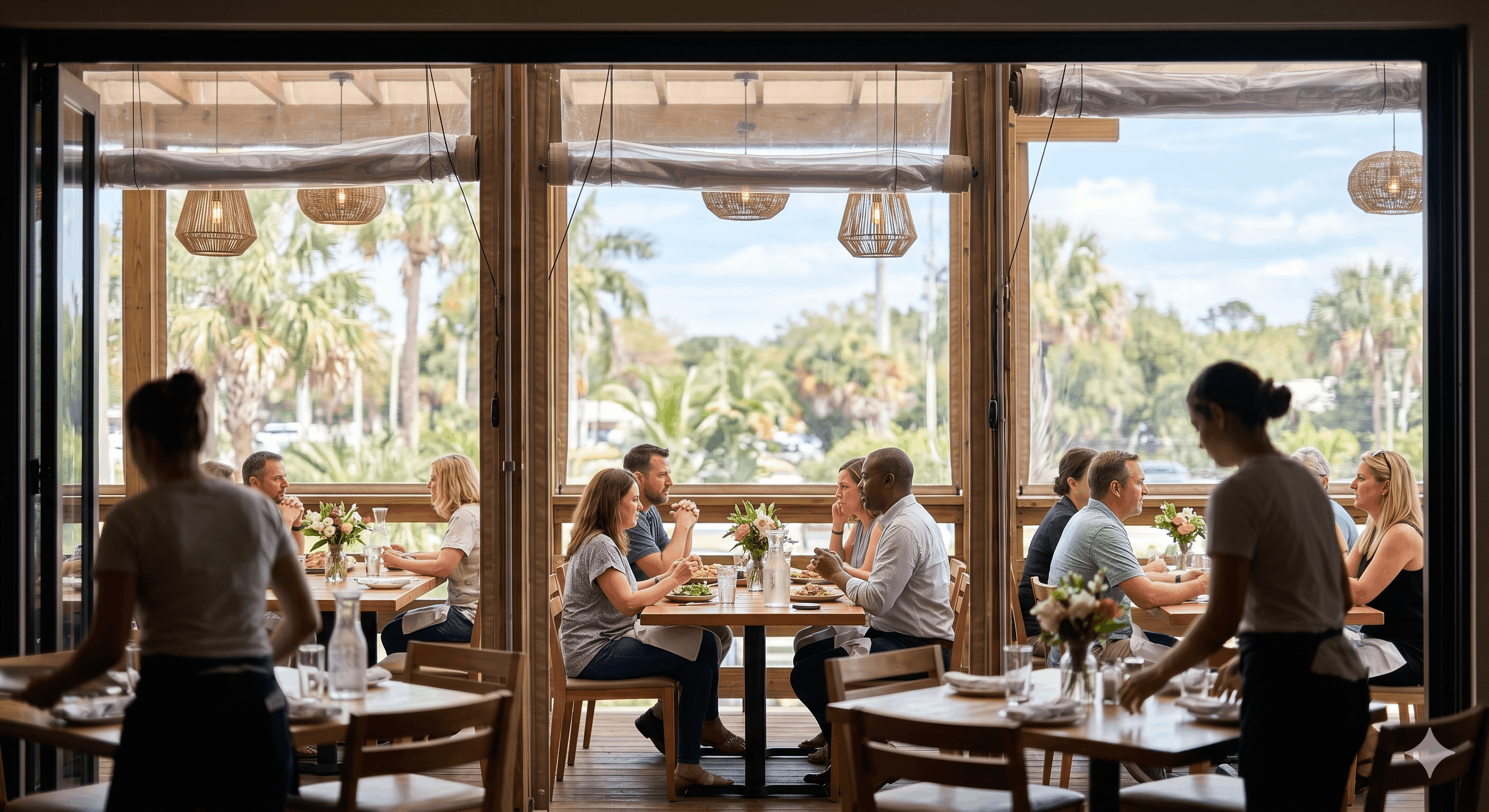
PVC or reinforced vinyl panels mounted in the MagnaTrack magnetic-track housing, deployed by motor on a single button press, retracted when conditions permit. Clear vinyl converts an outdoor patio into an outdoor-looking room — guests still see palms, water, city lights through the panel, but wind and rain stay outside. The temperature inside a deployed clear-vinyl enclosure runs approximately 10 degrees off the outside ambient with no mechanical climate control. Pair with ceiling fans in summer and radiant heaters in winter and the space performs close to interior for guest comfort.
Why it dominates commercial installs: clear vinyl is the only tier that handles three of the four Florida dining seasons without compromise. Winter cold snaps, spring rain, summer thunderstorms, shoulder-season wind — all handled. Guest visibility is preserved. Service continues during weather events that completely close unprotected patios.
Where it falls short: peak summer heat at midday still requires supplemental cooling, even with vinyl deployed, because the clear panels transmit more UV than solar fabric. And clear vinyl is not Cat-5-rated — it retracts before major storms. For operators whose primary pain is summer-heat lunch service, clear vinyl alone is not enough.
Commercial spec detail: radio-frequency-welded seams outlast stitched seams by years under commercial cycling conditions. Panel thickness should be commercial-weight (not residential gauge). Panels up to 10 feet by 12 feet are achievable on a single section; larger spans are engineered across multiple zippered sections. The dealer quote should specify thickness, seam technology, and section sizing.
Solar / Shade: The Daytime-Service Specialist
Woven solar fabric with four opacity options (80%, 90%, 95%, 99%) that blocks UV, reduces ambient under-screen temperature by 10 to 20 degrees, and maintains outward view at the lower opacity levels. For commercial patios running heavy daytime service — lunch concepts, hotel pool bars, brunch-forward casual dining — solar is often the difference between an operational midday patio and an empty one.
Why daytime-heavy concepts specify it: solar preserves the outward view that guests expect from a patio experience, while rejecting the heat and UV that empty west and south-facing patios between 11 a.m. and 4 p.m. For a concept where midday guest count drops 40% in summer because the patio is unusable, solar can recover the majority of that loss.
Where it falls short: Solar is not rainproof. A 15-minute afternoon thunderstorm still closes patio service under solar alone. Solar screens also don't provide cold-snap protection for winter service. Dinner-only concepts or concepts running through storm-heavy summer afternoons need a second tier (clear vinyl or hurricane Defender) on the primary openings.
Commercial spec detail: the fabric brand matters meaningfully in commercial use. Sunbrella and Soltis commercial-grade fabrics outperform residential-weight solar under the higher cycling and UV exposure of restaurant patios. Opacity choice is a business decision: 80% preserves the most views (best for ambiance-forward concepts), 95% maximizes heat rejection (best for comfort-critical concepts), 90% is the common middle for operators balancing both.
Insect Mesh: The Dusk-Service Filter
Polyester or fiberglass mesh designed to block mosquitoes and no-see-ums while preserving outward view and airflow. The lowest-cost MagnaTrack fabric tier. For shaded dinner-service patios where heat isn't the driver and rain protection isn't needed, insect alone can be sufficient.
Why certain concepts lead with it: a covered dinner-service patio under dense tree canopy or a covered lanai on the east or north side of the building, where heat is modest, and rain is rare during service hours, can operate through the dusk insect-pressure window with insect mesh alone. The installation cost is the lowest among the four tiers, payback is fast, and the fabric fully preserves the open-air feel.
Where it falls short: insect mesh passes heat, UV, and water at full intensity. Operators who spec insect alone because it's the cheapest tier often rebuy solar or vinyl within 18 months after experiencing a single summer's worth of heat and rain. The insect tier is correct when the pain is genuinely and exclusively due to bugs. It's wrong when the pain is anything else.
Commercial spec detail: commercial-grade mesh weighs more than residential-grade mesh due to the higher cycling of restaurant operations. The dealer's quote should specify the mesh weight.
Hurricane Defender: The Storm-Season and Premium Spec
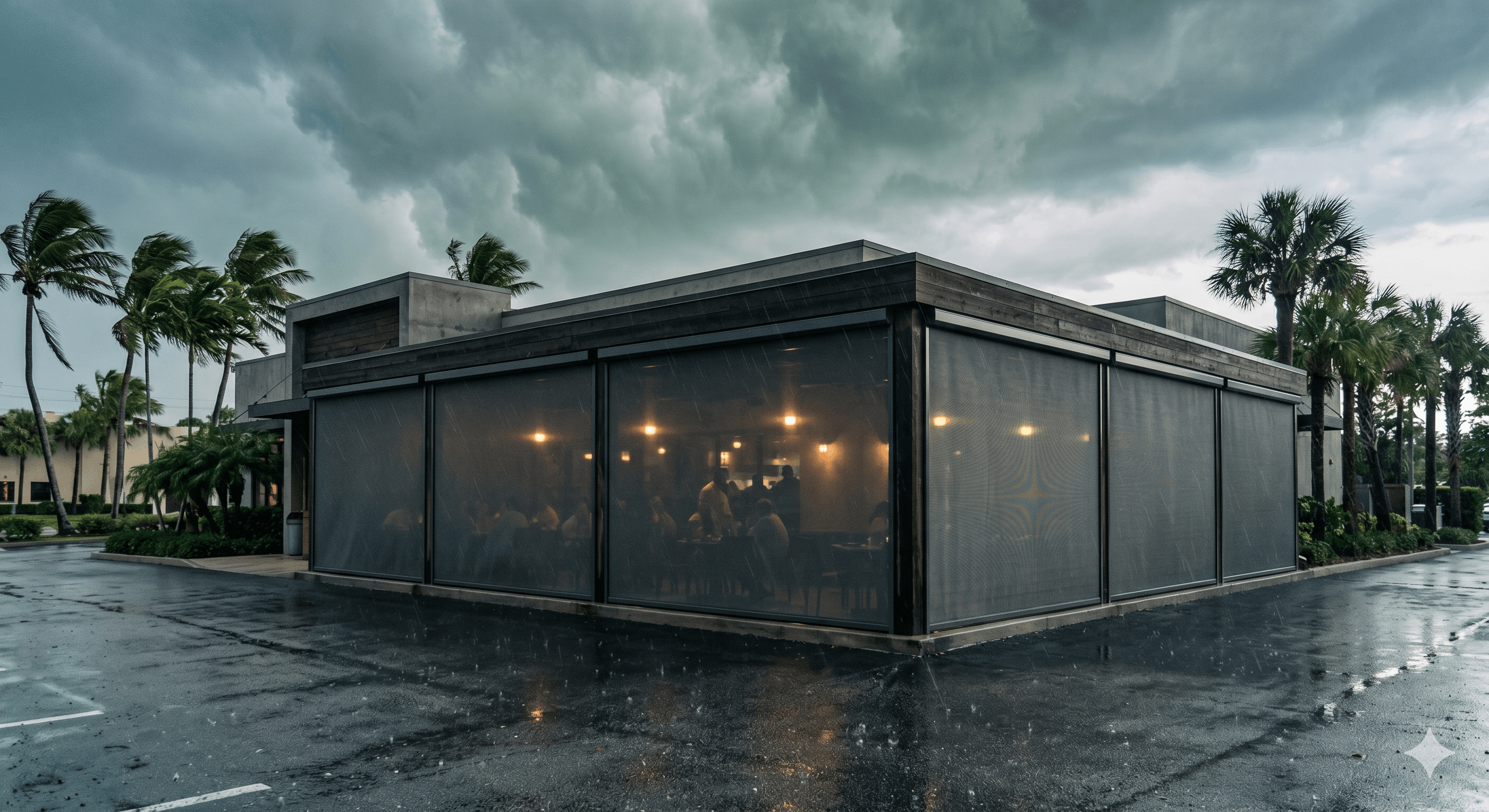
Progressive Screens' top-tier commercial product. Proprietary fabric (high-tenacity PET woven with Aramid core yarns, encapsulated in vinyl) running on a reinforced MagnaTrack channel. Carries Florida Product Approval number F30798. Rated to withstand wind exceeding 156 mph — Category 5 with debris impact protection. Commercial single-zone spans of 26 feet wide by 16 feet tall.
Why coastal and HVHZ operators specify it: HVHZ-county restaurants (Miami-Dade, Broward) often require Cat-5-rated opening protection on enclosed patios for code compliance. Coastal concepts capture meaningful guest-confidence value from staying open during tropical storm watches when nearby competitors close. The wind-mitigation insurance credit applies to commercial policies the same way it does to residential — an ongoing operating-cost offset that can total tens of thousands of dollars over the install's 15-year warranty window.
Why it serves as a single-tier solution for some concepts: Defender fabric also blocks insects, reduces UV exposure, and provides privacy. A concept that wants a single screen tier across the entire patio that handles storm, heat, insect, and daily operation can specify Defender for the entire install and skip the multi-tier complexity. The cost is the highest of the four tiers, so the math has to work — it does for premium concepts where the insurance offset, and guest-confidence value are material.
Where it falls short: Inland Florida concepts with minimal hurricane exposure and no HVHZ code requirement often find that clear vinyl covers meet 90% of their operational needs at a lower price point. Defender's full value propagates best for operators whose exposure, insurance, and guest expectations make storm continuity a revenue driver.
Common Florida Commercial Combinations
Most Florida restaurants specifying motorized screens for serious operational use don't pick one tier — they pick two. The MagnaTrack housing is identical across fabrics, so the patio's architectural appearance remains consistent even when the fabric tiers differ. Four patterns cover the majority of commercial installs in Florida.
Clear vinyl primary, solar on west-facing openings. Most common for mid-to-upscale casual concepts running both lunch and dinner. Clear vinyl handles three seasons of weather; solar on the west side handles summer afternoon heat. Common in CFL markets.
Hurricane Defender is used as the primary, and clear vinyl is used on secondary openings. Common for SFL coastal concepts and HVHZ-county operators. Defender on the main opening for code and storm continuity, clear vinyl on smaller secondary openings for budget optimization. Common in Broward and Palm Beach.
Solar primary, insect on shaded secondary sections. Common for casual daytime-heavy concepts (brunch, lunch, cafés) with smaller shaded dusk-service areas. Less common for dinner-weighted concepts.
Hurricane Defender across full patio. Common for hotel-resort restaurants, waterfront premium concepts, and operators capturing the full insurance wind-mitigation credit. Single-tier simplicity at the highest price point.
Run Your Patio's Combination — Commercial Calculator
The commercial calculator at floridalivingoutdoor.com/commercial-solutions handles mixed-type installs. Enter each opening on your patio, select the fabric tier for each, input your revenue variables, and the output will return a budget range and a weather-loss-recovery projection. It's the fastest path from operational context to a board-ready number, and it's designed to be run before the dealer conversation — not during.
The final blog in this series translates that calculator output into a board-meeting-ready presentation — the ROI math, the payback period, and the operational continuity case in one package.
Frequently Asked Questions
What kind of motorized screen should a Florida restaurant patio use?
Clear vinyl is the most common commercial specification because it converts the patio into a wind- and rain-proof enclosure that operates year-round. Solar screens serve daytime-heavy concepts with heat exposure. Insect screens fit shaded dusk-service patios where bugs are the only issue. Hurricane Defender serves coastal concepts, HVHZ-county operators, and any operator prioritizing storm-season continuity. Many Florida restaurants specify two types of seating across different patio openings.
Can clear vinyl screens work year-round on a Florida restaurant patio?
Yes, for three to four seasons of the year, depending on location. Clear vinyl handles winter cold snaps, spring rain, summer thunderstorms, and shoulder-season wind without interrupting service. The tier is not hurricane-rated and should be retracted before major storms. Temperature inside a clear-vinyl-enclosed patio runs about 10 degrees off ambient, so summer daytime service in the hottest months still benefits from ceiling fans or portable climate control to maintain guest comfort.
Do Florida restaurants need hurricane screens on their patios?
It depends on location, concept, and insurance posture. HVHZ-county restaurants (Miami-Dade, Broward) often need Cat-5-rated opening protection for code compliance on enclosed patios. Coastal operators gain the most from storm-season continuity — staying open when competitors close. Inland Florida restaurants may find clear vinyl sufficient for 90% of their operational needs. Hurricane Defender also provides year-round daily use as a solar and insect screen, making it a single-tier solution for some operators.
What's the best motorized screen for summer heat on a restaurant patio?
Solar screens at 90 to 95 percent opacity provide the best heat rejection for daytime service, reducing ambient temperature under the screen by 10 to 20 degrees while preserving outward view. For operators running both lunch and dinner service, solar alone is often insufficient — pair solar for daytime with clear vinyl or insect for dusk service. Some concepts spec Hurricane Defender across the full patio for a single-product year-round solution.
Can a restaurant install different types of screens on the same patio?
Yes, and many Florida restaurants do. The MagnaTrack housing is shared across all four fabric tiers, so the architectural appearance stays consistent even when fabrics differ. Common commercial combinations include solar on west-facing daytime sections paired with clear vinyl on evening dining sections, or clear vinyl on main dining with Hurricane Defender on the primary entrance for storm continuity.
How does the Florida restaurant concept affect the screen choice?
Concept drives the decision. Fine-dining concepts that operate primarily at dinner tend to favor clear vinyl for preserving ambiance. Casual lunch-heavy concepts lean toward solar for heat comfort. Bar-forward concepts serving dusk-to-late-night lean toward insect or solar-plus-insect. Hotel-resort restaurants and waterfront concepts often specify Hurricane Defender to bolster guest confidence during storm season. Concepts serving primarily tourists during the winter tourist season rely most on clear vinyl for cold-snap continuity.
What's the most durable motorized screen fabric for restaurant use?
Hurricane Defender's proprietary fabric — high-tenacity PET woven with Aramid core yarns encapsulated in vinyl — is the most durable option and the only one rated for Cat-5 wind exposure. Radio-frequency-welded clear vinyl panels are the most durable option in the clear tier. Commercial-grade solar fabrics from Sunbrella and Soltis outperform residential-grade solar fabrics in daily cycling in commercial use. The fabric specification should match the duty cycle — a point the dealer should specify in writing on the quote.
Florida Living Outdoor is a MagnaTrack Authorized Dealer serving Central and South Florida hospitality operators. Veteran-owned. Owner-operated. Run your commercial calculator to map your patio's screen-tier combination across the four Florida dining seasons.