
Restaurant Patio Weather Revenue Loss Florida: The 2026 Math
What a Weather-Closed Patio Actually Costs Your Florida Restaurant Every Year
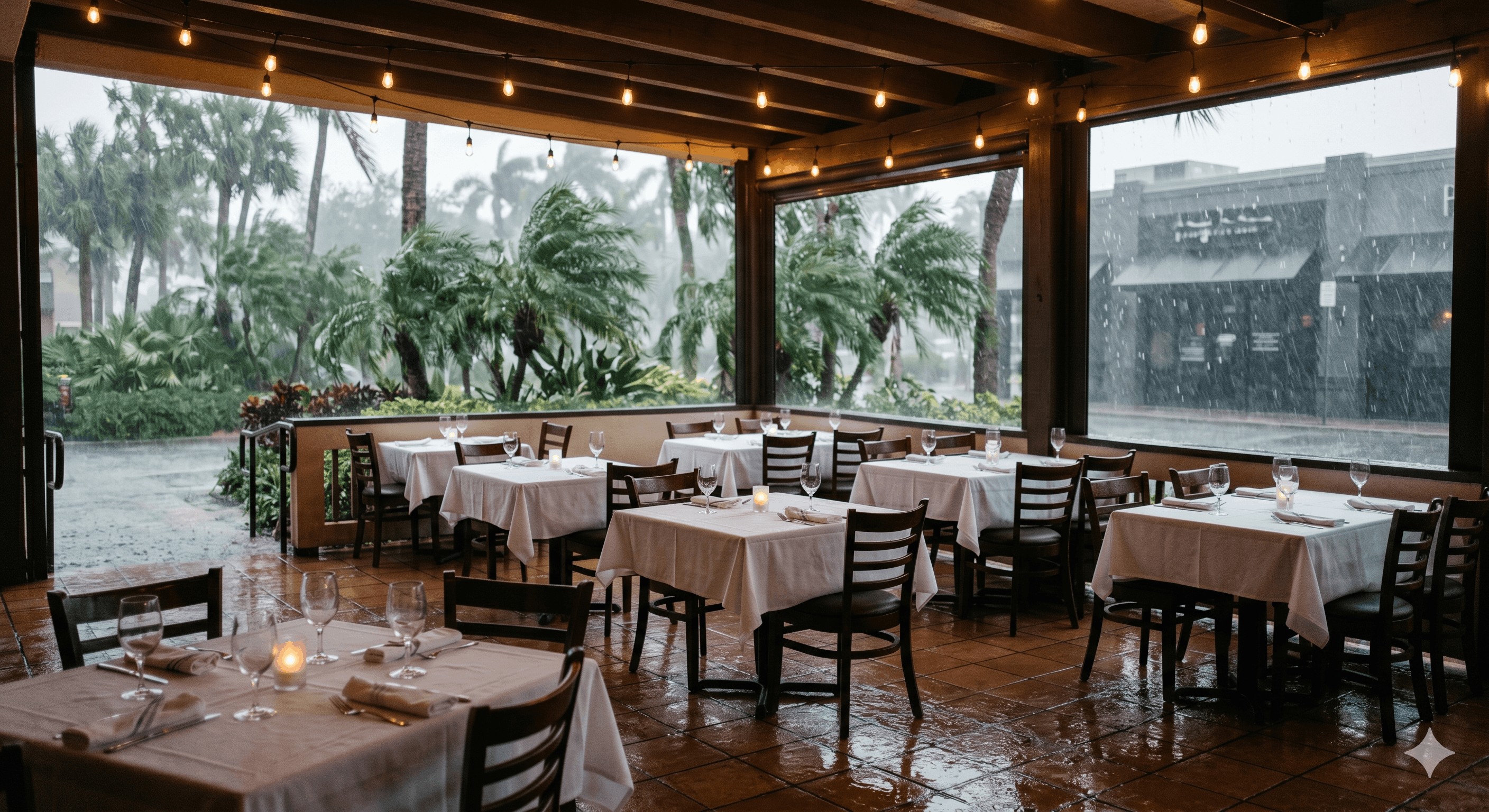
A Florida restaurant patio that closes for weather loses somewhere between $45,000 and $300,000 in gross revenue per year, depending on seat count, service style, average check, and local climate. For a 60-seat patio running dinner service at a $45 average check with two table turns, every weather-affected service costs approximately $3,800 in gross revenue. Florida's climate delivers 60 to 90 weather-affected services per year across most markets in the state — afternoon rain, summer heat, dusk insects, hurricane disruption, cold snaps, high-wind partial closures. The math compounds fast. And it compounds silently, because most operators never run the calculation.
This blog runs the calculation. It's the first in the commercial track of Florida Living Outdoor's motorized screen series, and it exists for one reason: if your patio is losing weather-affected services you haven't quantified, every operational decision you make about that space is underinformed.
The Short Answer: Your Weather Loss Has a Formula
Progressive Screens, the MagnaTrack manufacturer, has published a five-variable formula that commercial operators can run on a napkin:
Days × Seats × Dollars × Table Turns × Capacity = Annual Revenue Recovered
Flip the equation and it runs the other direction: that's what you're losing now, per year, to weather-affected services you can't deliver. This is the foundation of the commercial calculator we built — five inputs, one output, designed to give a GM or an ownership-group partner a board-ready number in less than five minutes.
The rest of this blog unpacks each variable and works through a representative Florida scenario.
The Six Weather Conditions That Close a Florida Patio
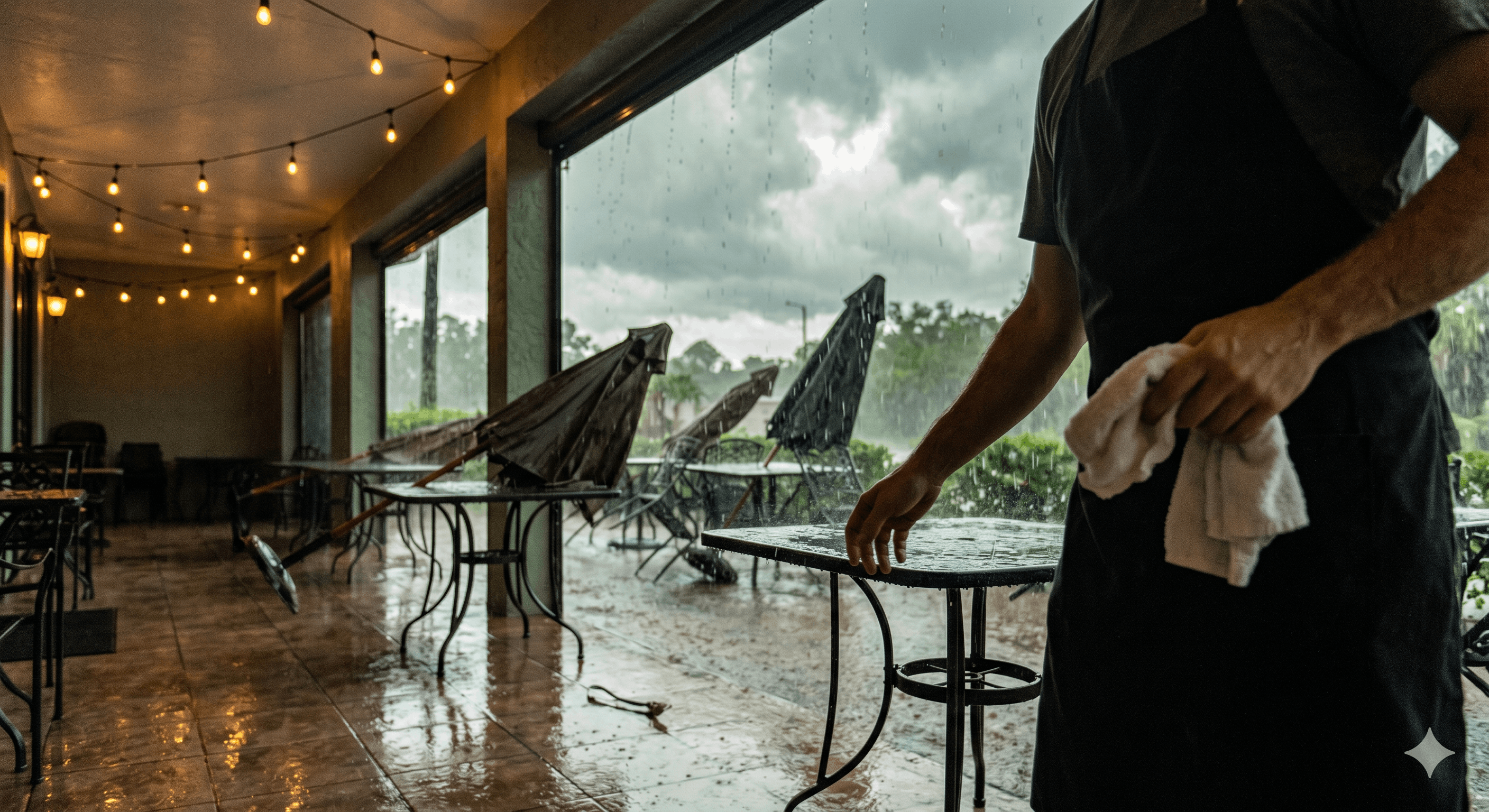
Before the math, the weather audit. Every Florida market delivers the same categories at different frequencies — coastal markets see more afternoon rain and hurricane exposure; inland markets see more summer heat; CFL gets more cold snaps than SFL.
Weather Condition
1. Afternoon rain (May–Oct)
2. Summer heat (Jun–Sep, 1–6 p.m.)
3. Insect pressure (dusk)
4. Hurricane season weather
5. Cold snaps (Dec–Feb, CFL)
6. High wind / sudden storms
Florida Frequency
1. 3–5 days/week
2. ~90 afternoons
3. ~150 evenings
4. 5–10 days/year
5. 10–15 evenings
6. Occasional
Patio Impact
1. Closes or shortens lunch + dinner
2. Empties patio during the hottest window
3. Drives guests inside at prime dinner
4. Full patio shutdown
5. Kills evening patio revenue
6. Partial closures mid-service
Not every entry on this list closes your patio every time. A light 15-minute rain might reduce turns by 30%; a heavy storm shuts the service completely. A summer heat afternoon doesn't close the patio — it empties it. An insect-heavy dusk doesn't close the patio — it redirects guests to the bar. The math works on weather-affected services, not binary closures: half-service counts as half of a full service lost.
Most Florida operators running an unprotected patio see 60 to 90 weather-affected services per year when the accounting is honest. Some see more. Waterfront concepts in Fort Lauderdale, Palm Beach, or St. Petersburg with heavy afternoon-rain exposure can run 100+ affected services, particularly through the summer storm season.
Unpacking the Five Variables
Days: Weather-Affected Services Per Year
This is the variable most operators underestimate. Counting only the days you closed completely misses the partial closures, the empty afternoons, and the services that ended at 7 p.m. instead of 10 p.m. because a 15-minute squall killed the remaining turns. Start with a conservative estimate — 60 to 70 weather-affected services for a typical mid-sized Florida patio — then adjust upward if your market has heavier exposure. The honest number is usually higher than the first estimate.
Seats: Patio-Only Seating Capacity
Use your licensed patio seating capacity, not the indoor total. If your patio seats 60 and your indoor dining room seats another 80, the weather loss applies to the 60 only — interior service continues in most weather. Partial-capacity configurations (some patio operators run reduced seats during shoulder hours) should use the full capacity number; that's what you lose when weather forces the full closure.
Dollars: Average Check Per Guest
Dinner average check for dinner-weighted patios. Lunch and dinner blended if the patio runs both services. Include beverage — the patio bar revenue is part of what you lose. Fine-dining concepts running $85+ average checks see much larger per-service losses; fast-casual concepts at $18–$25 see smaller per-service losses but higher turn counts, which partially offsets.
Table Turns: Turns Per Service
How many times each seat flips during the service window. Casual dining typically runs 1.5 to 2 turns at dinner; higher-velocity concepts run 3 or more; fine dining often runs 1 turn per dinner. Lunch service typically has higher turn counts than dinner. Multiply your actual number across services if you're blending lunch and dinner in the calculation.
Capacity: Realistic Occupancy Percentage
Your patio rarely runs at 100% seated every hour of service. A realistic assumption for most Florida restaurants is 65% to 75% of capacity across the weather-relevant service windows. Waterfront destination patios on Friday and Saturday nights can run higher — 85% or more; Tuesday-night suburban patios often run lower. Use your own data if you have it; use 70% as a reasonable starting point if you don't.
A Worked Example: 60-Seat Fort Lauderdale Dinner Patio
Consider an independent restaurant in Fort Lauderdale with a 60-seat covered patio, dinner-only service, $45 average check with beverage, two table turns, and a realistic 70% capacity assumption. The patio has no motorized enclosure today — weather events close it fully on storm days and partially on heat/insect days.
Variable
1. Patio seats
2. Average check (dinner)
3. Table turns per dinner service
4. Capacity assumption (realistic)
5. Gross revenue per full dinner service
6. Estimated weather-affected services per year
7. Annual gross revenue lost to weather
8. At 10.5% restaurant profit margin: contribution lost
Value
1. 60
2. $45
3. 2
4. 70%
5. $3,780
6. 70
7. $264,600
8. $27,783
$264,600 in annual gross revenue lost. At the US full-service restaurant average profit margin of 10.5%, that's approximately $27,800 in contribution margin lost every year to weather that a commercial-grade motorized screen install could have protected against.
The numbers scale linearly. A 40-seat patio at the same per-service economics loses roughly $176,000 a year. A 100-seat higher-velocity patio at three turns and a $55 check loses over $700,000. A waterfront fine-dining patio at $85 check and 1.5 turns with heavy summer exposure can clear $900,000 in annual weather losses.
None of these numbers are on any operator's P&L. They're invisible, because revenue that didn't happen doesn't book. Which is exactly why most commercial operators never address the problem — it doesn't show up as a line item until someone runs the calculation.
What Motorized Screens Actually Recover
A properly-specified commercial motorized screen install recovers most, not all, of the weather-affected services. The realistic recovery rate in Florida commercial applications runs 60% to 80% of previous weather losses — some conditions (major storms, extreme heat with the AC overwhelmed) still close the patio even with screens deployed. The remaining services that do run continue to carry normal operating variables (staff, supply, turnout), so the recovered revenue is gross, not net.
At a 70% recovery rate on the Fort Lauderdale example, the patio recovers roughly $185,000 in gross annual revenue and approximately $19,500 in contribution margin. Against a commercial install cost in the $25,000 to $75,000 range depending on scope, that's a payback period frequently reported in published industry data as six to twelve months for motorized solar installs, with hurricane-rated Defender installs sometimes taking slightly longer.
The math favors the install. The variable is how quickly.
Why This Matters Now
Florida's 2026 outdoor-dining landscape is more competitive than it was in 2020. Every independent and every concept operator is trying to make their patio work harder. The restaurants that convert their patios to weather-protected three-season or year-round operation capture: guests shifting away from competitors who close, seating revenue that previously went indoors (or nowhere), and the hosting continuity that keeps private events, date nights, and family dinners inside your walls when the sky opens up ten minutes after arrival.
The operators who delay this decision another season concede that revenue to the operators who don't.
Run Your Own Number — The Commercial Calculator
The commercial calculator at floridalivingoutdoor.com/commercial-solutions takes the five variables above and returns your annual weather-loss number in under five minutes. It's built for restaurant owners, GMs, and ownership-group partners who need a board-ready number before committing budget. No sales call required to see the output.
The next blog in this series covers why residential-grade motorized screens fail in commercial use and what a commercial spec actually looks like — so when you do take your calculator output into a dealer conversation, you can ask the right questions.
Frequently Asked Questions
How much revenue does a Florida restaurant lose to weather each year?
A typical Florida restaurant patio loses between $45,000 and $300,000 in gross revenue per year to weather-affected closures, depending on seat count, service style, average check, and the local climate pattern. A 60-seat dinner-service patio in most Florida markets sees approximately 70 weather-affected services per year, costing roughly $265,000 in annual gross revenue at a $45 average check and two table turns.
How do I calculate my restaurant's weather-closure loss?
Multiply five variables: patio seats, average check per guest, table turns per service, capacity assumption (typically 65 to 75 percent), and estimated weather-affected services per year. The result is annual gross revenue lost. Apply your restaurant's profit margin (industry average is 10.5 percent for full-service restaurants) to calculate contribution margin lost. The commercial calculator on the Florida Living Outdoor commercial solutions page runs this math automatically.
Can motorized screens make a restaurant patio year-round in Florida?
Yes, with the right screen tier specified. Clear vinyl or hurricane Defender screens convert an outdoor patio into a weather-protected three-season or year-round dining room that operates through afternoon rain, summer heat, dusk insect pressure, and most wind conditions. Residential-grade screens are not adequate for commercial duty cycles — commercial patios need commercial-grade motors and hardware, which we cover in the next blog in this series.
What's the payback period on motorized screens for a restaurant patio?
Authorized dealers report typical capital recovery of 6 to 12 months on motorized solar shade installations for restaurants, with Cat-5-rated hurricane Defender installs sometimes taking slightly longer depending on scope. The payback timeline depends on the restaurant's existing weather-loss exposure, the size of the patio, the check average, and how many services are recovered by the install.
How much additional revenue can motorized screens add to a restaurant patio?
Published industry data indicates a properly-equipped outdoor patio can increase a restaurant's total revenue by up to 30 percent by extending usable hours and recovering weather-closed services. The actual lift depends on the restaurant's current weather-loss exposure, neighborhood patio competition, and the service model. Motorized screens typically recover 60 to 80 percent of previously-lost weather services in Florida markets.
What types of motorized screens work for restaurant patios?
All four MagnaTrack screen types serve commercial patios, but the application differs. Clear vinyl is the most common specification — it converts the space into a wind and rain-proof room while preserving the outdoor feel. Solar screens handle heat and UV for daytime service. Insect screens handle dusk dinner service. Hurricane Defender provides storm-season continuity and opening protection that may qualify for code compliance in HVHZ counties.
Do motorized screens affect restaurant permitting or code compliance?
Commercial motorized screen installations typically require a permit, fire-code review, and — in HVHZ counties (Miami-Dade, Broward) — adherence to Florida Building Code opening-protection standards for any hurricane-rated installation. The Defender Storm System carries Florida Product Approval F30798. Working with a certified commercial dealer ensures the permit process, code compliance review, and inspection documentation are handled correctly.
Florida Living Outdoor is a MagnaTrack Authorized Dealer serving Central and South Florida commercial operators. Veteran-owned. Owner-operated. Run your commercial calculator to see your patio's annual weather-loss number in five minutes.