
Screen Enclosure vs. Motorized Screens: Which Is Right for Your Florida Patio?
Screened-In Porch or Motorized Screens? How to Know What's Right for Your Florida Home
The Great Florida Thaw — Blog 6 of 10
Reading time: ~10 minutes
Quick Answer: "What's the difference between a screened-in porch and motorized screens?"A screened-in porch is a permanent aluminum-framed structure with fixed mesh panels — always in place, always blocking bugs, but always partially obstructing your view and reducing the open-air feel. Motorized retractable screens deploy on demand and disappear completely when raised, giving you a fully open patio whenever conditions allow. Screen enclosures typically cost $6,000 to $15,000 for a standard patio or pool area. Motorized systems run $3,000 to $6,000 per opening, meaning a full patio with three to four openings can reach $12,000 to $24,000. The right choice depends on whether you value constant protection or on-demand flexibility — and neither option is wrong.
You already know you want protection. That part's settled. The bugs won, the sun won, the rain won — and you're done pretending the patio is fine without some kind of barrier between your family and whatever South Florida throws at you next.
The question keeping you stuck isn't whether to screen your outdoor space. It's how.
And if you've spent any time researching, you've probably landed in the same frustrating loop that catches most Florida homeowners: screen enclosures are what everybody has. Motorized retractable screens are what the internet keeps showing you. Your neighbor swears by the cage. Your contractor mentioned something retractable. We offer two different price ranges and two different experiences, and we don't provide a straight comparison with an agenda.
This is that comparison. No agenda. Just a framework.
We install motorized screens every week. We think they're extraordinary for certain situations. We also think screen enclosures are the better call in other situations—and we'll tell you exactly when because the worst outcome here isn't picking the wrong product. It's staying frozen in the research phase while another summer burns through your patio, your tolerance, and your evenings.
The Florida Default (And Why It Exists)
Screen enclosures are to Florida what basements are to the Midwest — so common they feel mandatory. Drive through any neighborhood in Broward, Palm Beach, or Hillsborough County, and you'll count more pool cages than mailboxes. The aluminum frames. The mesh panels. The screen door that never quite closes right after the third year.
There's a reason this became the default. Screen enclosures solve the two problems Florida homeowners care about most: bugs around the pool and debris in the water. They do both jobs around the clock without any input from you: no buttons, no maintenance schedule, no learning curve. The cage goes up, the bugs stay out, the leaves stay out, and you stop thinking about it.
That simplicity matters. A screen enclosure is a passive solution — it works whether you're home or on vacation, whether you remember to deploy it or forget. For pool owners, especially, this alone justifies the investment. Less skimming, fewer chemicals, cleaner water, and a barrier that satisfies Florida's pool safety requirements for child protection.
Screen enclosures in Florida typically fall between $6,000 and $15,000 for a standard patio or pool area, depending on size, roof style, and materials. Aluminum framing with fiberglass mesh is the most common configuration. The structure requires engineering, permitting, and a concrete footer — a process that takes four to twelve weeks from consultation to completion. The mesh itself lasts 5 to 15 years before needing replacement, and rescreening costs $1,000 to $5,000, depending on square footage and material choice.
Not a bad deal. Not a bad product.
But it comes with tradeoffs most homeowners don't think about until the cage is already up.
What a Screen Enclosure Takes Away
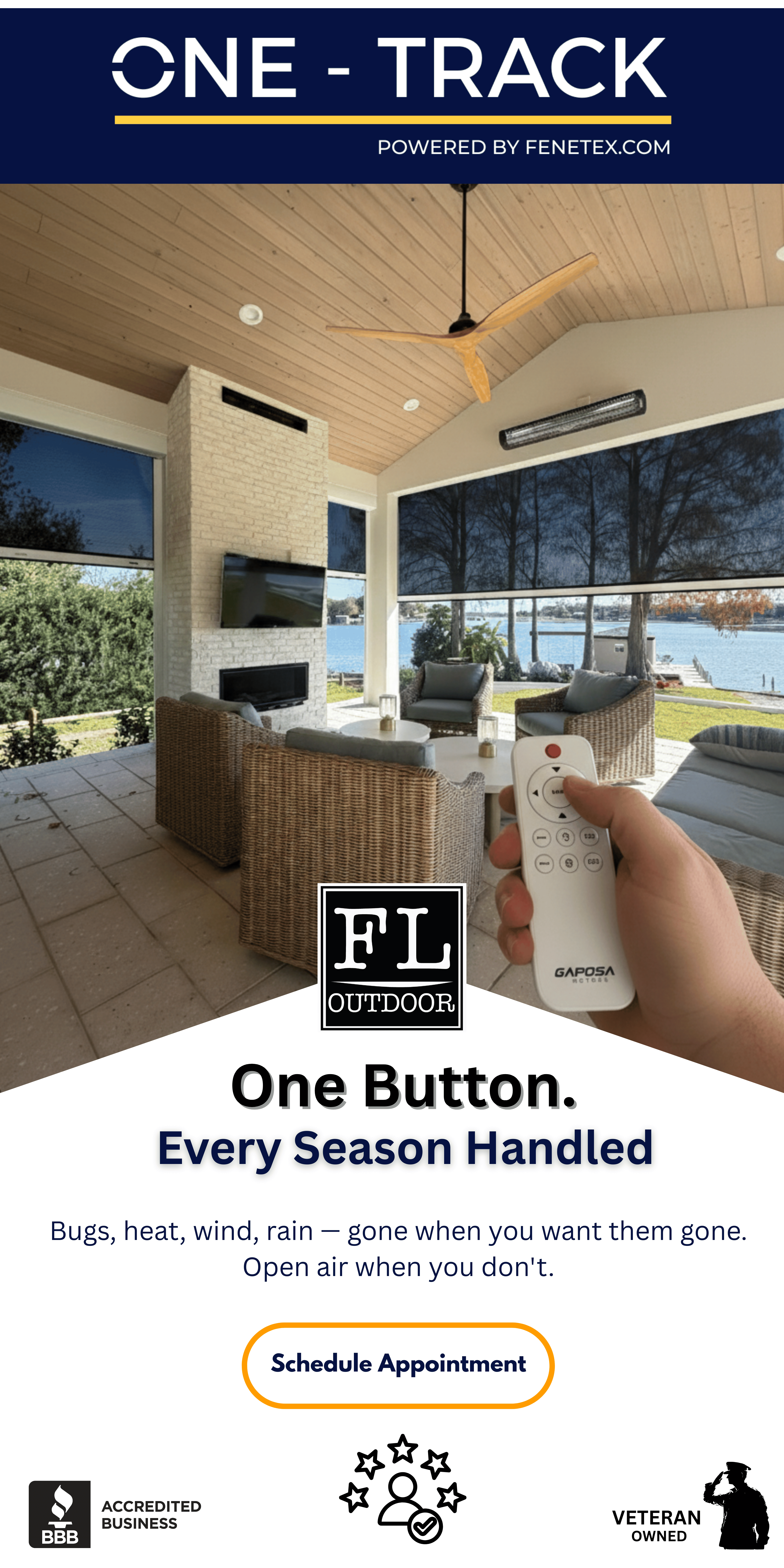
The view changes. Not dramatically — you can still see your yard through the mesh. But the aluminum framing creates visual lines that segment your sightline, and the mesh creates a faint haze that accumulates over time from dust, pollen, and hard-water stains. If you bought your home for the view, or spent real money on landscaping, that slight reduction in clarity adds up psychologically. You stop noticing it consciously. But you feel it.
The space becomes permanently enclosed. This is the tradeoff that catches people off guard. On a cool February evening — the kind South Florida gives you maybe thirty or forty times a year — you might want your patio completely open. No screen. No frame. Just air. A screen enclosure doesn't offer that option. It's enclosed in February the same way it's enclosed in August. The protection is constant, and so is the confinement.
Hurricane prep creates a separate headache. Standard screen enclosures aren't hurricane-rated. The mesh acts like a sail in high winds, putting enormous pressure on the aluminum frame. Many contractors recommend cutting the screens before a major storm to save the structure, then paying to have them replaced afterward. A typical rescreening after hurricane damage runs $2,000 to $8,000 or more, depending on severity. Insurance may cover part of it, but deductibles and claim limits often leave homeowners absorbing a significant chunk.
And the space doesn't flex. You can't open one wall for a breeze while keeping the others sealed for bugs. You can't lower the shade on the west side during the afternoon sun. The enclosure is one configuration, all the time, regardless of conditions.
The Alternative Most Homeowners Don't Know Exists
Motorized retractable screens are newer to the Florida market, which is why they still sound unfamiliar to most homeowners. The concept is simple: mesh panels housed in a compact overhead cassette that deploy downward along side tracks at the press of a button and retract completely when you don't need them.
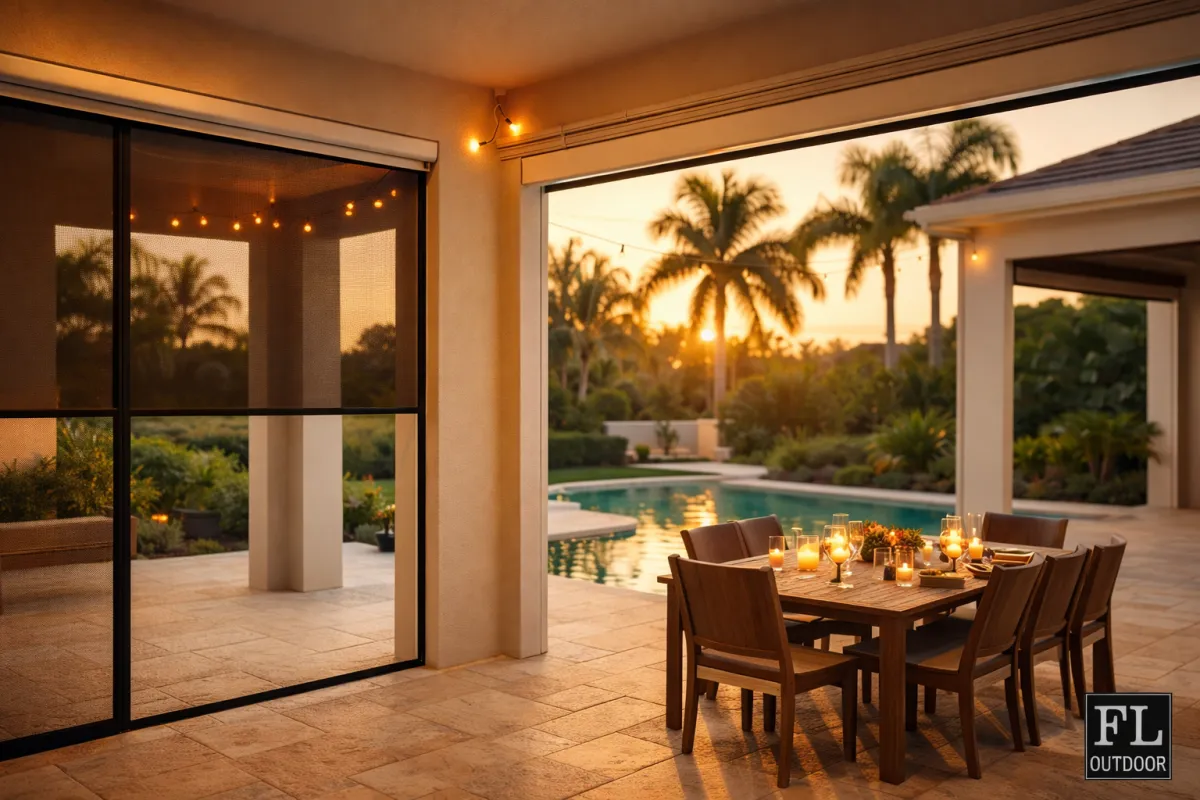
When the screens are down, you get bug protection, wind reduction, and varying degrees of solar filtering depending on the mesh type — insect mesh, solar shade, or privacy screen. When the screens are up, they disappear. No frame in your sightline. No mesh between you and the yard. The patio returns to a fully open space.
When the screens are down, you get bug protection, wind reduction, and varying degrees of sun filtering depending on the mesh type — insect mesh, solar shade, or privacy screen. When the screens are up, they disappear. No frame in your sightline. No mesh between you and the yard. The patio returns to a fully open space.
That flexibility is the fundamental difference. A screen enclosure gives you permanent protection. Motorized screens give you protection on demand.
For a standard patio opening — roughly 15 feet wide by 10 feet tall — a quality motorized screen system runs between $3,000 and $6,000 installed. Most patios have three to four openings, which puts the total investment between $12,000 and $24,000 for full perimeter coverage. That's higher than most screen enclosures, and worth being upfront about.
But the per-opening price includes the motor, the tracks, the cassette housing, smart home integration, and, in certain configurations, wind ratings that screen enclosures can't match. MagnaTrack systems by Progressive Screens, for example, carry hurricane ratings that meet Miami-Dade building code standards — protection against winds exceeding 150 miles per hour. The same screens you'd lower for a Tuesday evening cookout can deploy as storm protection when a hurricane approaches. One system. Two problems solved. (We wrote an entire piece on that dual-purpose value — it's Blog 8 in this series.) You can learn more about how the track technology works at OneTrackScreens.com.
The Honest Side-by-Side
Here's where most comparison articles lose credibility. They stack the deck in favor of whichever product the writer is selling. We're going to do something different — lay out the categories that actually matter and let you see where each option wins and where it falls short.
Neither column dominates. That's the point. If one option were strictly better, there would be no comparison article to write and no decision to agonize over.
Five Questions That Make the Decision for You
Forget the spec sheets for a minute. Forget the cost breakdowns. The decision between a screen enclosure and motorized screens comes down to how you actually live — not which product has better numbers on paper. Answer these five questions, and your answer becomes obvious.
1. Do you ever want your patio completely open?
If you'd use the space without any screening on mild days — February through April, October through November — motorized screens give you that option. A screen enclosure doesn't. If you genuinely don't care about open air and just want year-round bug exclusion, the enclosure wins on simplicity.
2. Is your primary concern pool debris or evening comfort?
Pool debris is a 24/7 problem that benefits from a 24/7 solution. Leaves fall at 3 a.m. Pollen coats the surface while you're at work. A screen enclosure handles this passively. If your frustration is centered on evenings lost to mosquitoes — the 5 p.m. to 9 p.m. window we covered in Blog 4 — motorized screens solve that specific problem without permanently enclosing the space.
3. Do you need hurricane protection from the same system?
This is where motorized screens carry an advantage that screen enclosures simply can't match. Hurricane-rated configurations like MagnaTrack meet Miami-Dade code and withstand winds above 150 mph. Standard screen enclosures require you to cut the mesh before a storm and pay for rescreening afterward — a cycle that costs $2,000 to $8,000 per event. If storm protection matters, motorized screens collapse two line items into one investment.
4. How much does the view matter to you?
If you spent money on the backyard — landscaping, a water feature, a view corridor — and you want to see it without aluminum framing and mesh haze, motorized screens preserve that experience when retracted. If your outdoor space faces a fence or a neighbor's wall and the view isn't a factor, the enclosure's visual footprint becomes irrelevant.
5. What's your relationship with maintenance and technology?
Screen enclosures are dead simple. No moving parts (other than a screen door), no motors to service, no remotes to lose. Motorized screens require occasional attention — annual motor checks, track cleaning, and keeping the system connected if you're using smart home integration. If you want something you never have to think about, the enclosure is your answer. If you're comfortable with technology and want something that adapts to conditions, motorized systems reward the engagement.
The Cost Reality Nobody Mentions
Here's where most comparisons get lazy. They show the upfront number and stop. The upfront number favors screen enclosures — no argument there. But the ten-year cost picture tells a different story.
A screen enclosure installed at $10,000 will likely need one full rescreening ($2,000 to $5,000) within a decade, plus potential hurricane repair costs. Call it $12,000 to $18,000 over ten years, depending on storm luck and maintenance habits.
Motorized screens installed at $18,000 for a full patio may need minor motor service and occasional mesh adjustments. But the mesh lasts longer because it's retracted and shielded from UV when not in use. And hurricane-rated models eliminate the rescreening after every storm cycle entirely. Ten-year cost: roughly $18,000 to $20,000.
The gap narrows more than most people expect. And it narrows further when you factor in what we explored in Blog 2—the usable hours calculation. Motorized screens with solar shade mesh can extend comfortable patio hours into the afternoon heat window, adding weeks of usability that a bug-only screen enclosure doesn't address.
Which Homeowner Are You?
The homeowner who wants a screen enclosure values consistency. They want the space handled. The pool stays clean. Bugs stay out. No daily decisions about what to deploy or retract. They're not chasing a resort-level transformation — they want a clean, protected, functional outdoor room that works the same way every single day. That's a legitimate priority, and the screen enclosure delivers it reliably.
The homeowner who wants motorized screens values flexibility. They want the bugs gone when they're a problem and the space wide open when conditions are perfect. They care about the view. They want storm protection built into the system rather than bolted on as a separate expense. They're building toward something that feels more curated — the kind of layered outdoor space we'll break down in Blog 10 when we talk about closing the gap between your patio and a resort.
Neither homeowner is wrong.
The homeowner buying a screen enclosure is seeking protection. The homeowner buying a motorized screen is buying control.
The Biggest Risk Isn't the Wrong Product
Here's what nobody tells you in these comparison articles, because it doesn't help anyone sell anything: the biggest risk isn't choosing the wrong option between these two. The biggest risk is reading this article, nodding along, bookmarking it — and then doing nothing for another six months while you "think about it."
We talked about this in Blog 1 — contractor calendars fill fast, manufacturing takes weeks, and by the time summer heat and mosquito season hit full force, you're looking at installation timelines that push into fall. The homeowner who decides in February gets to enjoy the investment by April. The homeowner who decides in June is sitting in the same unprotected patio until September.
Both screen enclosures and motorized screens are good investments that transform how you use your outdoor space. The data from Blog 2's usability audit makes this clear — either option can double or triple your comfortable patio hours. The money will be well spent either way.
The only bad decision is no decision.
Your Next Step
If the five questions above pointed you clearly toward one option, you have your answer. Schedule a consultation, get a site assessment for your specific space, and start the clock on installation.
If you're leaning toward motorized screens and want to understand the hurricane-protection angle more deeply, Blog 8 in this series — "One Investment, Two Problems" — walks through exactly how dual-purpose screen systems work and when the combined value makes the math irresistible.
If you're still on the fence, that's fine too. But pick a date — two weeks from today — and commit to a decision by then. Not a purchase. A decision. Call a screen enclosure company and a motorized screen specialist. Get both quotes for your actual space. Compare them against the framework in this article. And choose.
Your patio is waiting. The mosquitoes are not.
— Florida Living Outdoor | Part of "The Great Florida Thaw" series
Frequently Asked Questions
What is the difference between a screened-in porch and motorized screens?
A screened-in porch is a permanent, aluminum-framed structure with fixed mesh panels that provide continuous protection from bugs and debris. Motorized retractable screens deploy on demand via tracks and a motor, then retract completely when not needed. Screen enclosures are always in place; motorized screens appear and disappear at the press of a button.
Should I get a screen enclosure or retractable screens in Florida?
If your primary concern is pool debris and you want passive, set-and-forget protection, a screen enclosure is a better fit. If you value view preservation, on-demand flexibility, and hurricane-rated protection from the same system, motorized retractable screens are the better fit. The decision depends more on lifestyle priorities than on product specs.
Are motorized screens better than a screened-in porch?
Neither is universally better. Motorized screens offer flexibility, view preservation, and hurricane ratings that screen enclosures can't match. Screen enclosures offer simplicity, lower upfront cost, and constant passive protection. The right answer depends on whether you value permanent coverage or on-demand control.
How much do motorized screens cost compared to a screen enclosure in Florida?
A standard screen enclosure in Florida costs $6,000 to $15,000. Motorized retractable screens cost $3,000 to $6,000 per opening, putting a full patio with three to four openings at $12,000 to $24,000. However, the ten-year total cost of ownership narrows the gap when rescreening costs and hurricane repair cycles are factored in for traditional enclosures.