
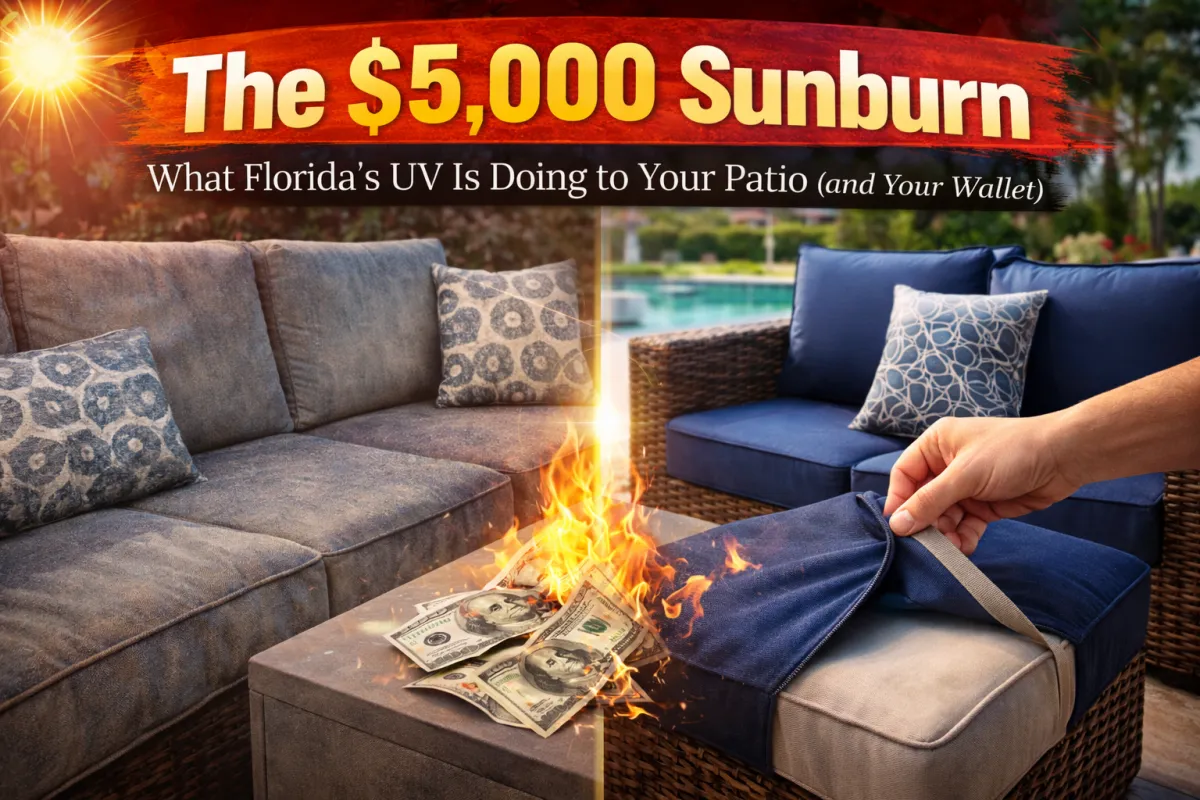
The $5,000 Sunburn: How Florida's Sun Is Quietly Draining Your Wallet
The $5,000 Sunburn: What Florida's UV Is Doing to Your Patio (and Your Wallet)
You probably noticed the cushions first.
Not a dramatic change. Nothing you'd photograph and send to a friend. Just a slow dimming — the navy blue going a little gray, the pattern losing its crispness, the fabric that was rich and deep when you bought it now looking tired. Like it aged ten years in two. You flipped the cushions. That helped for a while. Then both sides matched. Then you stopped noticing because that's what happens with gradual damage — your eyes adjust faster than the fabric fades.
This is how Florida's UV works. Not in single catastrophic events but in a daily, invisible accumulation that never announces itself. A slow bleed that never triggers an alarm because no single day looks different from the one before it. You don't see it happening. You see the result — and by then, the damage is already paid for in ways you haven't counted.
The cushions are just where it starts.
How Much Does Sun Damage Actually Cost Florida Homeowners?
South Florida homeowners typically spend between $1,000 and $2,500 per year on UV-related outdoor damage — and most of them don't realize that's what they're spending. The costs don't arrive in a single bill. They trickle in across separate purchases, spread over months, filed under "maintenance," "replacement," or "that's just Florida."
But when you add them up — really add them up — the five-year total lands somewhere between $5,000 and $10,000 for a typical unprotected outdoor living space. For homes with premium furniture, outdoor kitchens, and expensive pool decks, the number goes higher. Sometimes much higher.
A motorized retractable awning costs between $3,000 and $7,000, depending on the size and features. One purchase. One time. And. It addresses the single biggest source of ongoing damage to everything sitting on your patio.
The math isn't complicated. It's just one of those things nobody sits down to do — because once you see it, you have to act on it.
The Damage You're Already Paying For
Let's walk through the actual costs, line by line. Not theoretical. Not estimated for some other state. These are the numbers South Florida and Palm Beach Gardens homeowners face under one of the highest UV indices in the continental United States.
Outdoor Cushions and Fabrics
Even the good stuff fades here. Sunbrella, the gold standard in outdoor fabric, comes with UV-resistance ratings that assume normal exposure. South Florida isn't normal. The UV index here regularly hits 11 or 12 — classified as "extreme" by the World Health Organization — and stays there for months. Fabrics rated for five to seven years of life under moderate sun conditions often need replacement in two to three years in direct South Florida exposure.
Replacing a full set of patio cushions runs $800 to $2,000 depending on quantity and quality. If you're doing that every two to three years instead of every five to seven, you're paying double over the lifespan of your outdoor space. That's $400 to $1,000 per year in accelerated replacement cost alone — money that wouldn't need to be spent if the cushions weren't baking in direct sun six to eight hours a day.
Outdoor Furniture Frames and Surfaces
UV doesn't just attack fabric. It degrades the materials underneath. Aluminum frames oxidize and pit. Wicker — even synthetic resin wicker — becomes brittle, cracks, and loses its color. Teak that should age into a silver patina instead dries, splits, and checks under relentless direct exposure. Powder-coated finishes chalk and peel.
A decent set of outdoor dining furniture costs $2,000 to $5,000. In direct South Florida sun without shade, you'll see meaningful degradation within three to four years — chairs that wobble, tables that look chalky, wicker that snaps when you lean back wrong. Under shade, that same furniture can last seven to ten years with minimal maintenance. The difference isn't subtle. It's thousands of dollars over a decade, and it's the difference between furniture you're proud to invite people to sit on and furniture you hope they don't look at too closely.
Composite Decking and Pavers
If you have composite decking — Trex, TimberTech, Azek, or similar — it's fading right now. These materials are marketed as low-maintenance, and they are compared to natural wood. But UV exposure still causes color loss, surface chalking, and in some cases warping. Pavers fade too, especially darker colors that absorb more heat and UV radiation.
Refinishing or replacing a deck surface runs $3,000 to $8,000 or more depending on the size. That's a cost most homeowners assume is far off in the future — until they look at their five-year-old deck and realize it looks ten years old.
Outdoor Kitchen Components
Stainless steel dulls. Granite and stone surfaces lose their polish under constant UV bombardment. Built-in grill covers crack. The cabinetry you paid $15,000 for weathers faster than anything inside your house because the exposure is orders of magnitude more intense.
Nobody budgets for outdoor kitchen degradation because nobody expects it. The appliances were expensive. The installation was expensive. The assumption was that commercial-grade materials could handle anything. But in South Florida and Boca Raton, without shade, even commercial-grade loses the fight eventually — and the repair and replacement costs are substantial.
The Cost Nobody Connects to the Sun

Here's the one that surprises people most: your electric bill.
An unshaded patio sliding glass door — especially one facing south or west — acts as a solar collector. The sun hits the glass, the heat transfers through, and your home's interior temperature climbs. Your air conditioning fights it. All day, every day, from March through October. Sometimes longer.
This isn't a theory. The U.S. Department of Energy has measured it. Exterior window shading — awnings being the most common form — can reduce solar heat gain by up to 65 percent on south-facing windows and up to 77 percent on west-facing windows. The Professional Awning Manufacturers Association puts the cooling cost reduction at up to 25 percent.
In South Florida, where summer electric bills routinely run $250 to $400 per month — and some homes with large glass exposures push well past that — a 25 percent reduction translates to roughly $300 to $800 in annual savings. Over five years, that's $1,500 to $4,000 — from shade alone. Not from a new air conditioner. Not from a $500 smart thermostat. From a fabric panel that blocks the sun before it reaches your glass.
Most homeowners who complain about their energy bills have never once considered that the answer might be outside the house rather than inside it. They call the HVAC company. They upgrade the thermostat. They add insulation. They look everywhere except the unshaded glass wall that's been silently cooking their home since the day they moved in.
The Five-Year Aggregation
This is the number that changes people's minds. Not because it's scary — because it's undeniable.
Take a typical South Florida outdoor space. Nothing extravagant. A patio with decent furniture, good cushions, a grill, some landscaping, a sliding glass door connecting to the living area. Here's what five years of unshaded exposure costs:
Accelerated cushion replacement: $2,000 to $5,000 Furniture degradation and early replacement: $1,500 to $3,000 Decking or surface wear: $500 to $2,000 Excess cooling costs from unshaded windows: $1,500 to $4,000
Five-year total: $5,500 to $14,000.
A motorized retractable awning — the kind that extends with the press of a button, retracts when you want open sky, and includes wind sensors that automatically retract in high gusts — costs between $3,000 and $7,000 installed.
That means the awning pays for itself in two to four years. After that, every year of reduced replacement costs and lower energy bills is money back in your pocket. Not metaphorically. Actually.
And that calculation doesn't include the added hours of comfortable outdoor use — the mornings extended by shade, the afternoons made tolerable, the reduced temperature on every surface your family touches. The awning doesn't just protect your stuff. It gives you your patio back for the months you've been losing.
Why People Don't See It
There's a reason this math hides in plain sight, and it's not because homeowners are careless. It's because of how the costs arrive.
Nobody gets a bill that says "Annual UV Damage: $1,800." Instead, you buy new cushions one month. You spend more on electricity the next. You notice the furniture looking rough but figure that's just wear and tear. You replace the rug. You refinish the table. Each cost is small enough to absorb. Each one feels like a separate event. None of them triggers the alarm that a single $5,000 bill would.
Psychologists call this normalcy bias — the tendency to accept gradual damage as "just how things are." It's the same reason people ignore a slow roof leak until the ceiling caves in. The damage is real. The spending is real. But the pattern is invisible because no one adds it up.
Furniture fading feels like a fact of life in Florida. "Everything fades down here." You've heard it. You've probably said it. Your neighbors say it too, standing on their own sun-bleached patios, looking at their own graying cushions. It feels universal, so it feels inevitable.
It isn't. It's a choice — specifically, the choice to leave materials unshaded in a UV environment that's among the harshest in the country. Change the shade situation, and you change the outcome. The sun doesn't care about your furniture. But you can decide how much of it your furniture has to absorb.

What Shade Actually Does (And What It Doesn't)
A motorized retractable awning is not a roof. It doesn't make your patio an indoor room. And it doesn't need to.
What it does: blocks direct UV from hitting your furniture, your cushions, your decking, and your sliding glass door during the hours when the sun is most intense. On a south- or west-facing patio, that's roughly 11 a.m. to 5 p.m. — the window where the vast majority of UV damage occurs.
What that means practically: fabrics last two to three times longer. Furniture surfaces degrade at a fraction of the rate. Your cooling system gets a break. And the ambient temperature on your patio drops ten to fifteen degrees, which translates directly to more usable hours (as we covered in the last piece in this series).
Modern motorized awnings are not the striped canvas overhangs your grandparents had. Today's systems use solution-dyed acrylic fabrics rated for thousands of hours of UV exposure. They extend and retract at the press of a button — or automatically via sun and wind sensors. They're engineered for Florida's weather, including built-in wind sensors that retract the awning automatically when gusts exceed safe thresholds.
And they pair with motorized screens in ways most homeowners haven't considered. An awning overhead handles shade and rain protection. Screens on the sides handle bugs, wind, and privacy. Together, they create a controlled outdoor environment that turns a seasonal patio into a year-round room — without walls, without permits, without permanent construction. That's the combination companies like Florida Living Outdoor have been installing across South Florida for over two decades. It's not new. It's just not widely known.
The Reframe: You're Not Buying Shade. You're Stopping a Leak.
The homeowners who hesitate on awnings usually frame it as a luxury purchase. "It would be nice to have shade." "Maybe someday." "It's not a necessity."
But look at the numbers again.
You're already spending $1,000 to $2,500 per year on UV-related damage. You just don't see it as one expense because it arrives in pieces. An awning doesn't add a new cost. It stops an existing one. The money is already leaving. The only question is whether you redirect it.
This isn't a renovation. It's a repair. It's plugging a hole that's been draining your wallet and degrading your outdoor investment since the day you moved in.
Smart homeowners — the ones who think in terms of systems, not just purchases — get this instinctively. They don't ask "can I afford an awning?" They ask "can I afford not to have one?" And the answer, once you've seen the five-year numbers, is pretty clear.
What to Do With This Information
If you've read this far, you already know whether this describes your situation. You've seen the fading. You've felt the heat. You've opened the electric bill and winced.
Here's a practical starting point.
Walk your patio at 2 p.m. on a sunny day. Touch your furniture surfaces. Look at your cushion colors compared to a shaded sample — check under a flip or inside a zipper if you can. Stand inside your house near the sliding glass door and put your hand close to the glass. Feel the heat.
Now multiply that by 365 days. By five years. By ten.
That's the leak.
A motorized awning stops it. A motorized screen system adds side protection that extends the value further. Together, they form the shade-and-shield layer that most South Florida patios are missing — the layer that makes everything you've already invested in last longer, cost less, and perform the way you expected when you built the space.
If you want to understand what that looks like for your specific patio — the exposure, the sizing, the options — the team at Florida Living Outdoor has been doing this work for twenty-six years. Veteran-owned. Focused entirely on outdoor living solutions for Florida homes. A free consultation takes thirty minutes and gives you the numbers for your situation, not a hypothetical one.
No pressure. No commitment. Just the information you need to decide whether the leak is worth stopping.
This is the third piece in "The Great Florida Thaw," a ten-part series on outdoor living in South Florida. Previously: how many hours you're actually getting from your outdoor space. Next: why South Florida's mosquito season starts earlier than you think — and what that means for your evenings.