
Frequently Asked Questions
Florida Living Outdoor has the answer. Below is a list of the most commonly asked question by homeowners in
Florida Owners when trying to improve their outdoor spaces.
Don't find it here in the FAQ. Talk with FLO. Simply fill out the chat widget.
Got Questions About Motorized Screens or Pergolas
What is your phone number?
Florida Living Outdoor’s phone number is (386) 463-8494. Feel free to call anytime.
How do I schedule an appointment?
You can call the office or schedule a free 20-minute phone consultation online or schedule an appointment at the following calendar link https://floridalivingoutdoor.com/enhance-and-extend-outdoor-spaces/
Where is your office located?
Our office is located outside of Oviedo Florida, but we service the East Coast from New Smyrna Beach to Palm Coast and Central Florida from Oviedo to Mt Dora.
How do I get a quote?
You can call the office or schedule a free 20-minute phone consultation online or schedule an appointment at the following calendar link https://floridalivingoutdoor.com/enhance-and-extend-outdoor-spaces/
How long has Florida Living Outdoor been in business?
Florida Living Outdoor is owned and operated by Kip Hudakoz, who has spent 26 years in the Florida outdoor services industry. Kip is the owner-operator of Paramount Fencing and Custom Fence Orlando, where he built his reputation on custom-fabricated outdoor solutions — hand-crafted pergolas, custom fencing, and full backyard builds for homeowners across Central Florida.
He previously co-hosted The Florida Home and Garden radio show on News 96.5 "Ask the Experts," answering homeowner questions each week on outdoor design, fabrication, and installation.
In 2021, Kip launched Florida Living Outdoor — also known as FL Outdoors — as a separate brand built around one mission: delivering the ultimate backyard experience, with pergolas, motorized screens, awnings, custom fencing, and lighting all under one roof. Florida Living Outdoor was recognized by the Better Business Bureau with an A+ accreditation in 2024. What Kip enjoys most has not changed in 26 years — a new design, a new challenge, a new backyard to bring to life.
What does Florida Living Outdoor do?
FL Outdoor specializes in protecting and creating smart and usable outdoor spaces that your family can enjoy.
Do you have a showroom?
No. 99.5% of its business is done in a homeowner’s backyard. We have sample demo kits and brochures to create an understanding of the product. If you move forward, we can order a life-like rendering.
Do the screens come in different shades and colors?
The housing units come in five colors: black, white, gray, bronze, and beige. The screen mesh color varies.
What is a rendering:
A rendering is a lifelike photo of your home with the desired product applied. They look real.
Is there a place where I can see motorized screens?
Yes. I’m sure we can talk to one of our clients and see theirs.
What is in an in-home consultation?
We simply need to schedule a time and one of our estimators will come out and meet with you. They will take detailed measurements and find out your wants, needs, and desires.
Are all motorized screens the same?
No. Motorized Screens serve different functions such as bug, solar, or storm protection.
What makes MagnaTrack so special?
That is easy. MagnaTrack uses free-floating inner tracks that release and reattach with opposite pull neodymium magnets. Combined with ballistic fiber the screens can stop a 2” x 4” traveling at fast speed.
What are the five basic components of a motorized screen?
The housing unit, track, and weight bar are the same.
How important is the screen mesh?
The screen mesh can be as simple as something for bugs or maybe you need a solar screen to block damaging UV rays. They even make screen mesh with ballistic fiber that is meant for high wind load zones.
Do I have to be home for the consultation or estimate?
Yes. You need to be there. These products are highly customizable, and we need to know your wants, needs, and desires.
Can I get a price or quote over the phone?
No. These products are highly customizable, and prices may vary depending on your needs, wants, and desires.
How much does motorized screens and pergolas cost?
The MagnaTrack system is highly customizable. Every project is different, Openings vary and the sub-strip of the unit is being attached.
How big of an opening can the motorized screen fit into?
MagnaTrack motorized screens can span 30’ and up to 20’ in height.
What is your lead time on motorized screens?
Start to finish currently they are 8 – 10 weeks.
Which is better MagnaTrack or Phantom?
Well, the simple answer is MagnaTrack Motorized screens. Not because I say so, but because MagnaTrack is not a zipper track-based system. MagnaTrack Possesses free-floating inner tracks held together by rare earth neodymium magnets. Simply put, it takes 500 Lbs. of pressure to dislodge the screen from the sidetracks. The competitors are only 30 lbs. Who needs service calls?
Do you carry hurricane screens?
Yes. We carry the Defender Series by MagnaTrack.
What type of motorized screens do you carry?
Florida Living Outdoor is an authorized dealer for two motorized screen manufacturers, because no single product is the right answer for every application. For hurricane protection, we install the Defender Hurricane Screen by MagnaTrack — manufactured by Progressive Screens, a Hunter Douglas Company, in Sarasota, Florida. The Defender is Cat-5 rated, meets or exceeds Miami-Dade and Florida building code requirements for roll-down hurricane screens, and holds Florida Product Approval #F30798. We believe it is the best hurricane screen on the market. For daily shade, insect, UV, solar, and privacy applications, we install OneTrack by Fenetex. Fenetex has the upper hand in these categories, with a patented self-adjusting tension system, welded seams, and UV-stable fabrics designed for long-term exposure in Florida. We do not carry Phantom, Horizons, or Fintech motorized screens. We carry the products we believe do each job best.
Does the Hurricane Defender have a product approval code?
Yes. The Hurricane Defender has a product approval code. It has the Florida Product Approval #F30798
Are the Motorized Screens Miami Dade approved?
No. But the MagnaTrack Motorized Screen system meets or exceeds Miami Dade and Florida building code requirements for roll-down hurricane screens. Therefore, it can be installed in Miami-Dade.
Do you install screen enclosures around pools or patios
No. We do not build or install screen enclosures around swimming pools. We specialize in protecting and creating outdoor spaces with a click of a button.
Do you replace screen pool enclosures or blowout screens?
No. We do not.
Do you repair other companies' motorize screens?
Nope. We are a MagnaTrack Dealer. We do not carry Phantom, Horizons, or Fenetex. We carry the number one screen in the world. MagnaTrack.
What type of pergolas do you carry?
We carry and install Azenco-Outdoors pergolas. They are known for the louver roofs and anti-leak system aka R-blade. They also carry R-shades.
Are the Azenco-Outdoor pergolas Miami Dade approved?
Not yet, but we're working on it. Azenco is actively pursuing Miami-Dade product approval, and we're expecting it mid-2026. We'll update this page the moment it's official.
What colors do the pergolas come in?
There are three colors to select from such as black, white, and grayish bronze.
How big is each pergola zone?
A louver roof zone can go 23 feet long by 15 wide. Solid roof pergolas can cover 22 feet by 22 feet.
Got Questions About Motorized Screens or Pergolas
What is your phone number?
Florida Living Outdoor’s phone number is (386) 463-8494. Feel free to call anytime.
How do I schedule an appointment?
You can call the office or schedule a free 20-minute phone consultation online or schedule an appointment at the following calendar link https://floridalivingoutdoor.com/enhance-and-extend-outdoor-spaces/
Where is your office located?
Our office is located outside of Oviedo Florida, but we service the East Coast from New Smyrna Beach to Palm Coast and Central Florida from Oviedo to Mt Dora.
How do I get a quote?
You can call the office or schedule a free 20-minute phone consultation online or schedule an appointment at the following calendar link https://floridalivingoutdoor.com/enhance-and-extend-outdoor-spaces/
How long has Florida Living Outdoor been in business?
Florida Living Outdoor is owned and operated by Kip Hudakoz, who has spent 26 years in the Florida outdoor services industry. Kip is the owner-operator of Paramount Fencing and Custom Fence Orlando, where he built his reputation on custom-fabricated outdoor solutions — hand-crafted pergolas, custom fencing, and full backyard builds for homeowners across Central Florida.
He previously co-hosted The Florida Home and Garden radio show on News 96.5 "Ask the Experts," answering homeowner questions each week on outdoor design, fabrication, and installation.
In 2021, Kip launched Florida Living Outdoor — also known as FL Outdoors — as a separate brand built around one mission: delivering the ultimate backyard experience, with pergolas, motorized screens, awnings, custom fencing, and lighting all under one roof. Florida Living Outdoor was recognized by the Better Business Bureau with an A+ accreditation in 2024. What Kip enjoys most has not changed in 26 years — a new design, a new challenge, a new backyard to bring to life.
What does Florida Living Outdoor do?
FL Outdoor specializes in protecting and creating smart and usable outdoor spaces that your family can enjoy.
Do you have a showroom?
No. 99.5% of its business is done in a homeowner’s backyard. We have sample demo kits and brochures to create an understanding of the product. If you move forward, we can order a life-like rendering.
Do the screens come in different shades and colors?
The housing units come in five colors: black, white, gray, bronze, and beige. The screen mesh color varies.
What is a rendering:
A rendering is a lifelike photo of your home with the desired product applied. They look real.
Is there a place where I can see motorized screens?
Yes. I’m sure we can talk to one of our clients and see theirs.
What is in an in-home consultation?
We simply need to schedule a time and one of our estimators will come out and meet with you. They will take detailed measurements and find out your wants, needs, and desires.
Are all motorized screens the same?
No. Motorized Screens serve different functions such as bug, solar, or storm protection.
What makes MagnaTrack so special?
That is easy. MagnaTrack uses free-floating inner tracks that release and reattach with opposite pull neodymium magnets. Combined with ballistic fiber the screens can stop a 2” x 4” traveling at fast speed.
What are the five basic components of a motorized screen?
The housing unit, track, and weight bar are the same.
How important is the screen mesh?
The screen mesh can be as simple as something for bugs or maybe you need a solar screen to block damaging UV rays. They even make screen mesh with ballistic fiber that is meant for high wind load zones.
Do I have to be home for the consultation or estimate?
Yes. You need to be there. These products are highly customizable, and we need to know your wants, needs, and desires.
Can I get a price or quote over the phone?
No. These products are highly customizable, and prices may vary depending on your needs, wants, and desires.
How much does motorized screens and pergolas cost?
The MagnaTrack system is highly customizable. Every project is different, Openings vary and the sub-strip of the unit is being attached.
How big of an opening can the motorized screen fit into?
MagnaTrack motorized screens can span 30’ and up to 20’ in height.
What is your lead time on motorized screens?
Start to finish currently they are 8 – 10 weeks.
Which is better MagnaTrack or Phantom?
Well, the simple answer is MagnaTrack Motorized screens. Not because I say so, but because MagnaTrack is not a zipper track-based system. MagnaTrack Possesses free-floating inner tracks held together by rare earth neodymium magnets. Simply put, it takes 500 Lbs. of pressure to dislodge the screen from the sidetracks. The competitors are only 30 lbs. Who needs service calls?
Do you carry hurricane screens?
Yes. We carry the Defender Series by MagnaTrack.
What type of motorized screens do you carry?
We carry the MagnaTrack Motorized screens Manufactured by Progressive Screens. The track system is the same, but the screen is configured to protect against, bugs, UV-Ray, rain, and storms.
Does the Hurricane Defender have a product approval code?
Yes. The Hurricane Defender has a product approval code. It has the Florida Product Approval #F30798
Are the Motorized Screens Miami Dade approved?
No. But the MagnaTrack Motorized Screen system meets or exceeds Miami Dade and Florida building code requirements for roll-down hurricane screens. Therefore, it can be installed in Miami-Dade.
Do you install screen enclosures around pools or patios
No. We do not build or install screen enclosures around swimming pools. We specialize in protecting and creating outdoor spaces with a click of a button.
Do you replace screen pool enclosures or blowout screens?
No. We do not.
Do you repair other companies' motorize screens?
Nope. We are a MagnaTrack Dealer. We do not carry Phantom, Horizons, or Fenetex. We carry the number one screen in the world. MagnaTrack.
What type of pergolas do you carry?
We carry and install Azenco-Outdoors pergolas. They are known for the louver roofs and anti-leak system aka R-blade. They also carry R-shades.
Are the Azenco-Outdoor pergolas Miami Dade approved?
Not Yet, but we are working on it. It looks like June.
What colors do the pergolas come in?
There are three colors to select from such as black, white, and grayish bronze.
How big is each pergola zone?
A louver roof zone can go 23 feet long by 15 wide. Solid roof pergolas can cover 22 feet by 22 feet.
Your Vision Deserves
A Partner
Who Listens...
Your Vision Deserves
A Partner
Who Listens...
HERE ARE A FEW THINGS THAT YOU MIGHT BE INTERESTED IN
HERE ARE A FEW THINGS THAT YOU MIGHT BE INTERESTED IN
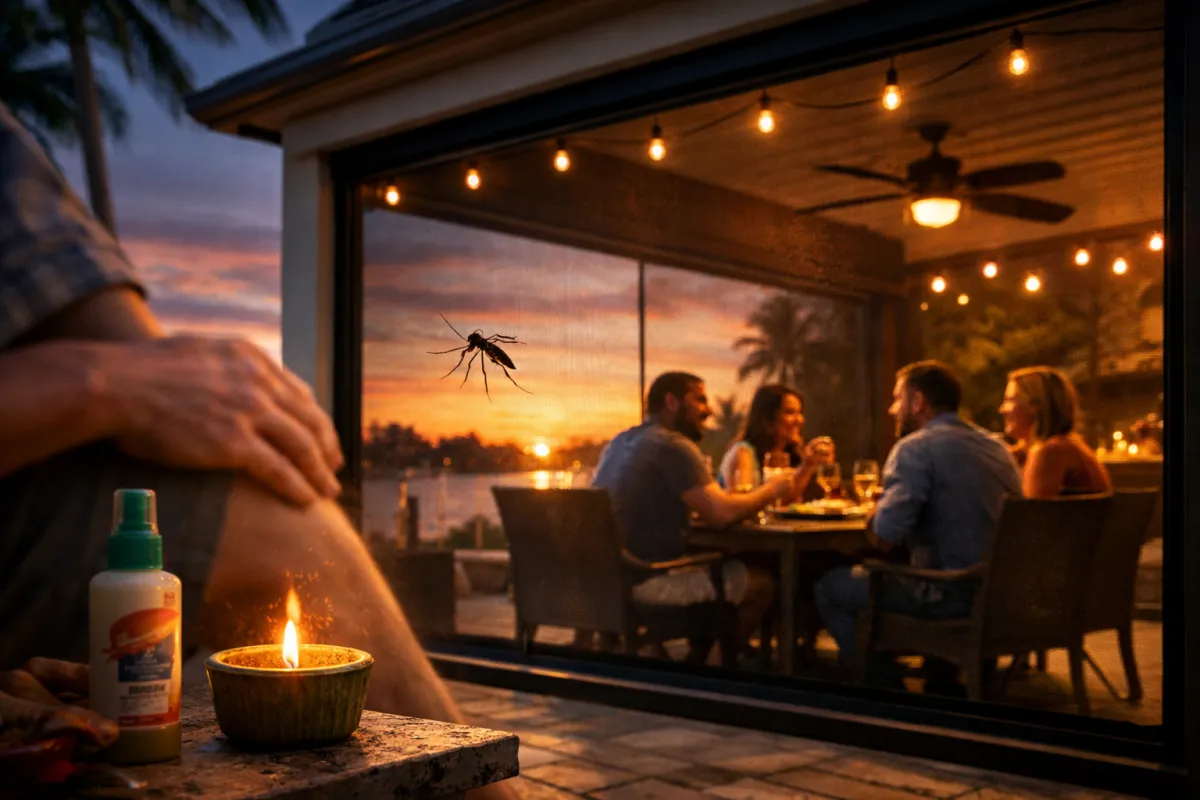
The Smallest Thief: How Mosquitoes Steal More Hours Than Hurricanes, Heat, and Rain Combined
Mosquitoes Don't Care That It's Only March: South Florida's Year-Round Reality
It was supposed to be a perfect evening.
Seventy-eight degrees. A breeze off the water. The grill was hot, the drinks were cold, and your neighbors were finally coming over for that dinner you'd been planning since January. You'd cleaned the patio furniture, hung the string lights, set the table with the good plates — the ones that feel like effort, like you meant this. You carried the food outside at 6:15. The sky was doing that thing it does in March, all soft gold and pink, and for about twenty minutes, you thought: this is it. This is why we live here.
By 6:40, someone was slapping their ankle. By 7:00, the citronella candles were lit and losing. By 7:15, everyone was standing in the kitchen holding plates they'd been eating from outside five minutes earlier, and nobody said why because nobody had to.
The mosquitoes decided dinner was over. Not you.
If you've lived in South Florida for more than one summer, you've been inside that scene. Maybe not those exact details, but the shape of it — the anticipation, the setup, the slow surrender. You know how the evening ends before it starts, and the strangest part is that you keep trying anyway, like a gambler who's lost the same bet a hundred times but still sits down at the table.
That pattern has a name. And it has a solution you probably haven't considered.
When Does Mosquito Season Actually Start in South Florida?
Here's the answer most people don't want to hear: it doesn't really stop.
South Florida's dominant mosquito species — Aedes aegypti and Aedes albopictus — are active year-round in the region's subtropical climate. There is no hard freeze to kill them. There is no dry season long enough to eliminate breeding sites. What changes is intensity, not presence.
Breeding activity picks up noticeably in late February and early March as temperatures consistently hold above 70 degrees and the first spring rains fill standing water. By April, populations are established. By May, they're aggressive. From June through October, they're at full strength — dense, persistent, and hungriest during the exact hours you want to be outside.
The peak feeding window for Aedes aegypti is late afternoon through early evening. Roughly 4 p.m. to 9 p.m. Those aren't random hours. Those are your hours. Dinner hours. After-work hours. The hours when the heat finally breaks and the light turns gold and the patio feels like the reason you moved to Florida. The mosquitoes know this. Not literally: They don't think. But their biology is tuned to the same clock you live by, and they've had millions of years to get the timing right.
You're not competing with a pest. You're competing with evolution.
The Cycle of Temporary Solutions
You've been through this. Everyone in South Florida has been through this.
First came the candles. Citronella, usually — maybe a few tiki torches for ambiance. They looked good on the table and smelled like a promise. They didn't work. Not really. The scent radius is about three feet in still air, and South Florida evenings are rarely still.
Then came the sprays. DEET, picaridin, the natural stuff with lemongrass. You sprayed yourself like you were prepping for chemical warfare, ate dinner smelling like a laboratory, and still got bitten on the one spot you missed — the back of your hand, the top of your foot, the patch of neck above your collar.
Then came the fans. Someone told you mosquitoes can't fly in wind. That's partly true — they struggle in sustained gusts above ten miles per hour. So you bought the big outdoor fan, angled it at the seating area, and turned it up. It helped a little. It also blew napkins off the table, made conversation difficult, and did nothing for anyone who stepped two feet outside the blast zone.
Then came the zappers, the traps, the essential oil diffusers, the mosquito-repellent plants that looked nice and smelled good and accomplished nothing measurable. You tried them because the internet told you to. Each one worked a little, for a while, in theory.
And each summer ended the same way. Inside by 7 p.m.
You tried candles. Inside by 7 p.m. You tried sprays. Inside by 7 p.m. You tried fans, zappers, traps, essential oils, and that plant your neighbor swore by. Inside by 7 p.m.
This isn't carelessness. This is learned helplessness. The psychological state that develops when you've tried repeatedly to solve a problem and failed enough times to stop believing a solution exists. You don't stop wanting to be outside. You stop expecting to be. And the gap between those two things is where the frustration lives, quiet and permanent, like a low hum you've tuned out but never actually stopped hearing.
Why Temporary Solutions Fail in South Florida
The short answer: you're fighting biology with chemistry, and biology always wins a war of attrition.
Repellents, chemical or natural, work by masking or altering the scent signals mosquitoes use to find you. They don't kill mosquitoes. They don't reduce the population. They don't change the breeding cycle. They put a temporary invisibility cloak on your skin, and the moment the cloak fades — through sweating, rubbing, swimming, or simple time —> you're visible again.
Traps and zappers attract and kill individual mosquitoes, but here's the math problem: a single female Aedes aegypti lays 100 to 200 eggs at a time, multiple times during her life. She can lay eggs in a bottle cap's worth of standing water — the saucer under a flowerpot, the crease in a tarp, the forgotten dog bowl by the side gate. In South Florida's climate, those eggs can hatch in as little as two days. Your zapper kills dozens. The breeding sites in your yard, your neighbor's yard, and the storm drain down the street produce thousands. The replacement rate makes individual kills meaningless — like bailing a boat with a teaspoon while the ocean pours in.
Fans disrupt flight patterns but only within their direct airflow. Step outside the zone and you're unprotected. They're like an umbrella in a hurricane — the concept is right but the scale is wrong.
And area sprays — the ones applied by pest control companies — knock populations down temporarily but require reapplication every few weeks. Mosquitoes repopulate from adjacent properties, from public waterways, from the swale along your street. The spray kills what's there. It doesn't prevent what's coming. It's like mopping a floor while the faucet runs — satisfying for an hour, pointless by tomorrow.
Every temporary solution shares the same flaw: it treats symptoms, not the structural problem. And the structural problem is simple. Your outdoor space has no barrier between you and the mosquitoes. Nothing physical. Nothing permanent. Just chemistry, airflow, and hope — none of which scale to the reality of eight months of aggressive mosquito pressure in a subtropical environment.
The Solution Nobody Considers

There's a reason most South Florida homeowners haven't thought about motorized screens as a mosquito solution. The mental category is wrong.
When people hear "screens," they picture a screen enclosure — the aluminum cage that's been the Florida default for decades. A permanent structure. Fixed walls. A closed box around the patio. That's one option, and it works for some homeowners.
But there's a category most people haven't encountered: motorized retractable screens that deploy at the press of a button and disappear when you don't need them.
These aren't the fixed mesh panels in your windows. They're engineered perimeter systems — tracks mounted to your patio structure, with screens that lower from ceiling-mounted housings to create a sealed barrier on any or all sides. When deployed, they stop mosquitoes completely. Not "reduce." Not "discourage." Stop. A physical barrier is the one thing a mosquito cannot adapt to, fly around, or outlast.
When retracted, they're virtually invisible. Your view stays open. Your patio stays unenclosed. You haven't built a cage — you've added a switch.
Down for dinner. Up for the morning. Down when the bugs come out. Up when you want the breeze. It takes about fifteen seconds and one button.
This is the shift most homeowners haven't made: from managing mosquitoes to eliminating them from the space. Not from the yard. Not from the neighborhood. From the space where you eat, sit, host, and live. The space that matters.
What Changes When the Barrier Exists
Picture the same evening from the opening. Same 78 degrees. Same breeze. Same neighbors, same grill, same drinks.
At 6:00, you press a button. The screens lower — quietly, smoothly, like blinds dropping into place. They reach the bottom track and seal. The patio is now enclosed on the sides that face the yard. The ceiling fan runs. The air moves through the mesh freely — breezes in, bugs out. You can see the palm trees, the water, the sunset. Everything looks the same. Everything feels different.
At 6:15, you carry the plates outside. At 6:40, someone mentions how nice it is. At 7:00, nobody is slapping anything. At 7:30, the conversation has moved to second drinks and someone's telling a story they wouldn't have started if they expected to be chased inside. At 8:15, the kids are still playing. At 9:00, you're considering dessert outside because why not — nobody's going anywhere. The string lights are doing their job. The breeze is moving through the mesh like it was never there. And somewhere in the back of your mind, a voice you've been ignoring for years finally goes quiet — the one that always said enjoy it while it lasts, because it won't.
It lasted. It's still lasting.
Not because the mosquitoes left. They didn't. They're still out there, doing what they do, following the same biological clock they always follow. They just can't reach you. The barrier doesn't negotiate with them. It doesn't wear off, blow away, or need reapplication. It's there when you lower it and gone when you raise it. That's it.
The evening doesn't end when the mosquitoes decide. It ends when you decide.
That reversal — from their schedule to yours — is worth more than any dollar figure can capture. But the dollars work too, if that's what matters to your decision. Families who install motorized screens consistently report that their outdoor space goes from seasonal use to year-round use. The usability audit we covered earlier in this series showed that unprotected patios deliver roughly five comfortable months. Protected patios push that to ten or eleven. When your outdoor investment doubles its usable hours because the evenings came back, the screens don't feel like an expense. They feel like the missing piece you didn't know existed.
Screens and Shade: The Combination That Changes Everything
Motorized screens handle the bugs, the wind-driven debris, and the horizontal rain. But South Florida throws more than mosquitoes at your evenings. The afternoon sun — especially on west-facing patios — turns surfaces into griddles well before the bugs arrive.
The combination that companies like Florida Living Outdoor install most often is motorized screens on the sides paired with a motorized retractable awning overhead. Screens handle the perimeter. The awning handles the sky. Together, they create an outdoor room that's shaded from above, sealed from the sides, and open whenever you want it to be.
It's not a screen enclosure. It's not a permanent structure. It's a system — engineered, motorized, controlled with a remote or your phone — that lets you decide, every single evening, what your patio looks like. Open sky and breeze? Raise everything. Bugs and sun? Lower everything. Rain rolling in? The awning covers you, the screens block the sideways spray, and you stay exactly where you are.
Florida Living Outdoor has been installing these systems across South Florida for twenty-six years. Veteran-owned. Focused entirely on outdoor living. They've seen the same frustrated homeowners, season after season, who've tried every candle and spray and trap on the market. The consultations are free, they take about thirty minutes, and they start with one question: what's keeping you from using your outdoor space the way you want to?
For most people, the answer is small, persistent, and has six legs.
The Smallest Thief Steals the Most
Here's the paradox of outdoor living in South Florida: hurricanes get the headlines, heat gets the complaints, rain gets the cancellations — but mosquitoes steal the most hours. They don't destroy anything. They don't damage anything. They simply make you leave. Night after night, month after month, year after year, the pattern repeats — not because you lack solutions, but because the solutions you've tried belong to the wrong category.
You don't need better chemistry to fight the mosquitoes. You need a barrier that makes the mosquitoes irrelevant.
Repellents are chemistry. Fans are airflow. Traps are arithmetic. None of them address the fundamental problem: there is no wall between you and a breeding population that outnumbers you by millions to one.
A motorized screen is a wall. A wall you control. A wall that appears when you need it and vanishes when you don't.
You've tried everything else. You know how those evenings end.
Now picture the one that doesn't end. The one where 7 p.m. comes and nobody moves. Where 8 p.m. comes and the kids are still outside. Where the evening belongs to you — not because the mosquitoes stopped existing, but because they stopped mattering.
That evening exists. It's one button away.
This is the fourth piece in "The Great Florida Thaw," a ten-part series on outdoor living in South Florida. Previously: what Florida's UV is doing to your patio and your wallet. Next: the energy problem nobody connects to their patio — and why your AC might be fighting the wrong battle.

HERE ARE A FEW THINGS THAT YOU MIGHT BE INTERESTED IN
HERE ARE A FEW THINGS THAT YOU MIGHT BE INTERESTED IN
The Smallest Thief: How Mosquitoes Steal More Hours Than Hurricanes, Heat, and Rain Combined
Mosquitoes Don't Care That It's Only March: South Florida's Year-Round Reality
It was supposed to be a perfect evening.
Seventy-eight degrees. A breeze off the water. The grill was hot, the drinks were cold, and your neighbors were finally coming over for that dinner you'd been planning since January. You'd cleaned the patio furniture, hung the string lights, set the table with the good plates — the ones that feel like effort, like you meant this. You carried the food outside at 6:15. The sky was doing that thing it does in March, all soft gold and pink, and for about twenty minutes, you thought: this is it. This is why we live here.
By 6:40, someone was slapping their ankle. By 7:00, the citronella candles were lit and losing. By 7:15, everyone was standing in the kitchen holding plates they'd been eating from outside five minutes earlier, and nobody said why because nobody had to.
The mosquitoes decided dinner was over. Not you.
If you've lived in South Florida for more than one summer, you've been inside that scene. Maybe not those exact details, but the shape of it — the anticipation, the setup, the slow surrender. You know how the evening ends before it starts, and the strangest part is that you keep trying anyway, like a gambler who's lost the same bet a hundred times but still sits down at the table.
That pattern has a name. And it has a solution you probably haven't considered.
When Does Mosquito Season Actually Start in South Florida?
Here's the answer most people don't want to hear: it doesn't really stop.
South Florida's dominant mosquito species — Aedes aegypti and Aedes albopictus — are active year-round in the region's subtropical climate. There is no hard freeze to kill them. There is no dry season long enough to eliminate breeding sites. What changes is intensity, not presence.
Breeding activity picks up noticeably in late February and early March as temperatures consistently hold above 70 degrees and the first spring rains fill standing water. By April, populations are established. By May, they're aggressive. From June through October, they're at full strength — dense, persistent, and hungriest during the exact hours you want to be outside.
The peak feeding window for Aedes aegypti is late afternoon through early evening. Roughly 4 p.m. to 9 p.m. Those aren't random hours. Those are your hours. Dinner hours. After-work hours. The hours when the heat finally breaks and the light turns gold and the patio feels like the reason you moved to Florida. The mosquitoes know this. Not literally: They don't think. But their biology is tuned to the same clock you live by, and they've had millions of years to get the timing right.
You're not competing with a pest. You're competing with evolution.
The Cycle of Temporary Solutions
You've been through this. Everyone in South Florida has been through this.
First came the candles. Citronella, usually — maybe a few tiki torches for ambiance. They looked good on the table and smelled like a promise. They didn't work. Not really. The scent radius is about three feet in still air, and South Florida evenings are rarely still.
Then came the sprays. DEET, picaridin, the natural stuff with lemongrass. You sprayed yourself like you were prepping for chemical warfare, ate dinner smelling like a laboratory, and still got bitten on the one spot you missed — the back of your hand, the top of your foot, the patch of neck above your collar.
Then came the fans. Someone told you mosquitoes can't fly in wind. That's partly true — they struggle in sustained gusts above ten miles per hour. So you bought the big outdoor fan, angled it at the seating area, and turned it up. It helped a little. It also blew napkins off the table, made conversation difficult, and did nothing for anyone who stepped two feet outside the blast zone.
Then came the zappers, the traps, the essential oil diffusers, the mosquito-repellent plants that looked nice and smelled good and accomplished nothing measurable. You tried them because the internet told you to. Each one worked a little, for a while, in theory.
And each summer ended the same way. Inside by 7 p.m.
You tried candles. Inside by 7 p.m. You tried sprays. Inside by 7 p.m. You tried fans, zappers, traps, essential oils, and that plant your neighbor swore by. Inside by 7 p.m.
This isn't carelessness. This is learned helplessness. The psychological state that develops when you've tried repeatedly to solve a problem and failed enough times to stop believing a solution exists. You don't stop wanting to be outside. You stop expecting to be. And the gap between those two things is where the frustration lives, quiet and permanent, like a low hum you've tuned out but never actually stopped hearing.
Why Temporary Solutions Fail in South Florida
The short answer: you're fighting biology with chemistry, and biology always wins a war of attrition.
Repellents, chemical or natural, work by masking or altering the scent signals mosquitoes use to find you. They don't kill mosquitoes. They don't reduce the population. They don't change the breeding cycle. They put a temporary invisibility cloak on your skin, and the moment the cloak fades — through sweating, rubbing, swimming, or simple time —> you're visible again.
Traps and zappers attract and kill individual mosquitoes, but here's the math problem: a single female Aedes aegypti lays 100 to 200 eggs at a time, multiple times during her life. She can lay eggs in a bottle cap's worth of standing water — the saucer under a flowerpot, the crease in a tarp, the forgotten dog bowl by the side gate. In South Florida's climate, those eggs can hatch in as little as two days. Your zapper kills dozens. The breeding sites in your yard, your neighbor's yard, and the storm drain down the street produce thousands. The replacement rate makes individual kills meaningless — like bailing a boat with a teaspoon while the ocean pours in.
Fans disrupt flight patterns but only within their direct airflow. Step outside the zone and you're unprotected. They're like an umbrella in a hurricane — the concept is right but the scale is wrong.
And area sprays — the ones applied by pest control companies — knock populations down temporarily but require reapplication every few weeks. Mosquitoes repopulate from adjacent properties, from public waterways, from the swale along your street. The spray kills what's there. It doesn't prevent what's coming. It's like mopping a floor while the faucet runs — satisfying for an hour, pointless by tomorrow.
Every temporary solution shares the same flaw: it treats symptoms, not the structural problem. And the structural problem is simple. Your outdoor space has no barrier between you and the mosquitoes. Nothing physical. Nothing permanent. Just chemistry, airflow, and hope — none of which scale to the reality of eight months of aggressive mosquito pressure in a subtropical environment.
The Solution Nobody Considers
There's a reason most South Florida homeowners haven't thought about motorized screens as a mosquito solution. The mental category is wrong.
When people hear "screens," they picture a screen enclosure — the aluminum cage that's been the Florida default for decades. A permanent structure. Fixed walls. A closed box around the patio. That's one option, and it works for some homeowners.
But there's a category most people haven't encountered: motorized retractable screens that deploy at the press of a button and disappear when you don't need them.
These aren't the fixed mesh panels in your windows. They're engineered perimeter systems — tracks mounted to your patio structure, with screens that lower from ceiling-mounted housings to create a sealed barrier on any or all sides. When deployed, they stop mosquitoes completely. Not "reduce." Not "discourage." Stop. A physical barrier is the one thing a mosquito cannot adapt to, fly around, or outlast.
When retracted, they're virtually invisible. Your view stays open. Your patio stays unenclosed. You haven't built a cage — you've added a switch.
Down for dinner. Up for the morning. Down when the bugs come out. Up when you want the breeze. It takes about fifteen seconds and one button.
This is the shift most homeowners haven't made: from managing mosquitoes to eliminating them from the space. Not from the yard. Not from the neighborhood. From the space where you eat, sit, host, and live. The space that matters.
What Changes When the Barrier Exists
Picture the same evening from the opening. Same 78 degrees. Same breeze. Same neighbors, same grill, same drinks.
At 6:00, you press a button. The screens lower — quietly, smoothly, like blinds dropping into place. They reach the bottom track and seal. The patio is now enclosed on the sides that face the yard. The ceiling fan runs. The air moves through the mesh freely — breezes in, bugs out. You can see the palm trees, the water, the sunset. Everything looks the same. Everything feels different.
At 6:15, you carry the plates outside. At 6:40, someone mentions how nice it is. At 7:00, nobody is slapping anything. At 7:30, the conversation has moved to second drinks and someone's telling a story they wouldn't have started if they expected to be chased inside. At 8:15, the kids are still playing. At 9:00, you're considering dessert outside because why not — nobody's going anywhere. The string lights are doing their job. The breeze is moving through the mesh like it was never there. And somewhere in the back of your mind, a voice you've been ignoring for years finally goes quiet — the one that always said enjoy it while it lasts, because it won't.
It lasted. It's still lasting.
Not because the mosquitoes left. They didn't. They're still out there, doing what they do, following the same biological clock they always follow. They just can't reach you. The barrier doesn't negotiate with them. It doesn't wear off, blow away, or need reapplication. It's there when you lower it and gone when you raise it. That's it.
The evening doesn't end when the mosquitoes decide. It ends when you decide.
That reversal — from their schedule to yours — is worth more than any dollar figure can capture. But the dollars work too, if that's what matters to your decision. Families who install motorized screens consistently report that their outdoor space goes from seasonal use to year-round use. The usability audit we covered earlier in this series showed that unprotected patios deliver roughly five comfortable months. Protected patios push that to ten or eleven. When your outdoor investment doubles its usable hours because the evenings came back, the screens don't feel like an expense. They feel like the missing piece you didn't know existed.
Screens and Shade: The Combination That Changes Everything
Motorized screens handle the bugs, the wind-driven debris, and the horizontal rain. But South Florida throws more than mosquitoes at your evenings. The afternoon sun — especially on west-facing patios — turns surfaces into griddles well before the bugs arrive.
The combination that companies like Florida Living Outdoor install most often is motorized screens on the sides paired with a motorized retractable awning overhead. Screens handle the perimeter. The awning handles the sky. Together, they create an outdoor room that's shaded from above, sealed from the sides, and open whenever you want it to be.
It's not a screen enclosure. It's not a permanent structure. It's a system — engineered, motorized, controlled with a remote or your phone — that lets you decide, every single evening, what your patio looks like. Open sky and breeze? Raise everything. Bugs and sun? Lower everything. Rain rolling in? The awning covers you, the screens block the sideways spray, and you stay exactly where you are.
Florida Living Outdoor has been installing these systems across South Florida for twenty-six years. Veteran-owned. Focused entirely on outdoor living. They've seen the same frustrated homeowners, season after season, who've tried every candle and spray and trap on the market. The consultations are free, they take about thirty minutes, and they start with one question: what's keeping you from using your outdoor space the way you want to?
For most people, the answer is small, persistent, and has six legs.
The Smallest Thief Steals the Most
Here's the paradox of outdoor living in South Florida: hurricanes get the headlines, heat gets the complaints, rain gets the cancellations — but mosquitoes steal the most hours. They don't destroy anything. They don't damage anything. They simply make you leave. Night after night, month after month, year after year, the pattern repeats — not because you lack solutions, but because the solutions you've tried belong to the wrong category.
You don't need better chemistry to fight the mosquitoes. You need a barrier that makes the mosquitoes irrelevant.
Repellents are chemistry. Fans are airflow. Traps are arithmetic. None of them address the fundamental problem: there is no wall between you and a breeding population that outnumbers you by millions to one.
A motorized screen is a wall. A wall you control. A wall that appears when you need it and vanishes when you don't.
You've tried everything else. You know how those evenings end.
Now picture the one that doesn't end. The one where 7 p.m. comes and nobody moves. Where 8 p.m. comes and the kids are still outside. Where the evening belongs to you — not because the mosquitoes stopped existing, but because they stopped mattering.
That evening exists. It's one button away.
This is the fourth piece in "The Great Florida Thaw," a ten-part series on outdoor living in South Florida. Previously: what Florida's UV is doing to your patio and your wallet. Next: the energy problem nobody connects to their patio — and why your AC might be fighting the wrong battle.
COMPANY
MOTORIZED SCREENS
SHADE SOLUTIONS
FENCING & LIGHTING
DESIGN IDEAS
SUPPORT



Copyright 2026. FL OUTDOOR. All Rights Reserved.
Powered and Built By