Frequently Asked Questions
Florida Living Outdoor has the answer. Below is a list of the most commonly asked question by homeowners in
Florida Owners when trying to improve their outdoor spaces.
Don't find it here in the FAQ. Talk with FLO. Simply fill out the chat widget.
Got Questions About Motorized Screens or Pergolas
What is your phone number?
Florida Living Outdoor’s phone number is (386) 463-8494. Feel free to call anytime.
How do I schedule an appointment?
You can call the office or schedule a free 20-minute phone consultation online or schedule an appointment at the following calendar link https://floridalivingoutdoor.com/enhance-and-extend-outdoor-spaces/
Where is your office located?
Our office is located outside of Oviedo Florida, but we service the East Coast from New Smyrna Beach to Palm Coast and Central Florida from Oviedo to Mt Dora.
How do I get a quote?
You can call the office or schedule a free 20-minute phone consultation online or schedule an appointment at the following calendar link https://floridalivingoutdoor.com/enhance-and-extend-outdoor-spaces/
How long has Florida Living Outdoor been in business?
Florida Living Outdoor is owned and operated by Kip Hudakoz, who has spent 26 years in the Florida outdoor services industry. Kip is the owner-operator of Paramount Fencing and Custom Fence Orlando, where he built his reputation on custom-fabricated outdoor solutions — hand-crafted pergolas, custom fencing, and full backyard builds for homeowners across Central Florida.
He previously co-hosted The Florida Home and Garden radio show on News 96.5 "Ask the Experts," answering homeowner questions each week on outdoor design, fabrication, and installation.
In 2021, Kip launched Florida Living Outdoor — also known as FL Outdoors — as a separate brand built around one mission: delivering the ultimate backyard experience, with pergolas, motorized screens, awnings, custom fencing, and lighting all under one roof. Florida Living Outdoor was recognized by the Better Business Bureau with an A+ accreditation in 2024. What Kip enjoys most has not changed in 26 years — a new design, a new challenge, a new backyard to bring to life.
What does Florida Living Outdoor do?
FL Outdoor specializes in protecting and creating smart and usable outdoor spaces that your family can enjoy.
Do you have a showroom?
No. 99.5% of its business is done in a homeowner’s backyard. We have sample demo kits and brochures to create an understanding of the product. If you move forward, we can order a life-like rendering.
Do the screens come in different shades and colors?
The housing units come in five colors: black, white, gray, bronze, and beige. The screen mesh color varies.
What is a rendering:
A rendering is a lifelike photo of your home with the desired product applied. They look real.
Is there a place where I can see motorized screens?
Yes. I’m sure we can talk to one of our clients and see theirs.
What is in an in-home consultation?
We simply need to schedule a time and one of our estimators will come out and meet with you. They will take detailed measurements and find out your wants, needs, and desires.
Are all motorized screens the same?
No. Motorized Screens serve different functions such as bug, solar, or storm protection.
What makes MagnaTrack so special?
That is easy. MagnaTrack uses free-floating inner tracks that release and reattach with opposite pull neodymium magnets. Combined with ballistic fiber the screens can stop a 2” x 4” traveling at fast speed.
What are the five basic components of a motorized screen?
The housing unit, track, and weight bar are the same.
How important is the screen mesh?
The screen mesh can be as simple as something for bugs or maybe you need a solar screen to block damaging UV rays. They even make screen mesh with ballistic fiber that is meant for high wind load zones.
Do I have to be home for the consultation or estimate?
Yes. You need to be there. These products are highly customizable, and we need to know your wants, needs, and desires.
Can I get a price or quote over the phone?
No. These products are highly customizable, and prices may vary depending on your needs, wants, and desires.
How much does motorized screens and pergolas cost?
The MagnaTrack system is highly customizable. Every project is different, Openings vary and the sub-strip of the unit is being attached.
How big of an opening can the motorized screen fit into?
MagnaTrack motorized screens can span 30’ and up to 20’ in height.
What is your lead time on motorized screens?
Start to finish currently they are 8 – 10 weeks.
Which is better MagnaTrack or Phantom?
Well, the simple answer is MagnaTrack Motorized screens. Not because I say so, but because MagnaTrack is not a zipper track-based system. MagnaTrack Possesses free-floating inner tracks held together by rare earth neodymium magnets. Simply put, it takes 500 Lbs. of pressure to dislodge the screen from the sidetracks. The competitors are only 30 lbs. Who needs service calls?
Do you carry hurricane screens?
Yes. We carry the Defender Series by MagnaTrack.
What type of motorized screens do you carry?
Florida Living Outdoor is an authorized dealer for two motorized screen manufacturers, because no single product is the right answer for every application. For hurricane protection, we install the Defender Hurricane Screen by MagnaTrack — manufactured by Progressive Screens, a Hunter Douglas Company, in Sarasota, Florida. The Defender is Cat-5 rated, meets or exceeds Miami-Dade and Florida building code requirements for roll-down hurricane screens, and holds Florida Product Approval #F30798. We believe it is the best hurricane screen on the market. For daily shade, insect, UV, solar, and privacy applications, we install OneTrack by Fenetex. Fenetex has the upper hand in these categories, with a patented self-adjusting tension system, welded seams, and UV-stable fabrics designed for long-term exposure in Florida. We do not carry Phantom, Horizons, or Fintech motorized screens. We carry the products we believe do each job best.
Does the Hurricane Defender have a product approval code?
Yes. The Hurricane Defender has a product approval code. It has the Florida Product Approval #F30798
Are the Motorized Screens Miami Dade approved?
No. But the MagnaTrack Motorized Screen system meets or exceeds Miami Dade and Florida building code requirements for roll-down hurricane screens. Therefore, it can be installed in Miami-Dade.
Do you install screen enclosures around pools or patios
No. We do not build or install screen enclosures around swimming pools. We specialize in protecting and creating outdoor spaces with a click of a button.
Do you replace screen pool enclosures or blowout screens?
No. We do not.
Do you repair other companies' motorize screens?
Nope. We are a MagnaTrack Dealer. We do not carry Phantom, Horizons, or Fenetex. We carry the number one screen in the world. MagnaTrack.
What type of pergolas do you carry?
We carry and install Azenco-Outdoors pergolas. They are known for the louver roofs and anti-leak system aka R-blade. They also carry R-shades.
Are the Azenco-Outdoor pergolas Miami Dade approved?
Not yet, but we're working on it. Azenco is actively pursuing Miami-Dade product approval, and we're expecting it mid-2026. We'll update this page the moment it's official.
What colors do the pergolas come in?
There are three colors to select from such as black, white, and grayish bronze.
How big is each pergola zone?
A louver roof zone can go 23 feet long by 15 wide. Solid roof pergolas can cover 22 feet by 22 feet.
Got Questions About Motorized Screens or Pergolas
What is your phone number?
Florida Living Outdoor’s phone number is (386) 463-8494. Feel free to call anytime.
How do I schedule an appointment?
You can call the office or schedule a free 20-minute phone consultation online or schedule an appointment at the following calendar link https://floridalivingoutdoor.com/enhance-and-extend-outdoor-spaces/
Where is your office located?
Our office is located outside of Oviedo Florida, but we service the East Coast from New Smyrna Beach to Palm Coast and Central Florida from Oviedo to Mt Dora.
How do I get a quote?
You can call the office or schedule a free 20-minute phone consultation online or schedule an appointment at the following calendar link https://floridalivingoutdoor.com/enhance-and-extend-outdoor-spaces/
How long has Florida Living Outdoor been in business?
Florida Living Outdoor is owned and operated by Kip Hudakoz, who has spent 26 years in the Florida outdoor services industry. Kip is the owner-operator of Paramount Fencing and Custom Fence Orlando, where he built his reputation on custom-fabricated outdoor solutions — hand-crafted pergolas, custom fencing, and full backyard builds for homeowners across Central Florida.
He previously co-hosted The Florida Home and Garden radio show on News 96.5 "Ask the Experts," answering homeowner questions each week on outdoor design, fabrication, and installation.
In 2021, Kip launched Florida Living Outdoor — also known as FL Outdoors — as a separate brand built around one mission: delivering the ultimate backyard experience, with pergolas, motorized screens, awnings, custom fencing, and lighting all under one roof. Florida Living Outdoor was recognized by the Better Business Bureau with an A+ accreditation in 2024. What Kip enjoys most has not changed in 26 years — a new design, a new challenge, a new backyard to bring to life.
What does Florida Living Outdoor do?
FL Outdoor specializes in protecting and creating smart and usable outdoor spaces that your family can enjoy.
Do you have a showroom?
No. 99.5% of its business is done in a homeowner’s backyard. We have sample demo kits and brochures to create an understanding of the product. If you move forward, we can order a life-like rendering.
Do the screens come in different shades and colors?
The housing units come in five colors: black, white, gray, bronze, and beige. The screen mesh color varies.
What is a rendering:
A rendering is a lifelike photo of your home with the desired product applied. They look real.
Is there a place where I can see motorized screens?
Yes. I’m sure we can talk to one of our clients and see theirs.
What is in an in-home consultation?
We simply need to schedule a time and one of our estimators will come out and meet with you. They will take detailed measurements and find out your wants, needs, and desires.
Are all motorized screens the same?
No. Motorized Screens serve different functions such as bug, solar, or storm protection.
What makes MagnaTrack so special?
That is easy. MagnaTrack uses free-floating inner tracks that release and reattach with opposite pull neodymium magnets. Combined with ballistic fiber the screens can stop a 2” x 4” traveling at fast speed.
What are the five basic components of a motorized screen?
The housing unit, track, and weight bar are the same.
How important is the screen mesh?
The screen mesh can be as simple as something for bugs or maybe you need a solar screen to block damaging UV rays. They even make screen mesh with ballistic fiber that is meant for high wind load zones.
Do I have to be home for the consultation or estimate?
Yes. You need to be there. These products are highly customizable, and we need to know your wants, needs, and desires.
Can I get a price or quote over the phone?
No. These products are highly customizable, and prices may vary depending on your needs, wants, and desires.
How much does motorized screens and pergolas cost?
The MagnaTrack system is highly customizable. Every project is different, Openings vary and the sub-strip of the unit is being attached.
How big of an opening can the motorized screen fit into?
MagnaTrack motorized screens can span 30’ and up to 20’ in height.
What is your lead time on motorized screens?
Start to finish currently they are 8 – 10 weeks.
Which is better MagnaTrack or Phantom?
Well, the simple answer is MagnaTrack Motorized screens. Not because I say so, but because MagnaTrack is not a zipper track-based system. MagnaTrack Possesses free-floating inner tracks held together by rare earth neodymium magnets. Simply put, it takes 500 Lbs. of pressure to dislodge the screen from the sidetracks. The competitors are only 30 lbs. Who needs service calls?
Do you carry hurricane screens?
Yes. We carry the Defender Series by MagnaTrack.
What type of motorized screens do you carry?
We carry the MagnaTrack Motorized screens Manufactured by Progressive Screens. The track system is the same, but the screen is configured to protect against, bugs, UV-Ray, rain, and storms.
Does the Hurricane Defender have a product approval code?
Yes. The Hurricane Defender has a product approval code. It has the Florida Product Approval #F30798
Are the Motorized Screens Miami Dade approved?
No. But the MagnaTrack Motorized Screen system meets or exceeds Miami Dade and Florida building code requirements for roll-down hurricane screens. Therefore, it can be installed in Miami-Dade.
Do you install screen enclosures around pools or patios
No. We do not build or install screen enclosures around swimming pools. We specialize in protecting and creating outdoor spaces with a click of a button.
Do you replace screen pool enclosures or blowout screens?
No. We do not.
Do you repair other companies' motorize screens?
Nope. We are a MagnaTrack Dealer. We do not carry Phantom, Horizons, or Fenetex. We carry the number one screen in the world. MagnaTrack.
What type of pergolas do you carry?
We carry and install Azenco-Outdoors pergolas. They are known for the louver roofs and anti-leak system aka R-blade. They also carry R-shades.
Are the Azenco-Outdoor pergolas Miami Dade approved?
Not Yet, but we are working on it. It looks like June.
What colors do the pergolas come in?
There are three colors to select from such as black, white, and grayish bronze.
How big is each pergola zone?
A louver roof zone can go 23 feet long by 15 wide. Solid roof pergolas can cover 22 feet by 22 feet.
Your Vision Deserves
A Partner
Who Listens...
Your Vision Deserves
A Partner
Who Listens...
HERE ARE A FEW THINGS THAT YOU MIGHT BE INTERESTED IN
HERE ARE A FEW THINGS THAT YOU MIGHT BE INTERESTED IN
Stop Reacting to Summer. Start Controlling It.
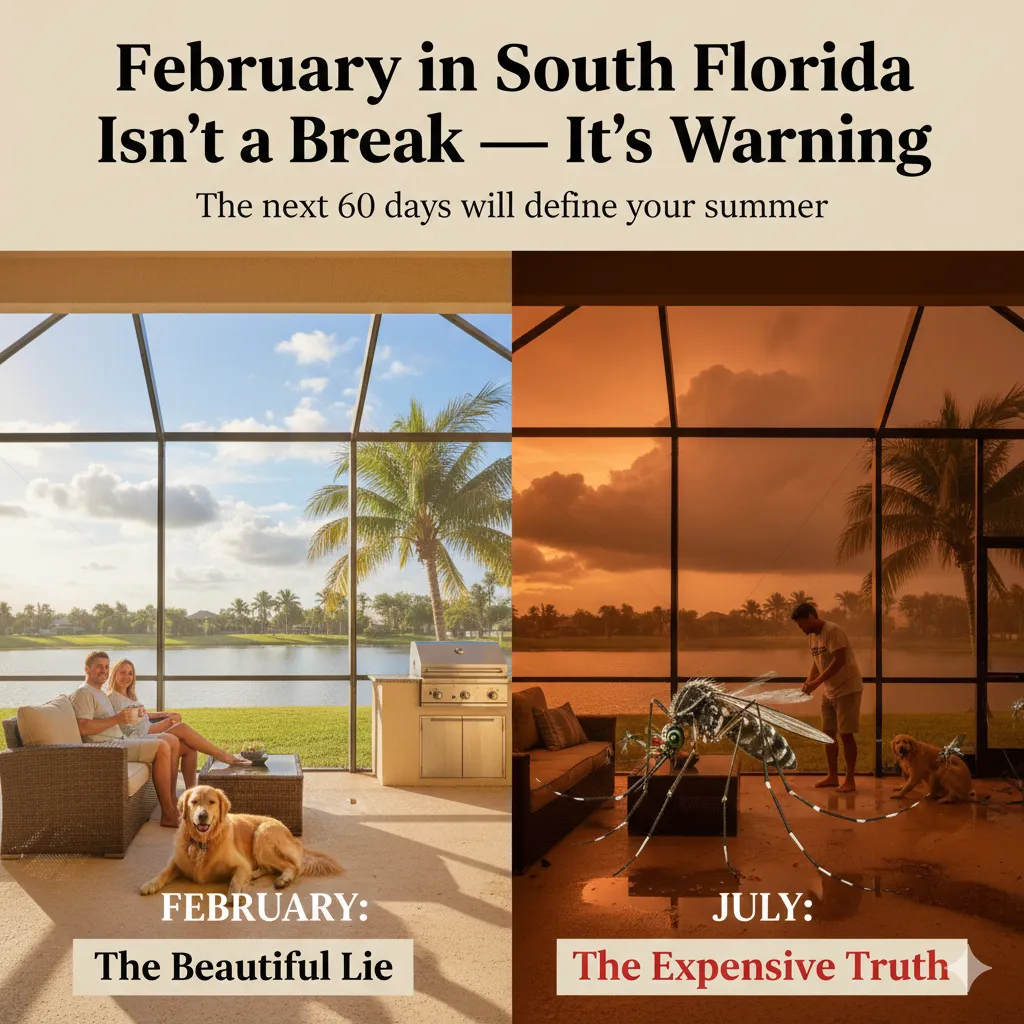
February in South Florida Isn't a Break — It's a Warning
You're standing on your patio right now and it feels perfect. Seventy-eight degrees. Low humidity. A breeze coming off the water that makes you forget what August did to you last year.
This is the lie February tells.
Not a malicious one. Just a comfortable one. The kind that lets you pour another cup of coffee, scratch the dog behind the ears, and think, I've got time. Time to figure out the shade situation. Time to deal with the mosquitoes that ruined every evening last July. Time to do something about the fact that your patio — the one you spent real money on, the one with the outdoor kitchen you used maybe eight times last year — becomes a ghost town every May and stays that way through October.
February feels like permission to wait. The weather is agreeable. The bugs are mostly absent. Your neighbors are outside. Everything looks fine.
You don't have as much time as you think. And if you're a homeowner anywhere south of Orlando, the next sixty days will determine whether this summer feels different — or exactly the same.
When Should You Actually Start Preparing?
South Florida homeowners should begin planning their outdoor space upgrades in February or early March. That sounds aggressive. It isn't.
Here's the math most people don't do. A custom motorized screen installation — from the first phone call to the last bolt — takes six to twelve weeks. That's consultation, site measurement, product selection, manufacturing, permitting (if required by your county), and installation. Retractable Awning

Systems follow a similar timeline. Some go faster. Many don't.
Now add the calendar pressure. By mid-April, reputable outdoor living contractors across South Florida are booked into June and July. This happens every single year, and every single year homeowners are surprised by it. The ones who call in May hear the same thing: We can probably get to you in August.
August. When the season you were trying to fix is already half over.
The planning fallacy is real here. People assume the gap between "deciding" and "done" is a few weeks. For custom outdoor work in a high-demand market, it's a few months. That gap is what separates the homeowners who enjoy their summer from the ones who spend it saying next year.
The Six-Month Gauntlet Nobody Warns You About
There's a reason February matters so much in South Florida, and it isn't just contractor availability. It's what's coming.
Starting in late March, temperatures climb past the comfort threshold and stay there. By May, you're looking at daily highs in the upper eighties with humidity that makes ninety feel like a hundred and five. The heat index — the number that actually describes what your body experiences — regularly exceeds a hundred degrees from June through September. Your patio concrete absorbs that heat and holds it. Touch your outdoor dining table at 2 p.m. in July. You'll pull your hand back.
But heat is only one layer. It might not even be the worst one.
Mosquito populations, which never fully disappear this far south, begin breeding aggressively as early as February. The Aedes aegypti — the species responsible for dengue and Zika transmission — is a daytime biter. It peaks during the exact hours you want to be on your patio: late afternoon into evening. By March, your golden hours are already compromised.
Then comes the rain. Florida's wet season runs roughly June through September, delivering afternoon thunderstorms with almost clockwork regularity. Not all-day rain. Twenty-to-thirty-minute downpours, often violent, followed by clearing skies and cooler air. But those twenty minutes are enough to send everyone scrambling for the sliding door, enough to end a dinner party mid-sentence, enough to soak the cushions you forgot to cover. And they happen four, five, six days a week through the peak months. After a while, you stop planning outdoor dinners altogether. Not because you decided to. Because you gave up trying.
Heat. Bugs. Rain. Wind. They don't arrive all at once. They layer in, one on top of the other, starting earlier than most people realize and lasting longer than anyone wants. By the time the full weight of summer lands — sometime in late May — the window for doing anything about it has already closed.
That's why February isn't a break. It's the last clear window before a six-to-eight-month stretch that will test every unprotected outdoor space in South Florida.
What "Preparing" Actually Looks Like
Preparing doesn't mean buying something today. It means understanding what you're dealing with and making decisions while you still have options.
Start with an honest look at your outdoor space. Walk out there at 3 p.m. on a sunny afternoon — not a February afternoon, but in your mind's eye, a June one — and stand where your guests would sit. Is there shade? Any at all? Where does the sun hit the hardest? Now imagine it's July, fifteen degrees hotter, with humidity thick enough to feel on your skin like a second shirt. Imagine the same spot at 6 p.m. with mosquitoes finding your ankles before you've finished your first drink. Imagine a storm rolling in at 4:30 while you're halfway through grilling, the wind shoving rain sideways across the patio.
If any of those scenarios ends with everyone going inside — and be honest, because almost every unprotected patio in South Florida fails at least two of those three — you have a gap.
The question is what kind of gap.
If heat and sun are the primary issue — your space is exposed, there's no overhead cover, and the afternoon sun makes surfaces too hot to touch — then shade is the first priority. Retractable awning systems are one option. They extend when you need cover and retract when you want open sky, which matters in South Florida because you don't always want shade. February mornings and December evenings are reasons to have the option of full sun. Pergolas, fixed covers, shade sails — these all have tradeoffs worth understanding. The key is that none of them install overnight, and all require some lead time for customization and site-specific design.
If bugs are the primary issue — specifically, if mosquitoes are stealing your evenings — then the conversation shifts to screening. Traditional screen enclosures have been the default in Florida for decades. They work. But they're permanent, they filter your view year-round, and they can't protect against wind-driven rain. Motorized retractable screens are a newer category. They deploy when you want protection and retract completely when you don't. Some systems carry wind ratings high enough to handle moderate storms. Some are rated for hurricane-force conditions. The right choice depends on how you use your space, what bothers you most, and what flexibility matters to you.
If it's everything — heat, bugs, rain, the general sense that your outdoor space underperforms for six months or more — then you're looking at a layered approach. Shade overhead. Protection on the sides. This combination addresses the majority of what makes South Florida patios uncomfortable during the long season. And understanding that the combination exists is itself a planning step most homeowners haven't taken.
None of this requires a signature in February. All of it requires a conversation in February.
The Real Cost of Waiting
There's a financial dimension here that goes beyond contractor scheduling, and it tends to hide in plain sight.
Your outdoor furniture is fading right now. Not dramatically — not in a way you'd notice week to week. But Florida's UV intensity is among the highest in the continental United States, and unprotected fabrics, cushions, and composite surfaces degrade measurably faster here than almost anywhere else in the country. Over a five-year cycle, the replacement cost for unshaded outdoor furnishings can run into the thousands. We'll dig into those numbers in a later piece in this series, but the point for now is simple: every month without shade is a month of accelerating depreciation on things you've already paid for.
There's an energy cost, too. An unshaded sliding glass door — especially one facing south or west — acts as a solar collector, pushing heat into your home and forcing your cooling system to compensate. The Department of Energy has documented that exterior shading can reduce solar heat gain through windows by up to sixty-five percent. That's not a small number. It translates directly to your electric bill.
And then there's the cost that doesn't show up on any invoice: the hours you don't spend outside. The dinners you move indoors. The weekends you spend looking at your patio through the glass rather than sitting on it. If you invested thirty, forty, fifty thousand dollars or more in an outdoor kitchen, a pool deck, quality furniture, landscaping — and you're only using that space comfortably four or five months a year — the per-hour return on that investment is worse than you think.
We avoid this math because it's uncomfortable. But discomfort is information. And February is when that information is still actionable.
A Month-by-Month Look at What's Coming
If you're reading this in February, here's what the next eight months look like for an unprotected South Florida patio:
March: Temperatures creep into the mid-eighties. Humidity starts climbing. Mosquito breeding accelerates. Still comfortable in the mornings and evenings, but the window is narrowing. This is the last month most contractors can start a project and finish before the heat arrives.
April: Upper eighties. Humidity is noticeable — not oppressive yet, but present, like a warning shot. Mosquitoes are established and breeding in every puddle, gutter, and plant saucer on your property. Contractor calendars begin filling for the season. If you haven't started the conversation, you're entering a queue that stretches into the summer months you're trying to fix.
May: The transition month. The one where denial breaks. Heat index starts exceeding a hundred degrees on peak afternoons. Bug pressure is serious — evenings outside without protection mean welts the next morning. Afternoon storms begin, tentatively at first, then almost daily by month's end. Unshaded patios become uncomfortable by mid-morning and stay that way until after dark. Most homeowners unconsciously begin retreating indoors. The sliding door becomes a window you look through, not a door you walk through.
June through September: Full summer. Daily highs near or above ninety. Heat index routinely over a hundred and five. Afternoon thunderstorms almost daily — you can practically set your watch by them. Mosquitoes at peak density. Unprotected outdoor spaces are functionally unusable during the hottest hours and the most pleasant evening hours alike. This is the stretch where homeowners say, every year, I should have done something sooner. Four months of saying it. Four months of not being able to do much about it, because everyone who installs outdoor systems is backlogged.
October: Some relief, but slowly. Temperatures begin declining, though humidity lingers. Hurricane season is still active. Bug pressure eases but doesn't disappear.
That's the reality. Not a scare tactic — just a calendar. And against that calendar, February looks less like "too early" and more like "just in time."
What Smart Planning Looks Like Right Now
If you're reading this and feeling the pull of I should probably do something, here's a practical framework that doesn't require you to commit to anything today.
This week: Walk your outdoor space with fresh eyes. Note where the sun hits hardest in the afternoon. Note which direction your biggest windows and doors face. Think about the last time you hosted something outside in July and how it went.
This month: Research your options. Not product specs — those come later. Just categories. Understand the difference between fixed shade and retractable shade. Understand the difference between permanent screens and retractable screens. Know what exists before you decide what fits.
By mid-March: If you think you want professional help, schedule consultations. Most reputable companies offer free assessments. The consultation itself costs nothing, and it puts you in the queue before the spring rush. Even if you decide to wait, you'll have pricing, timelines, and options in hand rather than guessing.
By April 1: Make your decision. If you want something installed before the worst of summer, this is roughly the latest comfortable starting point for custom work in South Florida. Projects initiated after this date increasingly compete with peak-season demand.
This isn't a countdown to pressure you. It's a map of how the timeline actually works — and the homeowners who've been through a few South Florida summers already know this rhythm. They've lived the scramble. They've felt the frustration of calling in June and hearing maybe September.
The ones who enjoy their summers tend to have one thing in common. They didn't wait for summer to arrive before reacting to it.
This Is the First of Ten
This piece is the opening of a ten-part series we're calling The Great Florida Thaw. Over the coming weeks, we'll walk through every dimension of what makes South Florida outdoor living challenging — and what makes it solvable. The hidden costs you're already paying. The mosquito reality nobody talks about honestly. How your patio might be heating your house. The real differences between screen enclosures and motorized systems. How to use your outdoor space through the rainy season. And how to close the gap between the patio you have and the one you pictured when you moved here.
No pressure. No hype. Just clear information that helps you decide what's right for your home and your life.
But it starts with timing. And the timing starts now.
February in South Florida is beautiful. It might be the most beautiful month we get — cool enough to sit outside at noon, warm enough to eat dinner on the patio at eight, dry enough to leave the cushions out overnight without thinking twice. Enjoy it. Soak it in. Just don't mistake it for a guarantee that you have months to spare.
You have weeks.
Use them.

HERE ARE A FEW THINGS THAT YOU MIGHT BE INTERESTED IN
HERE ARE A FEW THINGS THAT YOU MIGHT BE INTERESTED IN
Stop Reacting to Summer. Start Controlling It.
February in South Florida Isn't a Break — It's a Warning
You're standing on your patio right now and it feels perfect. Seventy-eight degrees. Low humidity. A breeze coming off the water that makes you forget what August did to you last year.
This is the lie February tells.
Not a malicious one. Just a comfortable one. The kind that lets you pour another cup of coffee, scratch the dog behind the ears, and think, I've got time. Time to figure out the shade situation. Time to deal with the mosquitoes that ruined every evening last July. Time to do something about the fact that your patio — the one you spent real money on, the one with the outdoor kitchen you used maybe eight times last year — becomes a ghost town every May and stays that way through October.
February feels like permission to wait. The weather is agreeable. The bugs are mostly absent. Your neighbors are outside. Everything looks fine.
You don't have as much time as you think. And if you're a homeowner anywhere south of Orlando, the next sixty days will determine whether this summer feels different — or exactly the same.
When Should You Actually Start Preparing?
South Florida homeowners should begin planning their outdoor space upgrades in February or early March. That sounds aggressive. It isn't.
Here's the math most people don't do. A custom motorized screen installation — from the first phone call to the last bolt — takes six to twelve weeks. That's consultation, site measurement, product selection, manufacturing, permitting (if required by your county), and installation. Retractable Awning
Systems follow a similar timeline. Some go faster. Many don't.
Now add the calendar pressure. By mid-April, reputable outdoor living contractors across South Florida are booked into June and July. This happens every single year, and every single year homeowners are surprised by it. The ones who call in May hear the same thing: We can probably get to you in August.
August. When the season you were trying to fix is already half over.
The planning fallacy is real here. People assume the gap between "deciding" and "done" is a few weeks. For custom outdoor work in a high-demand market, it's a few months. That gap is what separates the homeowners who enjoy their summer from the ones who spend it saying next year.
The Six-Month Gauntlet Nobody Warns You About
There's a reason February matters so much in South Florida, and it isn't just contractor availability. It's what's coming.
Starting in late March, temperatures climb past the comfort threshold and stay there. By May, you're looking at daily highs in the upper eighties with humidity that makes ninety feel like a hundred and five. The heat index — the number that actually describes what your body experiences — regularly exceeds a hundred degrees from June through September. Your patio concrete absorbs that heat and holds it. Touch your outdoor dining table at 2 p.m. in July. You'll pull your hand back.
But heat is only one layer. It might not even be the worst one.
Mosquito populations, which never fully disappear this far south, begin breeding aggressively as early as February. The Aedes aegypti — the species responsible for dengue and Zika transmission — is a daytime biter. It peaks during the exact hours you want to be on your patio: late afternoon into evening. By March, your golden hours are already compromised.
Then comes the rain. Florida's wet season runs roughly June through September, delivering afternoon thunderstorms with almost clockwork regularity. Not all-day rain. Twenty-to-thirty-minute downpours, often violent, followed by clearing skies and cooler air. But those twenty minutes are enough to send everyone scrambling for the sliding door, enough to end a dinner party mid-sentence, enough to soak the cushions you forgot to cover. And they happen four, five, six days a week through the peak months. After a while, you stop planning outdoor dinners altogether. Not because you decided to. Because you gave up trying.
Heat. Bugs. Rain. Wind. They don't arrive all at once. They layer in, one on top of the other, starting earlier than most people realize and lasting longer than anyone wants. By the time the full weight of summer lands — sometime in late May — the window for doing anything about it has already closed.
That's why February isn't a break. It's the last clear window before a six-to-eight-month stretch that will test every unprotected outdoor space in South Florida.
What "Preparing" Actually Looks Like
Preparing doesn't mean buying something today. It means understanding what you're dealing with and making decisions while you still have options.
Start with an honest look at your outdoor space. Walk out there at 3 p.m. on a sunny afternoon — not a February afternoon, but in your mind's eye, a June one — and stand where your guests would sit. Is there shade? Any at all? Where does the sun hit the hardest? Now imagine it's July, fifteen degrees hotter, with humidity thick enough to feel on your skin like a second shirt. Imagine the same spot at 6 p.m. with mosquitoes finding your ankles before you've finished your first drink. Imagine a storm rolling in at 4:30 while you're halfway through grilling, the wind shoving rain sideways across the patio.
If any of those scenarios ends with everyone going inside — and be honest, because almost every unprotected patio in South Florida fails at least two of those three — you have a gap.
The question is what kind of gap.
If heat and sun are the primary issue — your space is exposed, there's no overhead cover, and the afternoon sun makes surfaces too hot to touch — then shade is the first priority. Retractable awning systems are one option. They extend when you need cover and retract when you want open sky, which matters in South Florida because you don't always want shade. February mornings and December evenings are reasons to have the option of full sun. Pergolas, fixed covers, shade sails — these all have tradeoffs worth understanding. The key is that none of them install overnight, and all require some lead time for customization and site-specific design.
If bugs are the primary issue — specifically, if mosquitoes are stealing your evenings — then the conversation shifts to screening. Traditional screen enclosures have been the default in Florida for decades. They work. But they're permanent, they filter your view year-round, and they can't protect against wind-driven rain. Motorized retractable screens are a newer category. They deploy when you want protection and retract completely when you don't. Some systems carry wind ratings high enough to handle moderate storms. Some are rated for hurricane-force conditions. The right choice depends on how you use your space, what bothers you most, and what flexibility matters to you.
If it's everything — heat, bugs, rain, the general sense that your outdoor space underperforms for six months or more — then you're looking at a layered approach. Shade overhead. Protection on the sides. This combination addresses the majority of what makes South Florida patios uncomfortable during the long season. And understanding that the combination exists is itself a planning step most homeowners haven't taken.
None of this requires a signature in February. All of it requires a conversation in February.
The Real Cost of Waiting
There's a financial dimension here that goes beyond contractor scheduling, and it tends to hide in plain sight.
Your outdoor furniture is fading right now. Not dramatically — not in a way you'd notice week to week. But Florida's UV intensity is among the highest in the continental United States, and unprotected fabrics, cushions, and composite surfaces degrade measurably faster here than almost anywhere else in the country. Over a five-year cycle, the replacement cost for unshaded outdoor furnishings can run into the thousands. We'll dig into those numbers in a later piece in this series, but the point for now is simple: every month without shade is a month of accelerating depreciation on things you've already paid for.
There's an energy cost, too. An unshaded sliding glass door — especially one facing south or west — acts as a solar collector, pushing heat into your home and forcing your cooling system to compensate. The Department of Energy has documented that exterior shading can reduce solar heat gain through windows by up to sixty-five percent. That's not a small number. It translates directly to your electric bill.
And then there's the cost that doesn't show up on any invoice: the hours you don't spend outside. The dinners you move indoors. The weekends you spend looking at your patio through the glass rather than sitting on it. If you invested thirty, forty, fifty thousand dollars or more in an outdoor kitchen, a pool deck, quality furniture, landscaping — and you're only using that space comfortably four or five months a year — the per-hour return on that investment is worse than you think.
We avoid this math because it's uncomfortable. But discomfort is information. And February is when that information is still actionable.
A Month-by-Month Look at What's Coming
If you're reading this in February, here's what the next eight months look like for an unprotected South Florida patio:
March: Temperatures creep into the mid-eighties. Humidity starts climbing. Mosquito breeding accelerates. Still comfortable in the mornings and evenings, but the window is narrowing. This is the last month most contractors can start a project and finish before the heat arrives.
April: Upper eighties. Humidity is noticeable — not oppressive yet, but present, like a warning shot. Mosquitoes are established and breeding in every puddle, gutter, and plant saucer on your property. Contractor calendars begin filling for the season. If you haven't started the conversation, you're entering a queue that stretches into the summer months you're trying to fix.
May: The transition month. The one where denial breaks. Heat index starts exceeding a hundred degrees on peak afternoons. Bug pressure is serious — evenings outside without protection mean welts the next morning. Afternoon storms begin, tentatively at first, then almost daily by month's end. Unshaded patios become uncomfortable by mid-morning and stay that way until after dark. Most homeowners unconsciously begin retreating indoors. The sliding door becomes a window you look through, not a door you walk through.
June through September: Full summer. Daily highs near or above ninety. Heat index routinely over a hundred and five. Afternoon thunderstorms almost daily — you can practically set your watch by them. Mosquitoes at peak density. Unprotected outdoor spaces are functionally unusable during the hottest hours and the most pleasant evening hours alike. This is the stretch where homeowners say, every year, I should have done something sooner. Four months of saying it. Four months of not being able to do much about it, because everyone who installs outdoor systems is backlogged.
October: Some relief, but slowly. Temperatures begin declining, though humidity lingers. Hurricane season is still active. Bug pressure eases but doesn't disappear.
That's the reality. Not a scare tactic — just a calendar. And against that calendar, February looks less like "too early" and more like "just in time."
What Smart Planning Looks Like Right Now
If you're reading this and feeling the pull of I should probably do something, here's a practical framework that doesn't require you to commit to anything today.
This week: Walk your outdoor space with fresh eyes. Note where the sun hits hardest in the afternoon. Note which direction your biggest windows and doors face. Think about the last time you hosted something outside in July and how it went.
This month: Research your options. Not product specs — those come later. Just categories. Understand the difference between fixed shade and retractable shade. Understand the difference between permanent screens and retractable screens. Know what exists before you decide what fits.
By mid-March: If you think you want professional help, schedule consultations. Most reputable companies offer free assessments. The consultation itself costs nothing, and it puts you in the queue before the spring rush. Even if you decide to wait, you'll have pricing, timelines, and options in hand rather than guessing.
By April 1: Make your decision. If you want something installed before the worst of summer, this is roughly the latest comfortable starting point for custom work in South Florida. Projects initiated after this date increasingly compete with peak-season demand.
This isn't a countdown to pressure you. It's a map of how the timeline actually works — and the homeowners who've been through a few South Florida summers already know this rhythm. They've lived the scramble. They've felt the frustration of calling in June and hearing maybe September.
The ones who enjoy their summers tend to have one thing in common. They didn't wait for summer to arrive before reacting to it.
This Is the First of Ten
This piece is the opening of a ten-part series we're calling The Great Florida Thaw. Over the coming weeks, we'll walk through every dimension of what makes South Florida outdoor living challenging — and what makes it solvable. The hidden costs you're already paying. The mosquito reality nobody talks about honestly. How your patio might be heating your house. The real differences between screen enclosures and motorized systems. How to use your outdoor space through the rainy season. And how to close the gap between the patio you have and the one you pictured when you moved here.
No pressure. No hype. Just clear information that helps you decide what's right for your home and your life.
But it starts with timing. And the timing starts now.
February in South Florida is beautiful. It might be the most beautiful month we get — cool enough to sit outside at noon, warm enough to eat dinner on the patio at eight, dry enough to leave the cushions out overnight without thinking twice. Enjoy it. Soak it in. Just don't mistake it for a guarantee that you have months to spare.
You have weeks.
Use them.
COMPANY
MOTORIZED SCREENS
SHADE SOLUTIONS
FENCING & LIGHTING
DESIGN IDEAS
SUPPORT



Copyright 2026. FL OUTDOOR. All Rights Reserved.
Powered and Built By