
Florida Outdoor News
Welcome to FL Outdoor News, your go-to source for the latest trends in enhancing and extending backyard spaces in Florida!
Discover how these innovative solutions can transform your outdoor living area into a luxurious oasis. Whether you're dreaming of a stylish pergola,
the convenience of motorized screens, looking for a little shade, or the elegance of high-end custom fencing, we’ve got you covered.
HERE IS THE LATEST:
SUN PROTECTON
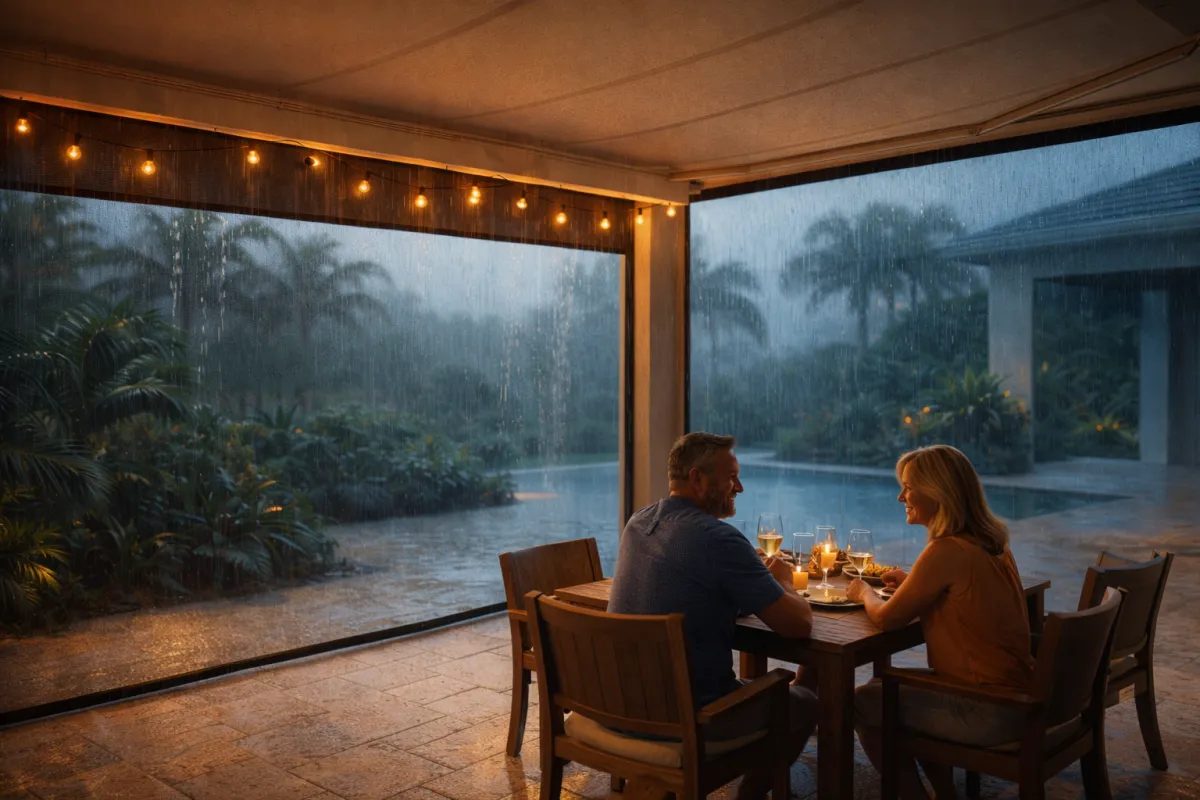
You Don't Have to Go Inside...
Rain Doesn't Mean Inside: Why South Florida Homeowners Are Done Retreating from Afternoon Storms
South Florida's afternoon rain does not have to end your time outside. Most summer storms last fifteen to thirty minutes, drop the temperature by ten to fifteen degrees, and leave behind the most comfortable outdoor conditions of the entire day. The problem isn't the rain itself. The problem is having no protection from it. With the right combination of overhead coverage and side protection — retractable awnings above, motorized screens on the sides — most homeowners can sit through a typical afternoon pop-up without moving from their chair.
That sounds like a bold claim. So let's talk about what's actually happening when it rains in South Florida, why most people react the way they do, and what changes when you stop treating every storm like an evacuation order.
The Scene That Plays Out Every Afternoon
It's a Saturday in July. You're on the patio with friends. Steaks are on the grill. Someone brought a good bottle of wine. The kids are in the pool. The afternoon has been building toward one of those South Florida evenings where everything feels exactly right.
Then the sky goes dark in the west.
You know what happens next. Everyone knows. The wind shifts. The first fat drops hit the pavers. Somebody grabs the speaker. Somebody else grabs the food. Plates, napkins, drinks — all of it rushed inside through the sliding glass door while rain hammers the empty patio you were enjoying thirty seconds ago.
The party doesn't die. But it changes. It moves indoors, where the kitchen feels too small and the living room smells like chlorine from wet swimsuits. Twenty minutes later, the rain stops. The patio steams. But nobody goes back outside because the cushions are soaked and the moment has passed.
This happens so often that most South Florida homeowners have stopped registering it as a problem. It's just how summer works. You plan around the rain. You check the radar obsessively. Every outdoor gathering carries the unspoken understanding that it might get cut short.
But what if the problem isn't the rain? What if it's the retreat?
What Florida Rain Actually Does (And How Long It Lasts)
South Florida's rainy season runs from roughly mid-May through mid-October. During those five months, the region receives about 69 percent of its annual rainfall, according to the National Weather Service. That sounds relentless. It isn't.
The rain follows a pattern so predictable you could almost set your watch by it. Morning heat builds moisture. By early to mid-afternoon, that moisture rises, condenses, and collapses into a thunderstorm. The Florida Climate Center notes that the state's frequency of summer thunderstorms rivals equatorial Africa and the Amazon basin — except Florida's storms are seasonal, concentrated, and almost always brief.
Most of these storms last about thirty minutes. Some blow through in ten. The heavy downpour portion — the part that sends everyone scrambling — typically runs fifteen to twenty minutes before tapering to a drizzle.
Here's the part that matters and that most people overlook: after the rain passes,temperatures can drop ten to fifteen degrees. The air feels lighter. The humidity breaks, at least temporarily. The sun returns at a lower angle. The insects — which had been building all afternoon — scatter.
Those twenty minutes after a summer storm? They're the best outdoor minutes of the entire day.
But most people miss them because they're inside drying off their phone and wiping down the counter where someone set a wet plate.
The Psychology of the Retreat
There's a reason most homeowners sprint for the door the moment they feel the first drop. It isn't logical. It's learned.
You've been rained on before. You remember the one time the storm lasted two hours and ruined a birthday party. You remember the time lightning struck close enough to rattle the windows. You remember the patio furniture cushions that took two days to dry and smelled like mildew for a week.
Those memories stack. They create a mental shortcut: rain equals inside. No exceptions. No distinctions between a passing shower and a tropical depression. Just one rule — grab what you can and go.
Psychologists have a name for this. The availability heuristic means you judge the likelihood of something based on how easily you can recall an example. One terrible storm at the wrong moment outweighs fifty quick showers that barely interrupted anything. Your brain remembers the disaster. It forgets the drizzle.
There's another pattern at work. All-or-nothing thinking tells you there are only two options: fully exposed to the weather, or fully inside. Wet or dry. Out or in. There's no in-between in that mental model.
Except there is.
The Middle Ground Most People Don't Know Exists
Between "totally exposed patio" and "glass-enclosed Florida room" sits a category of protection most homeowners haven't considered. Think of it as a weather buffer zone — not permanent, not sealed, not trying to turn your outdoor space into an indoor one. Just enough coverage to handle what a typical South Florida afternoon throws at you.
That buffer zone has two components.
The first is overhead protection. A retractable awning extends over your patio and blocks rain from above. Quality awning fabric is water-resistant, blocks ninety-seven percent of UV, and deploys or retracts in under a minute. It handles light to moderate rain — the vast majority of afternoon pop-ups — and retracts before anything severe arrives.
The second component is side protection. Summer storms don't just fall straight down. Wind drives rain sideways — sometimes hard.Motorized retractable screens that deploy into precision tracks on the sides of your patio block that wind-driven rain while you sit behind them, dry. When the storm passes, they retract and disappear.
Used independently, each solves part of the problem. An awning without screens leaves you exposed to sideways gusts. Screens without an awning leave you under open sky. Together, they handle roughly eighty percent of what summer throws at your patio. Not every storm. Not the ones where the sky turns green and the weather app shows a wall of red. Those, you go inside for. But the standard afternoon pop-up — the one that sends people running four times a week from May through October — that storm becomes something you sit through.
Not endure. Sit through. Drink in hand. Food on the table.
What It Actually Feels Like
This is the part that's hard to explain until you've lived it.
Rain drumming on an awning overhead sounds different when you're dry underneath. It shifts from threat to backdrop. The same rain your neighbors are fleeing, hitting the same pavement, filling the same puddles. But you're not in it. You're next to it. A screen between you and the sideways gusts. A canopy between you and the downpour. And you haven't moved.
The temperature drops. You feel it immediately — the oppressive weight of the afternoon lifts, and for the first time since eleven that morning, being outside feels comfortable instead of punishing.
Your guests notice. Someone says, "I can't believe we're still out here." Someone pours another glass. Twenty minutes later, the rain stops. The screens retract. The awning rolls back. And you're still outside, in a space that's now fifteen degrees cooler, with the evening stretching ahead.
When This Doesn't Work
Let's be honest about the limits. A retractable awning is not a roof. In sustained, heavy rain, fabric can only handle so much before water pools. Most manufacturers recommend retracting during severe storms. Same applies to high winds — if gusts are sustained above thirty to forty miles per hour, you retract and wait.
Motorized screens handle wind-driven rain well in moderate conditions, but they don't create a sealed enclosure. In a tropical downpour with fifty-mile-per-hour gusts, moisture will find its way through. These systems are designed for everyday weather, not named storms.
And lightning is lightning. If a storm includes frequent cloud-to-ground strikes in your immediate area, no patio setup changes the safety math. Go inside. Come back when it passes.
The distinction matters. It separates the eighty percent of storms that don't require retreat from the twenty percent that do. Most homeowners treat every storm like it belongs in that twenty percent. That's what costs you hundreds of outdoor hours every summer.
The Hours You're Losing
Run the numbers on actual time lost.
South Florida averages over eighty days of thunderstorm activity per year, almost all concentrated between May and October. That's five months of daily or near-daily storms. If each one costs you two hours — thirty minutes of rain plus the ninety minutes you don't return because the furniture is wet and the momentum is gone — that's over 160 hours per summer.
160 hours. Twenty full days of outdoor living, lost to storms that mostly lasted a quarter of an hour.
Not all are recoverable. Some storms hit after dark. Some come on days you weren't outside. But conservatively, a weather buffer zone recovers fifty to eighty hours per season — evenings you get back, dinners that finish outdoors, weekends freed from the radar.
If you spent twelve thousand dollars on an outdoor kitchen and you're losing twenty percent of your warm-weather hours to fifteen-minute rainstorms, you're paying for a space you can't fully use.
What This Costs (And What It Doesn't)
Retractable awnings for a standard patio typically run between three thousand and eight thousand dollars installed, depending on size, fabric quality, and whether you want manual or motorized operation. Motorized is the more common choice in South Florida because the convenience of one-button deployment matters when storms arrive fast.
Motorized screen systems for the same patio typically cost between five thousand and fifteen thousand dollars, depending on the number of openings, fabric type (weather-control mesh versus clear vinyl), and motorization. Higher-end systems with precision track technology cost more but perform significantly better in wind and rain because the screens don't flap or pull free.
Combined, you're looking at roughly eight thousand to twenty thousand dollars for both systems on an average patio. Compare that to a glass enclosure at twenty-five thousand to sixty thousand, or a full Florida room conversion at even more — and you're getting adaptable weather protection at a fraction of the permanent-structure price, without losing the open-air feel that made the patio worth having.
The Entertaining Question
Summer entertaining in South Florida carries an anxiety people in other climates don't understand. You plan the menu, clean the patio, set up the bar cart — and somewhere in the back of your mind, a voice says:What if it rains?The forecast says forty percent chance of afternoon thunderstorms. In South Florida during summer, that means there will be a storm somewhere. Whether it hits your house while your guests are mid-appetizer is a coin toss.
This anxiety shapes behavior. Some homeowners stop entertaining outdoors from June through October. Others host with a backup plan — plates inside, food that moves fast, a mental rehearsal of the scramble. A weather buffer zone doesn't eliminate severe storm risk. But it changes the threshold. Instead of retreating at the first drop, you deploy your coverage and keep going. The shift isn't about equipment. It's about permission — permission to stop treating summer weather as an enemy and start treating it as a feature of the climate you chose.
The Temperature Conversation Nobody's Having
Here's what gets overlooked: rain iscooling.
South Florida summers routinely push heat index values above 105 degrees. By mid-afternoon, pavers radiate heat, the air feels thick enough to swim through, and your outdoor space — even with shade — can feel oppressive. Many homeowners retreat inside by 2 PM regardless of rain. The heat alone drives them in.
When a storm rolls through, the downdraft from the collapsing thunderhead pushes cooler air ahead of it. The rain drops temperatures further. Post-storm, with lower temperatures and temporary humidity relief, the outdoor environment transforms. If you're protected from the rain itself, what you're experiencing during a storm is the most comfortable outdoor stretch available in a South Florida summer.
Homeowners who figure this out stop dreading the afternoon storm. They start anticipating it. Three-thirty rolls around, the sky goes gray, and instead of packing up, they settle in. The rain is coming. Good. It's about to get comfortable out here.
Making the Decision
Not everyone needs both systems. If your patio already has a solid roof and your issue is wind-driven rain from the sides, motorized screens alone may solve the problem. If your patio is open to the sky but sheltered from wind, a retractable awning alone might be enough. If you're exposed to both overhead rain and sideways gusts — which describes most open South Florida patios — both systems together give you the widest protection.
Before committing, check which direction prevailing storms come from. Ask about wind ratings on both awnings and screen systems — not all products handle the same wind loads. Ask your installer about sensor integration that allows systems to deploy or retract automatically based on weather.
If you're unsure whether the investment makes sense, track it this summer. Count how many times you go inside because of rain and how long the storm actually lasted. Most people who run that math are surprised by how much time they're surrendering to storms that lasted less than a commercial break.
Back to Saturday in July
Same afternoon. Same friends. Same steaks on the grill.
The sky goes dark. The wind shifts. Drops hit the pavers beyond the patio's edge.
This time, nobody moves. You press a button. The awning extends overhead. The screens lower into their tracks. Takes less than a minute.
Rain hammers the fabric above and runs off in a sheet, splashing pavers three feet from where you're sitting. The screens catch the gusts that would have soaked the table. Inside that bubble, it's dry. Ten degrees cooler than five minutes ago. And loud — the kind of loud where rain on fabric becomes the soundtrack instead of the alarm.
Someone says, "Should we go in?"
Nobody does.
The storm passes. The screens retract. The sun returns at a low angle, hitting wet pavers with that golden post-rain light South Florida does better than anywhere. The evening stretches ahead. Cooler. Quieter. The kind of evening you moved here for.
Rain didn't mean inside. It just meant the best part of the day was starting.
Florida Living Outdoorhas been helping South Florida homeowners reclaim their outdoor spaces for over 26 years. As a veteran-owned company, we installmotorized screen systemsandretractable awningsdesigned specifically for Florida's climate. If you'd like to understand what a weather buffer zone would look like for your patio, we're happy to walk through the options.

WEATHER CONTROL
You Don't Have to Go Inside...
Rain Doesn't Mean Inside: Why South Florida Homeowners Are Done Retreating from Afternoon Storms
South Florida's afternoon rain does not have to end your time outside. Most summer storms last fifteen to thirty minutes, drop the temperature by ten to fifteen degrees, and leave behind the most comfortable outdoor conditions of the entire day. The problem isn't the rain itself. The problem is having no protection from it. With the right combination of overhead coverage and side protection — retractable awnings above, motorized screens on the sides — most homeowners can sit through a typical afternoon pop-up without moving from their chair.
That sounds like a bold claim. So let's talk about what's actually happening when it rains in South Florida, why most people react the way they do, and what changes when you stop treating every storm like an evacuation order.
The Scene That Plays Out Every Afternoon
It's a Saturday in July. You're on the patio with friends. Steaks are on the grill. Someone brought a good bottle of wine. The kids are in the pool. The afternoon has been building toward one of those South Florida evenings where everything feels exactly right.
Then the sky goes dark in the west.
You know what happens next. Everyone knows. The wind shifts. The first fat drops hit the pavers. Somebody grabs the speaker. Somebody else grabs the food. Plates, napkins, drinks — all of it rushed inside through the sliding glass door while rain hammers the empty patio you were enjoying thirty seconds ago.
The party doesn't die. But it changes. It moves indoors, where the kitchen feels too small and the living room smells like chlorine from wet swimsuits. Twenty minutes later, the rain stops. The patio steams. But nobody goes back outside because the cushions are soaked and the moment has passed.
This happens so often that most South Florida homeowners have stopped registering it as a problem. It's just how summer works. You plan around the rain. You check the radar obsessively. Every outdoor gathering carries the unspoken understanding that it might get cut short.
But what if the problem isn't the rain? What if it's the retreat?
What Florida Rain Actually Does (And How Long It Lasts)
South Florida's rainy season runs from roughly mid-May through mid-October. During those five months, the region receives about 69 percent of its annual rainfall, according to the National Weather Service. That sounds relentless. It isn't.
The rain follows a pattern so predictable you could almost set your watch by it. Morning heat builds moisture. By early to mid-afternoon, that moisture rises, condenses, and collapses into a thunderstorm. The Florida Climate Center notes that the state's frequency of summer thunderstorms rivals equatorial Africa and the Amazon basin — except Florida's storms are seasonal, concentrated, and almost always brief.
Most of these storms last about thirty minutes. Some blow through in ten. The heavy downpour portion — the part that sends everyone scrambling — typically runs fifteen to twenty minutes before tapering to a drizzle.
Here's the part that matters and that most people overlook: after the rain passes,temperatures can drop ten to fifteen degrees. The air feels lighter. The humidity breaks, at least temporarily. The sun returns at a lower angle. The insects — which had been building all afternoon — scatter.
Those twenty minutes after a summer storm? They're the best outdoor minutes of the entire day.
But most people miss them because they're inside drying off their phone and wiping down the counter where someone set a wet plate.
The Psychology of the Retreat
There's a reason most homeowners sprint for the door the moment they feel the first drop. It isn't logical. It's learned.
You've been rained on before. You remember the one time the storm lasted two hours and ruined a birthday party. You remember the time lightning struck close enough to rattle the windows. You remember the patio furniture cushions that took two days to dry and smelled like mildew for a week.
Those memories stack. They create a mental shortcut: rain equals inside. No exceptions. No distinctions between a passing shower and a tropical depression. Just one rule — grab what you can and go.
Psychologists have a name for this. The availability heuristic means you judge the likelihood of something based on how easily you can recall an example. One terrible storm at the wrong moment outweighs fifty quick showers that barely interrupted anything. Your brain remembers the disaster. It forgets the drizzle.
There's another pattern at work. All-or-nothing thinking tells you there are only two options: fully exposed to the weather, or fully inside. Wet or dry. Out or in. There's no in-between in that mental model.
Except there is.
The Middle Ground Most People Don't Know Exists
Between "totally exposed patio" and "glass-enclosed Florida room" sits a category of protection most homeowners haven't considered. Think of it as a weather buffer zone — not permanent, not sealed, not trying to turn your outdoor space into an indoor one. Just enough coverage to handle what a typical South Florida afternoon throws at you.
That buffer zone has two components.
The first is overhead protection. A retractable awning extends over your patio and blocks rain from above. Quality awning fabric is water-resistant, blocks ninety-seven percent of UV, and deploys or retracts in under a minute. It handles light to moderate rain — the vast majority of afternoon pop-ups — and retracts before anything severe arrives.
The second component is side protection. Summer storms don't just fall straight down. Wind drives rain sideways — sometimes hard.Motorized retractable screens that deploy into precision tracks on the sides of your patio block that wind-driven rain while you sit behind them, dry. When the storm passes, they retract and disappear.
Used independently, each solves part of the problem. An awning without screens leaves you exposed to sideways gusts. Screens without an awning leave you under open sky. Together, they handle roughly eighty percent of what summer throws at your patio. Not every storm. Not the ones where the sky turns green and the weather app shows a wall of red. Those, you go inside for. But the standard afternoon pop-up — the one that sends people running four times a week from May through October — that storm becomes something you sit through.
Not endure. Sit through. Drink in hand. Food on the table.
What It Actually Feels Like
This is the part that's hard to explain until you've lived it.
Rain drumming on an awning overhead sounds different when you're dry underneath. It shifts from threat to backdrop. The same rain your neighbors are fleeing, hitting the same pavement, filling the same puddles. But you're not in it. You're next to it. A screen between you and the sideways gusts. A canopy between you and the downpour. And you haven't moved.
The temperature drops. You feel it immediately — the oppressive weight of the afternoon lifts, and for the first time since eleven that morning, being outside feels comfortable instead of punishing.
Your guests notice. Someone says, "I can't believe we're still out here." Someone pours another glass. Twenty minutes later, the rain stops. The screens retract. The awning rolls back. And you're still outside, in a space that's now fifteen degrees cooler, with the evening stretching ahead.
When This Doesn't Work
Let's be honest about the limits. A retractable awning is not a roof. In sustained, heavy rain, fabric can only handle so much before water pools. Most manufacturers recommend retracting during severe storms. Same applies to high winds — if gusts are sustained above thirty to forty miles per hour, you retract and wait.
Motorized screens handle wind-driven rain well in moderate conditions, but they don't create a sealed enclosure. In a tropical downpour with fifty-mile-per-hour gusts, moisture will find its way through. These systems are designed for everyday weather, not named storms.
And lightning is lightning. If a storm includes frequent cloud-to-ground strikes in your immediate area, no patio setup changes the safety math. Go inside. Come back when it passes.
The distinction matters. It separates the eighty percent of storms that don't require retreat from the twenty percent that do. Most homeowners treat every storm like it belongs in that twenty percent. That's what costs you hundreds of outdoor hours every summer.
The Hours You're Losing
Run the numbers on actual time lost.
South Florida averages over eighty days of thunderstorm activity per year, almost all concentrated between May and October. That's five months of daily or near-daily storms. If each one costs you two hours — thirty minutes of rain plus the ninety minutes you don't return because the furniture is wet and the momentum is gone — that's over 160 hours per summer.
160 hours. Twenty full days of outdoor living, lost to storms that mostly lasted a quarter of an hour.
Not all are recoverable. Some storms hit after dark. Some come on days you weren't outside. But conservatively, a weather buffer zone recovers fifty to eighty hours per season — evenings you get back, dinners that finish outdoors, weekends freed from the radar.
If you spent twelve thousand dollars on an outdoor kitchen and you're losing twenty percent of your warm-weather hours to fifteen-minute rainstorms, you're paying for a space you can't fully use.
What This Costs (And What It Doesn't)
Retractable awnings for a standard patio typically run between three thousand and eight thousand dollars installed, depending on size, fabric quality, and whether you want manual or motorized operation. Motorized is the more common choice in South Florida because the convenience of one-button deployment matters when storms arrive fast.
Motorized screen systems for the same patio typically cost between five thousand and fifteen thousand dollars, depending on the number of openings, fabric type (weather-control mesh versus clear vinyl), and motorization. Higher-end systems with precision track technology cost more but perform significantly better in wind and rain because the screens don't flap or pull free.
Combined, you're looking at roughly eight thousand to twenty thousand dollars for both systems on an average patio. Compare that to a glass enclosure at twenty-five thousand to sixty thousand, or a full Florida room conversion at even more — and you're getting adaptable weather protection at a fraction of the permanent-structure price, without losing the open-air feel that made the patio worth having.
The Entertaining Question
Summer entertaining in South Florida carries an anxiety people in other climates don't understand. You plan the menu, clean the patio, set up the bar cart — and somewhere in the back of your mind, a voice says:What if it rains?The forecast says forty percent chance of afternoon thunderstorms. In South Florida during summer, that means there will be a storm somewhere. Whether it hits your house while your guests are mid-appetizer is a coin toss.
This anxiety shapes behavior. Some homeowners stop entertaining outdoors from June through October. Others host with a backup plan — plates inside, food that moves fast, a mental rehearsal of the scramble. A weather buffer zone doesn't eliminate severe storm risk. But it changes the threshold. Instead of retreating at the first drop, you deploy your coverage and keep going. The shift isn't about equipment. It's about permission — permission to stop treating summer weather as an enemy and start treating it as a feature of the climate you chose.
The Temperature Conversation Nobody's Having
Here's what gets overlooked: rain iscooling.
South Florida summers routinely push heat index values above 105 degrees. By mid-afternoon, pavers radiate heat, the air feels thick enough to swim through, and your outdoor space — even with shade — can feel oppressive. Many homeowners retreat inside by 2 PM regardless of rain. The heat alone drives them in.
When a storm rolls through, the downdraft from the collapsing thunderhead pushes cooler air ahead of it. The rain drops temperatures further. Post-storm, with lower temperatures and temporary humidity relief, the outdoor environment transforms. If you're protected from the rain itself, what you're experiencing during a storm is the most comfortable outdoor stretch available in a South Florida summer.
Homeowners who figure this out stop dreading the afternoon storm. They start anticipating it. Three-thirty rolls around, the sky goes gray, and instead of packing up, they settle in. The rain is coming. Good. It's about to get comfortable out here.
Making the Decision
Not everyone needs both systems. If your patio already has a solid roof and your issue is wind-driven rain from the sides, motorized screens alone may solve the problem. If your patio is open to the sky but sheltered from wind, a retractable awning alone might be enough. If you're exposed to both overhead rain and sideways gusts — which describes most open South Florida patios — both systems together give you the widest protection.
Before committing, check which direction prevailing storms come from. Ask about wind ratings on both awnings and screen systems — not all products handle the same wind loads. Ask your installer about sensor integration that allows systems to deploy or retract automatically based on weather.
If you're unsure whether the investment makes sense, track it this summer. Count how many times you go inside because of rain and how long the storm actually lasted. Most people who run that math are surprised by how much time they're surrendering to storms that lasted less than a commercial break.
Back to Saturday in July
Same afternoon. Same friends. Same steaks on the grill.
The sky goes dark. The wind shifts. Drops hit the pavers beyond the patio's edge.
This time, nobody moves. You press a button. The awning extends overhead. The screens lower into their tracks. Takes less than a minute.
Rain hammers the fabric above and runs off in a sheet, splashing pavers three feet from where you're sitting. The screens catch the gusts that would have soaked the table. Inside that bubble, it's dry. Ten degrees cooler than five minutes ago. And loud — the kind of loud where rain on fabric becomes the soundtrack instead of the alarm.
Someone says, "Should we go in?"
Nobody does.
The storm passes. The screens retract. The sun returns at a low angle, hitting wet pavers with that golden post-rain light South Florida does better than anywhere. The evening stretches ahead. Cooler. Quieter. The kind of evening you moved here for.
Rain didn't mean inside. It just meant the best part of the day was starting.
Florida Living Outdoorhas been helping South Florida homeowners reclaim their outdoor spaces for over 26 years. As a veteran-owned company, we installmotorized screen systemsandretractable awningsdesigned specifically for Florida's climate. If you'd like to understand what a weather buffer zone would look like for your patio, we're happy to walk through the options.
HURRICANE CORNER
You Don't Have to Go Inside...
Rain Doesn't Mean Inside: Why South Florida Homeowners Are Done Retreating from Afternoon Storms
South Florida's afternoon rain does not have to end your time outside. Most summer storms last fifteen to thirty minutes, drop the temperature by ten to fifteen degrees, and leave behind the most comfortable outdoor conditions of the entire day. The problem isn't the rain itself. The problem is having no protection from it. With the right combination of overhead coverage and side protection — retractable awnings above, motorized screens on the sides — most homeowners can sit through a typical afternoon pop-up without moving from their chair.
That sounds like a bold claim. So let's talk about what's actually happening when it rains in South Florida, why most people react the way they do, and what changes when you stop treating every storm like an evacuation order.
The Scene That Plays Out Every Afternoon
It's a Saturday in July. You're on the patio with friends. Steaks are on the grill. Someone brought a good bottle of wine. The kids are in the pool. The afternoon has been building toward one of those South Florida evenings where everything feels exactly right.
Then the sky goes dark in the west.
You know what happens next. Everyone knows. The wind shifts. The first fat drops hit the pavers. Somebody grabs the speaker. Somebody else grabs the food. Plates, napkins, drinks — all of it rushed inside through the sliding glass door while rain hammers the empty patio you were enjoying thirty seconds ago.
The party doesn't die. But it changes. It moves indoors, where the kitchen feels too small and the living room smells like chlorine from wet swimsuits. Twenty minutes later, the rain stops. The patio steams. But nobody goes back outside because the cushions are soaked and the moment has passed.
This happens so often that most South Florida homeowners have stopped registering it as a problem. It's just how summer works. You plan around the rain. You check the radar obsessively. Every outdoor gathering carries the unspoken understanding that it might get cut short.
But what if the problem isn't the rain? What if it's the retreat?
What Florida Rain Actually Does (And How Long It Lasts)
South Florida's rainy season runs from roughly mid-May through mid-October. During those five months, the region receives about 69 percent of its annual rainfall, according to the National Weather Service. That sounds relentless. It isn't.
The rain follows a pattern so predictable you could almost set your watch by it. Morning heat builds moisture. By early to mid-afternoon, that moisture rises, condenses, and collapses into a thunderstorm. The Florida Climate Center notes that the state's frequency of summer thunderstorms rivals equatorial Africa and the Amazon basin — except Florida's storms are seasonal, concentrated, and almost always brief.
Most of these storms last about thirty minutes. Some blow through in ten. The heavy downpour portion — the part that sends everyone scrambling — typically runs fifteen to twenty minutes before tapering to a drizzle.
Here's the part that matters and that most people overlook: after the rain passes,temperatures can drop ten to fifteen degrees. The air feels lighter. The humidity breaks, at least temporarily. The sun returns at a lower angle. The insects — which had been building all afternoon — scatter.
Those twenty minutes after a summer storm? They're the best outdoor minutes of the entire day.
But most people miss them because they're inside drying off their phone and wiping down the counter where someone set a wet plate.
The Psychology of the Retreat
There's a reason most homeowners sprint for the door the moment they feel the first drop. It isn't logical. It's learned.
You've been rained on before. You remember the one time the storm lasted two hours and ruined a birthday party. You remember the time lightning struck close enough to rattle the windows. You remember the patio furniture cushions that took two days to dry and smelled like mildew for a week.
Those memories stack. They create a mental shortcut: rain equals inside. No exceptions. No distinctions between a passing shower and a tropical depression. Just one rule — grab what you can and go.
Psychologists have a name for this. The availability heuristic means you judge the likelihood of something based on how easily you can recall an example. One terrible storm at the wrong moment outweighs fifty quick showers that barely interrupted anything. Your brain remembers the disaster. It forgets the drizzle.
There's another pattern at work. All-or-nothing thinking tells you there are only two options: fully exposed to the weather, or fully inside. Wet or dry. Out or in. There's no in-between in that mental model.
Except there is.
The Middle Ground Most People Don't Know Exists
Between "totally exposed patio" and "glass-enclosed Florida room" sits a category of protection most homeowners haven't considered. Think of it as a weather buffer zone — not permanent, not sealed, not trying to turn your outdoor space into an indoor one. Just enough coverage to handle what a typical South Florida afternoon throws at you.
That buffer zone has two components.
The first is overhead protection. A retractable awning extends over your patio and blocks rain from above. Quality awning fabric is water-resistant, blocks ninety-seven percent of UV, and deploys or retracts in under a minute. It handles light to moderate rain — the vast majority of afternoon pop-ups — and retracts before anything severe arrives.
The second component is side protection. Summer storms don't just fall straight down. Wind drives rain sideways — sometimes hard.Motorized retractable screens that deploy into precision tracks on the sides of your patio block that wind-driven rain while you sit behind them, dry. When the storm passes, they retract and disappear.
Used independently, each solves part of the problem. An awning without screens leaves you exposed to sideways gusts. Screens without an awning leave you under open sky. Together, they handle roughly eighty percent of what summer throws at your patio. Not every storm. Not the ones where the sky turns green and the weather app shows a wall of red. Those, you go inside for. But the standard afternoon pop-up — the one that sends people running four times a week from May through October — that storm becomes something you sit through.
Not endure. Sit through. Drink in hand. Food on the table.
What It Actually Feels Like
This is the part that's hard to explain until you've lived it.
Rain drumming on an awning overhead sounds different when you're dry underneath. It shifts from threat to backdrop. The same rain your neighbors are fleeing, hitting the same pavement, filling the same puddles. But you're not in it. You're next to it. A screen between you and the sideways gusts. A canopy between you and the downpour. And you haven't moved.
The temperature drops. You feel it immediately — the oppressive weight of the afternoon lifts, and for the first time since eleven that morning, being outside feels comfortable instead of punishing.
Your guests notice. Someone says, "I can't believe we're still out here." Someone pours another glass. Twenty minutes later, the rain stops. The screens retract. The awning rolls back. And you're still outside, in a space that's now fifteen degrees cooler, with the evening stretching ahead.
When This Doesn't Work
Let's be honest about the limits. A retractable awning is not a roof. In sustained, heavy rain, fabric can only handle so much before water pools. Most manufacturers recommend retracting during severe storms. Same applies to high winds — if gusts are sustained above thirty to forty miles per hour, you retract and wait.
Motorized screens handle wind-driven rain well in moderate conditions, but they don't create a sealed enclosure. In a tropical downpour with fifty-mile-per-hour gusts, moisture will find its way through. These systems are designed for everyday weather, not named storms.
And lightning is lightning. If a storm includes frequent cloud-to-ground strikes in your immediate area, no patio setup changes the safety math. Go inside. Come back when it passes.
The distinction matters. It separates the eighty percent of storms that don't require retreat from the twenty percent that do. Most homeowners treat every storm like it belongs in that twenty percent. That's what costs you hundreds of outdoor hours every summer.
The Hours You're Losing
Run the numbers on actual time lost.
South Florida averages over eighty days of thunderstorm activity per year, almost all concentrated between May and October. That's five months of daily or near-daily storms. If each one costs you two hours — thirty minutes of rain plus the ninety minutes you don't return because the furniture is wet and the momentum is gone — that's over 160 hours per summer.
160 hours. Twenty full days of outdoor living, lost to storms that mostly lasted a quarter of an hour.
Not all are recoverable. Some storms hit after dark. Some come on days you weren't outside. But conservatively, a weather buffer zone recovers fifty to eighty hours per season — evenings you get back, dinners that finish outdoors, weekends freed from the radar.
If you spent twelve thousand dollars on an outdoor kitchen and you're losing twenty percent of your warm-weather hours to fifteen-minute rainstorms, you're paying for a space you can't fully use.
What This Costs (And What It Doesn't)
Retractable awnings for a standard patio typically run between three thousand and eight thousand dollars installed, depending on size, fabric quality, and whether you want manual or motorized operation. Motorized is the more common choice in South Florida because the convenience of one-button deployment matters when storms arrive fast.
Motorized screen systems for the same patio typically cost between five thousand and fifteen thousand dollars, depending on the number of openings, fabric type (weather-control mesh versus clear vinyl), and motorization. Higher-end systems with precision track technology cost more but perform significantly better in wind and rain because the screens don't flap or pull free.
Combined, you're looking at roughly eight thousand to twenty thousand dollars for both systems on an average patio. Compare that to a glass enclosure at twenty-five thousand to sixty thousand, or a full Florida room conversion at even more — and you're getting adaptable weather protection at a fraction of the permanent-structure price, without losing the open-air feel that made the patio worth having.
The Entertaining Question
Summer entertaining in South Florida carries an anxiety people in other climates don't understand. You plan the menu, clean the patio, set up the bar cart — and somewhere in the back of your mind, a voice says:What if it rains?The forecast says forty percent chance of afternoon thunderstorms. In South Florida during summer, that means there will be a storm somewhere. Whether it hits your house while your guests are mid-appetizer is a coin toss.
This anxiety shapes behavior. Some homeowners stop entertaining outdoors from June through October. Others host with a backup plan — plates inside, food that moves fast, a mental rehearsal of the scramble. A weather buffer zone doesn't eliminate severe storm risk. But it changes the threshold. Instead of retreating at the first drop, you deploy your coverage and keep going. The shift isn't about equipment. It's about permission — permission to stop treating summer weather as an enemy and start treating it as a feature of the climate you chose.
The Temperature Conversation Nobody's Having
Here's what gets overlooked: rain iscooling.
South Florida summers routinely push heat index values above 105 degrees. By mid-afternoon, pavers radiate heat, the air feels thick enough to swim through, and your outdoor space — even with shade — can feel oppressive. Many homeowners retreat inside by 2 PM regardless of rain. The heat alone drives them in.
When a storm rolls through, the downdraft from the collapsing thunderhead pushes cooler air ahead of it. The rain drops temperatures further. Post-storm, with lower temperatures and temporary humidity relief, the outdoor environment transforms. If you're protected from the rain itself, what you're experiencing during a storm is the most comfortable outdoor stretch available in a South Florida summer.
Homeowners who figure this out stop dreading the afternoon storm. They start anticipating it. Three-thirty rolls around, the sky goes gray, and instead of packing up, they settle in. The rain is coming. Good. It's about to get comfortable out here.
Making the Decision
Not everyone needs both systems. If your patio already has a solid roof and your issue is wind-driven rain from the sides, motorized screens alone may solve the problem. If your patio is open to the sky but sheltered from wind, a retractable awning alone might be enough. If you're exposed to both overhead rain and sideways gusts — which describes most open South Florida patios — both systems together give you the widest protection.
Before committing, check which direction prevailing storms come from. Ask about wind ratings on both awnings and screen systems — not all products handle the same wind loads. Ask your installer about sensor integration that allows systems to deploy or retract automatically based on weather.
If you're unsure whether the investment makes sense, track it this summer. Count how many times you go inside because of rain and how long the storm actually lasted. Most people who run that math are surprised by how much time they're surrendering to storms that lasted less than a commercial break.
Back to Saturday in July
Same afternoon. Same friends. Same steaks on the grill.
The sky goes dark. The wind shifts. Drops hit the pavers beyond the patio's edge.
This time, nobody moves. You press a button. The awning extends overhead. The screens lower into their tracks. Takes less than a minute.
Rain hammers the fabric above and runs off in a sheet, splashing pavers three feet from where you're sitting. The screens catch the gusts that would have soaked the table. Inside that bubble, it's dry. Ten degrees cooler than five minutes ago. And loud — the kind of loud where rain on fabric becomes the soundtrack instead of the alarm.
Someone says, "Should we go in?"
Nobody does.
The storm passes. The screens retract. The sun returns at a low angle, hitting wet pavers with that golden post-rain light South Florida does better than anywhere. The evening stretches ahead. Cooler. Quieter. The kind of evening you moved here for.
Rain didn't mean inside. It just meant the best part of the day was starting.
Florida Living Outdoorhas been helping South Florida homeowners reclaim their outdoor spaces for over 26 years. As a veteran-owned company, we installmotorized screen systemsandretractable awningsdesigned specifically for Florida's climate. If you'd like to understand what a weather buffer zone would look like for your patio, we're happy to walk through the options.
BEST OF SERIES
You Don't Have to Go Inside...
Rain Doesn't Mean Inside: Why South Florida Homeowners Are Done Retreating from Afternoon Storms
South Florida's afternoon rain does not have to end your time outside. Most summer storms last fifteen to thirty minutes, drop the temperature by ten to fifteen degrees, and leave behind the most comfortable outdoor conditions of the entire day. The problem isn't the rain itself. The problem is having no protection from it. With the right combination of overhead coverage and side protection — retractable awnings above, motorized screens on the sides — most homeowners can sit through a typical afternoon pop-up without moving from their chair.
That sounds like a bold claim. So let's talk about what's actually happening when it rains in South Florida, why most people react the way they do, and what changes when you stop treating every storm like an evacuation order.
The Scene That Plays Out Every Afternoon
It's a Saturday in July. You're on the patio with friends. Steaks are on the grill. Someone brought a good bottle of wine. The kids are in the pool. The afternoon has been building toward one of those South Florida evenings where everything feels exactly right.
Then the sky goes dark in the west.
You know what happens next. Everyone knows. The wind shifts. The first fat drops hit the pavers. Somebody grabs the speaker. Somebody else grabs the food. Plates, napkins, drinks — all of it rushed inside through the sliding glass door while rain hammers the empty patio you were enjoying thirty seconds ago.
The party doesn't die. But it changes. It moves indoors, where the kitchen feels too small and the living room smells like chlorine from wet swimsuits. Twenty minutes later, the rain stops. The patio steams. But nobody goes back outside because the cushions are soaked and the moment has passed.
This happens so often that most South Florida homeowners have stopped registering it as a problem. It's just how summer works. You plan around the rain. You check the radar obsessively. Every outdoor gathering carries the unspoken understanding that it might get cut short.
But what if the problem isn't the rain? What if it's the retreat?
What Florida Rain Actually Does (And How Long It Lasts)
South Florida's rainy season runs from roughly mid-May through mid-October. During those five months, the region receives about 69 percent of its annual rainfall, according to the National Weather Service. That sounds relentless. It isn't.
The rain follows a pattern so predictable you could almost set your watch by it. Morning heat builds moisture. By early to mid-afternoon, that moisture rises, condenses, and collapses into a thunderstorm. The Florida Climate Center notes that the state's frequency of summer thunderstorms rivals equatorial Africa and the Amazon basin — except Florida's storms are seasonal, concentrated, and almost always brief.
Most of these storms last about thirty minutes. Some blow through in ten. The heavy downpour portion — the part that sends everyone scrambling — typically runs fifteen to twenty minutes before tapering to a drizzle.
Here's the part that matters and that most people overlook: after the rain passes,temperatures can drop ten to fifteen degrees. The air feels lighter. The humidity breaks, at least temporarily. The sun returns at a lower angle. The insects — which had been building all afternoon — scatter.
Those twenty minutes after a summer storm? They're the best outdoor minutes of the entire day.
But most people miss them because they're inside drying off their phone and wiping down the counter where someone set a wet plate.
The Psychology of the Retreat
There's a reason most homeowners sprint for the door the moment they feel the first drop. It isn't logical. It's learned.
You've been rained on before. You remember the one time the storm lasted two hours and ruined a birthday party. You remember the time lightning struck close enough to rattle the windows. You remember the patio furniture cushions that took two days to dry and smelled like mildew for a week.
Those memories stack. They create a mental shortcut: rain equals inside. No exceptions. No distinctions between a passing shower and a tropical depression. Just one rule — grab what you can and go.
Psychologists have a name for this. The availability heuristic means you judge the likelihood of something based on how easily you can recall an example. One terrible storm at the wrong moment outweighs fifty quick showers that barely interrupted anything. Your brain remembers the disaster. It forgets the drizzle.
There's another pattern at work. All-or-nothing thinking tells you there are only two options: fully exposed to the weather, or fully inside. Wet or dry. Out or in. There's no in-between in that mental model.
Except there is.
The Middle Ground Most People Don't Know Exists
Between "totally exposed patio" and "glass-enclosed Florida room" sits a category of protection most homeowners haven't considered. Think of it as a weather buffer zone — not permanent, not sealed, not trying to turn your outdoor space into an indoor one. Just enough coverage to handle what a typical South Florida afternoon throws at you.
That buffer zone has two components.
The first is overhead protection. A retractable awning extends over your patio and blocks rain from above. Quality awning fabric is water-resistant, blocks ninety-seven percent of UV, and deploys or retracts in under a minute. It handles light to moderate rain — the vast majority of afternoon pop-ups — and retracts before anything severe arrives.
The second component is side protection. Summer storms don't just fall straight down. Wind drives rain sideways — sometimes hard.Motorized retractable screens that deploy into precision tracks on the sides of your patio block that wind-driven rain while you sit behind them, dry. When the storm passes, they retract and disappear.
Used independently, each solves part of the problem. An awning without screens leaves you exposed to sideways gusts. Screens without an awning leave you under open sky. Together, they handle roughly eighty percent of what summer throws at your patio. Not every storm. Not the ones where the sky turns green and the weather app shows a wall of red. Those, you go inside for. But the standard afternoon pop-up — the one that sends people running four times a week from May through October — that storm becomes something you sit through.
Not endure. Sit through. Drink in hand. Food on the table.
What It Actually Feels Like
This is the part that's hard to explain until you've lived it.
Rain drumming on an awning overhead sounds different when you're dry underneath. It shifts from threat to backdrop. The same rain your neighbors are fleeing, hitting the same pavement, filling the same puddles. But you're not in it. You're next to it. A screen between you and the sideways gusts. A canopy between you and the downpour. And you haven't moved.
The temperature drops. You feel it immediately — the oppressive weight of the afternoon lifts, and for the first time since eleven that morning, being outside feels comfortable instead of punishing.
Your guests notice. Someone says, "I can't believe we're still out here." Someone pours another glass. Twenty minutes later, the rain stops. The screens retract. The awning rolls back. And you're still outside, in a space that's now fifteen degrees cooler, with the evening stretching ahead.
When This Doesn't Work
Let's be honest about the limits. A retractable awning is not a roof. In sustained, heavy rain, fabric can only handle so much before water pools. Most manufacturers recommend retracting during severe storms. Same applies to high winds — if gusts are sustained above thirty to forty miles per hour, you retract and wait.
Motorized screens handle wind-driven rain well in moderate conditions, but they don't create a sealed enclosure. In a tropical downpour with fifty-mile-per-hour gusts, moisture will find its way through. These systems are designed for everyday weather, not named storms.
And lightning is lightning. If a storm includes frequent cloud-to-ground strikes in your immediate area, no patio setup changes the safety math. Go inside. Come back when it passes.
The distinction matters. It separates the eighty percent of storms that don't require retreat from the twenty percent that do. Most homeowners treat every storm like it belongs in that twenty percent. That's what costs you hundreds of outdoor hours every summer.
The Hours You're Losing
Run the numbers on actual time lost.
South Florida averages over eighty days of thunderstorm activity per year, almost all concentrated between May and October. That's five months of daily or near-daily storms. If each one costs you two hours — thirty minutes of rain plus the ninety minutes you don't return because the furniture is wet and the momentum is gone — that's over 160 hours per summer.
160 hours. Twenty full days of outdoor living, lost to storms that mostly lasted a quarter of an hour.
Not all are recoverable. Some storms hit after dark. Some come on days you weren't outside. But conservatively, a weather buffer zone recovers fifty to eighty hours per season — evenings you get back, dinners that finish outdoors, weekends freed from the radar.
If you spent twelve thousand dollars on an outdoor kitchen and you're losing twenty percent of your warm-weather hours to fifteen-minute rainstorms, you're paying for a space you can't fully use.
What This Costs (And What It Doesn't)
Retractable awnings for a standard patio typically run between three thousand and eight thousand dollars installed, depending on size, fabric quality, and whether you want manual or motorized operation. Motorized is the more common choice in South Florida because the convenience of one-button deployment matters when storms arrive fast.
Motorized screen systems for the same patio typically cost between five thousand and fifteen thousand dollars, depending on the number of openings, fabric type (weather-control mesh versus clear vinyl), and motorization. Higher-end systems with precision track technology cost more but perform significantly better in wind and rain because the screens don't flap or pull free.
Combined, you're looking at roughly eight thousand to twenty thousand dollars for both systems on an average patio. Compare that to a glass enclosure at twenty-five thousand to sixty thousand, or a full Florida room conversion at even more — and you're getting adaptable weather protection at a fraction of the permanent-structure price, without losing the open-air feel that made the patio worth having.
The Entertaining Question
Summer entertaining in South Florida carries an anxiety people in other climates don't understand. You plan the menu, clean the patio, set up the bar cart — and somewhere in the back of your mind, a voice says:What if it rains?The forecast says forty percent chance of afternoon thunderstorms. In South Florida during summer, that means there will be a storm somewhere. Whether it hits your house while your guests are mid-appetizer is a coin toss.
This anxiety shapes behavior. Some homeowners stop entertaining outdoors from June through October. Others host with a backup plan — plates inside, food that moves fast, a mental rehearsal of the scramble. A weather buffer zone doesn't eliminate severe storm risk. But it changes the threshold. Instead of retreating at the first drop, you deploy your coverage and keep going. The shift isn't about equipment. It's about permission — permission to stop treating summer weather as an enemy and start treating it as a feature of the climate you chose.
The Temperature Conversation Nobody's Having
Here's what gets overlooked: rain iscooling.
South Florida summers routinely push heat index values above 105 degrees. By mid-afternoon, pavers radiate heat, the air feels thick enough to swim through, and your outdoor space — even with shade — can feel oppressive. Many homeowners retreat inside by 2 PM regardless of rain. The heat alone drives them in.
When a storm rolls through, the downdraft from the collapsing thunderhead pushes cooler air ahead of it. The rain drops temperatures further. Post-storm, with lower temperatures and temporary humidity relief, the outdoor environment transforms. If you're protected from the rain itself, what you're experiencing during a storm is the most comfortable outdoor stretch available in a South Florida summer.
Homeowners who figure this out stop dreading the afternoon storm. They start anticipating it. Three-thirty rolls around, the sky goes gray, and instead of packing up, they settle in. The rain is coming. Good. It's about to get comfortable out here.
Making the Decision
Not everyone needs both systems. If your patio already has a solid roof and your issue is wind-driven rain from the sides, motorized screens alone may solve the problem. If your patio is open to the sky but sheltered from wind, a retractable awning alone might be enough. If you're exposed to both overhead rain and sideways gusts — which describes most open South Florida patios — both systems together give you the widest protection.
Before committing, check which direction prevailing storms come from. Ask about wind ratings on both awnings and screen systems — not all products handle the same wind loads. Ask your installer about sensor integration that allows systems to deploy or retract automatically based on weather.
If you're unsure whether the investment makes sense, track it this summer. Count how many times you go inside because of rain and how long the storm actually lasted. Most people who run that math are surprised by how much time they're surrendering to storms that lasted less than a commercial break.
Back to Saturday in July
Same afternoon. Same friends. Same steaks on the grill.
The sky goes dark. The wind shifts. Drops hit the pavers beyond the patio's edge.
This time, nobody moves. You press a button. The awning extends overhead. The screens lower into their tracks. Takes less than a minute.
Rain hammers the fabric above and runs off in a sheet, splashing pavers three feet from where you're sitting. The screens catch the gusts that would have soaked the table. Inside that bubble, it's dry. Ten degrees cooler than five minutes ago. And loud — the kind of loud where rain on fabric becomes the soundtrack instead of the alarm.
Someone says, "Should we go in?"
Nobody does.
The storm passes. The screens retract. The sun returns at a low angle, hitting wet pavers with that golden post-rain light South Florida does better than anywhere. The evening stretches ahead. Cooler. Quieter. The kind of evening you moved here for.
Rain didn't mean inside. It just meant the best part of the day was starting.
Florida Living Outdoorhas been helping South Florida homeowners reclaim their outdoor spaces for over 26 years. As a veteran-owned company, we installmotorized screen systemsandretractable awningsdesigned specifically for Florida's climate. If you'd like to understand what a weather buffer zone would look like for your patio, we're happy to walk through the options.
DISCUSSION & GUIDES
You Don't Have to Go Inside...
Rain Doesn't Mean Inside: Why South Florida Homeowners Are Done Retreating from Afternoon Storms
South Florida's afternoon rain does not have to end your time outside. Most summer storms last fifteen to thirty minutes, drop the temperature by ten to fifteen degrees, and leave behind the most comfortable outdoor conditions of the entire day. The problem isn't the rain itself. The problem is having no protection from it. With the right combination of overhead coverage and side protection — retractable awnings above, motorized screens on the sides — most homeowners can sit through a typical afternoon pop-up without moving from their chair.
That sounds like a bold claim. So let's talk about what's actually happening when it rains in South Florida, why most people react the way they do, and what changes when you stop treating every storm like an evacuation order.
The Scene That Plays Out Every Afternoon
It's a Saturday in July. You're on the patio with friends. Steaks are on the grill. Someone brought a good bottle of wine. The kids are in the pool. The afternoon has been building toward one of those South Florida evenings where everything feels exactly right.
Then the sky goes dark in the west.
You know what happens next. Everyone knows. The wind shifts. The first fat drops hit the pavers. Somebody grabs the speaker. Somebody else grabs the food. Plates, napkins, drinks — all of it rushed inside through the sliding glass door while rain hammers the empty patio you were enjoying thirty seconds ago.
The party doesn't die. But it changes. It moves indoors, where the kitchen feels too small and the living room smells like chlorine from wet swimsuits. Twenty minutes later, the rain stops. The patio steams. But nobody goes back outside because the cushions are soaked and the moment has passed.
This happens so often that most South Florida homeowners have stopped registering it as a problem. It's just how summer works. You plan around the rain. You check the radar obsessively. Every outdoor gathering carries the unspoken understanding that it might get cut short.
But what if the problem isn't the rain? What if it's the retreat?
What Florida Rain Actually Does (And How Long It Lasts)
South Florida's rainy season runs from roughly mid-May through mid-October. During those five months, the region receives about 69 percent of its annual rainfall, according to the National Weather Service. That sounds relentless. It isn't.
The rain follows a pattern so predictable you could almost set your watch by it. Morning heat builds moisture. By early to mid-afternoon, that moisture rises, condenses, and collapses into a thunderstorm. The Florida Climate Center notes that the state's frequency of summer thunderstorms rivals equatorial Africa and the Amazon basin — except Florida's storms are seasonal, concentrated, and almost always brief.
Most of these storms last about thirty minutes. Some blow through in ten. The heavy downpour portion — the part that sends everyone scrambling — typically runs fifteen to twenty minutes before tapering to a drizzle.
Here's the part that matters and that most people overlook: after the rain passes,temperatures can drop ten to fifteen degrees. The air feels lighter. The humidity breaks, at least temporarily. The sun returns at a lower angle. The insects — which had been building all afternoon — scatter.
Those twenty minutes after a summer storm? They're the best outdoor minutes of the entire day.
But most people miss them because they're inside drying off their phone and wiping down the counter where someone set a wet plate.
The Psychology of the Retreat
There's a reason most homeowners sprint for the door the moment they feel the first drop. It isn't logical. It's learned.
You've been rained on before. You remember the one time the storm lasted two hours and ruined a birthday party. You remember the time lightning struck close enough to rattle the windows. You remember the patio furniture cushions that took two days to dry and smelled like mildew for a week.
Those memories stack. They create a mental shortcut: rain equals inside. No exceptions. No distinctions between a passing shower and a tropical depression. Just one rule — grab what you can and go.
Psychologists have a name for this. The availability heuristic means you judge the likelihood of something based on how easily you can recall an example. One terrible storm at the wrong moment outweighs fifty quick showers that barely interrupted anything. Your brain remembers the disaster. It forgets the drizzle.
There's another pattern at work. All-or-nothing thinking tells you there are only two options: fully exposed to the weather, or fully inside. Wet or dry. Out or in. There's no in-between in that mental model.
Except there is.
The Middle Ground Most People Don't Know Exists
Between "totally exposed patio" and "glass-enclosed Florida room" sits a category of protection most homeowners haven't considered. Think of it as a weather buffer zone — not permanent, not sealed, not trying to turn your outdoor space into an indoor one. Just enough coverage to handle what a typical South Florida afternoon throws at you.
That buffer zone has two components.
The first is overhead protection. A retractable awning extends over your patio and blocks rain from above. Quality awning fabric is water-resistant, blocks ninety-seven percent of UV, and deploys or retracts in under a minute. It handles light to moderate rain — the vast majority of afternoon pop-ups — and retracts before anything severe arrives.
The second component is side protection. Summer storms don't just fall straight down. Wind drives rain sideways — sometimes hard.Motorized retractable screens that deploy into precision tracks on the sides of your patio block that wind-driven rain while you sit behind them, dry. When the storm passes, they retract and disappear.
Used independently, each solves part of the problem. An awning without screens leaves you exposed to sideways gusts. Screens without an awning leave you under open sky. Together, they handle roughly eighty percent of what summer throws at your patio. Not every storm. Not the ones where the sky turns green and the weather app shows a wall of red. Those, you go inside for. But the standard afternoon pop-up — the one that sends people running four times a week from May through October — that storm becomes something you sit through.
Not endure. Sit through. Drink in hand. Food on the table.
What It Actually Feels Like
This is the part that's hard to explain until you've lived it.
Rain drumming on an awning overhead sounds different when you're dry underneath. It shifts from threat to backdrop. The same rain your neighbors are fleeing, hitting the same pavement, filling the same puddles. But you're not in it. You're next to it. A screen between you and the sideways gusts. A canopy between you and the downpour. And you haven't moved.
The temperature drops. You feel it immediately — the oppressive weight of the afternoon lifts, and for the first time since eleven that morning, being outside feels comfortable instead of punishing.
Your guests notice. Someone says, "I can't believe we're still out here." Someone pours another glass. Twenty minutes later, the rain stops. The screens retract. The awning rolls back. And you're still outside, in a space that's now fifteen degrees cooler, with the evening stretching ahead.
When This Doesn't Work
Let's be honest about the limits. A retractable awning is not a roof. In sustained, heavy rain, fabric can only handle so much before water pools. Most manufacturers recommend retracting during severe storms. Same applies to high winds — if gusts are sustained above thirty to forty miles per hour, you retract and wait.
Motorized screens handle wind-driven rain well in moderate conditions, but they don't create a sealed enclosure. In a tropical downpour with fifty-mile-per-hour gusts, moisture will find its way through. These systems are designed for everyday weather, not named storms.
And lightning is lightning. If a storm includes frequent cloud-to-ground strikes in your immediate area, no patio setup changes the safety math. Go inside. Come back when it passes.
The distinction matters. It separates the eighty percent of storms that don't require retreat from the twenty percent that do. Most homeowners treat every storm like it belongs in that twenty percent. That's what costs you hundreds of outdoor hours every summer.
The Hours You're Losing
Run the numbers on actual time lost.
South Florida averages over eighty days of thunderstorm activity per year, almost all concentrated between May and October. That's five months of daily or near-daily storms. If each one costs you two hours — thirty minutes of rain plus the ninety minutes you don't return because the furniture is wet and the momentum is gone — that's over 160 hours per summer.
160 hours. Twenty full days of outdoor living, lost to storms that mostly lasted a quarter of an hour.
Not all are recoverable. Some storms hit after dark. Some come on days you weren't outside. But conservatively, a weather buffer zone recovers fifty to eighty hours per season — evenings you get back, dinners that finish outdoors, weekends freed from the radar.
If you spent twelve thousand dollars on an outdoor kitchen and you're losing twenty percent of your warm-weather hours to fifteen-minute rainstorms, you're paying for a space you can't fully use.
What This Costs (And What It Doesn't)
Retractable awnings for a standard patio typically run between three thousand and eight thousand dollars installed, depending on size, fabric quality, and whether you want manual or motorized operation. Motorized is the more common choice in South Florida because the convenience of one-button deployment matters when storms arrive fast.
Motorized screen systems for the same patio typically cost between five thousand and fifteen thousand dollars, depending on the number of openings, fabric type (weather-control mesh versus clear vinyl), and motorization. Higher-end systems with precision track technology cost more but perform significantly better in wind and rain because the screens don't flap or pull free.
Combined, you're looking at roughly eight thousand to twenty thousand dollars for both systems on an average patio. Compare that to a glass enclosure at twenty-five thousand to sixty thousand, or a full Florida room conversion at even more — and you're getting adaptable weather protection at a fraction of the permanent-structure price, without losing the open-air feel that made the patio worth having.
The Entertaining Question
Summer entertaining in South Florida carries an anxiety people in other climates don't understand. You plan the menu, clean the patio, set up the bar cart — and somewhere in the back of your mind, a voice says:What if it rains?The forecast says forty percent chance of afternoon thunderstorms. In South Florida during summer, that means there will be a storm somewhere. Whether it hits your house while your guests are mid-appetizer is a coin toss.
This anxiety shapes behavior. Some homeowners stop entertaining outdoors from June through October. Others host with a backup plan — plates inside, food that moves fast, a mental rehearsal of the scramble. A weather buffer zone doesn't eliminate severe storm risk. But it changes the threshold. Instead of retreating at the first drop, you deploy your coverage and keep going. The shift isn't about equipment. It's about permission — permission to stop treating summer weather as an enemy and start treating it as a feature of the climate you chose.
The Temperature Conversation Nobody's Having
Here's what gets overlooked: rain iscooling.
South Florida summers routinely push heat index values above 105 degrees. By mid-afternoon, pavers radiate heat, the air feels thick enough to swim through, and your outdoor space — even with shade — can feel oppressive. Many homeowners retreat inside by 2 PM regardless of rain. The heat alone drives them in.
When a storm rolls through, the downdraft from the collapsing thunderhead pushes cooler air ahead of it. The rain drops temperatures further. Post-storm, with lower temperatures and temporary humidity relief, the outdoor environment transforms. If you're protected from the rain itself, what you're experiencing during a storm is the most comfortable outdoor stretch available in a South Florida summer.
Homeowners who figure this out stop dreading the afternoon storm. They start anticipating it. Three-thirty rolls around, the sky goes gray, and instead of packing up, they settle in. The rain is coming. Good. It's about to get comfortable out here.
Making the Decision
Not everyone needs both systems. If your patio already has a solid roof and your issue is wind-driven rain from the sides, motorized screens alone may solve the problem. If your patio is open to the sky but sheltered from wind, a retractable awning alone might be enough. If you're exposed to both overhead rain and sideways gusts — which describes most open South Florida patios — both systems together give you the widest protection.
Before committing, check which direction prevailing storms come from. Ask about wind ratings on both awnings and screen systems — not all products handle the same wind loads. Ask your installer about sensor integration that allows systems to deploy or retract automatically based on weather.
If you're unsure whether the investment makes sense, track it this summer. Count how many times you go inside because of rain and how long the storm actually lasted. Most people who run that math are surprised by how much time they're surrendering to storms that lasted less than a commercial break.
Back to Saturday in July
Same afternoon. Same friends. Same steaks on the grill.
The sky goes dark. The wind shifts. Drops hit the pavers beyond the patio's edge.
This time, nobody moves. You press a button. The awning extends overhead. The screens lower into their tracks. Takes less than a minute.
Rain hammers the fabric above and runs off in a sheet, splashing pavers three feet from where you're sitting. The screens catch the gusts that would have soaked the table. Inside that bubble, it's dry. Ten degrees cooler than five minutes ago. And loud — the kind of loud where rain on fabric becomes the soundtrack instead of the alarm.
Someone says, "Should we go in?"
Nobody does.
The storm passes. The screens retract. The sun returns at a low angle, hitting wet pavers with that golden post-rain light South Florida does better than anywhere. The evening stretches ahead. Cooler. Quieter. The kind of evening you moved here for.
Rain didn't mean inside. It just meant the best part of the day was starting.
Florida Living Outdoorhas been helping South Florida homeowners reclaim their outdoor spaces for over 26 years. As a veteran-owned company, we installmotorized screen systemsandretractable awningsdesigned specifically for Florida's climate. If you'd like to understand what a weather buffer zone would look like for your patio, we're happy to walk through the options.
COMPANY
MOTORIZED SCREENS
SHADE SOLUTIONS
FENCING & LIGHTING
DESIGN IDEAS
SUPPORT



Copyright 2026. FL OUTDOOR. All Rights Reserved.
Powered and Built By