TEXTILENE® 80, 90 and nano™ 95, 97, 99: Choosing Solar Fabric for Heat, Glare and Privacy
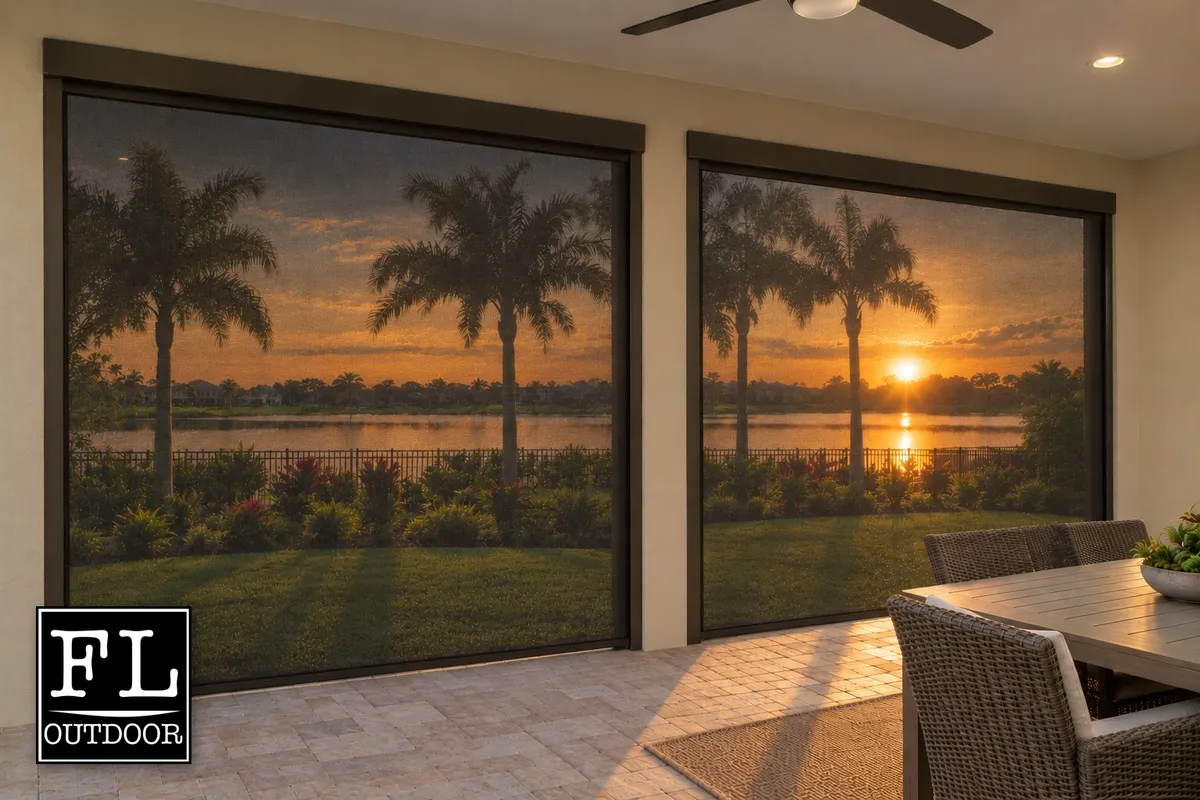
Around 4:30 on a July afternoon, a west-facing lanai turns into a different room. The sun drops just low enough to slip under the roofline. The glass tabletop gets too hot to rest a hand on. The TV vanishes behind its own glare, and the cushions lose a little more color, the way they do every summer. A bug screen does nothing about any of that.
That's the job for real solar fabric. This is Part 3 of our series, and it covers the five TEXTILENE® fabrics built for heat, glare and privacy: TEXTILENE® 80 and 90, and TEXTILENE® nano™ 95, 97 and 99. They come from two quite different designs, and once you see the difference, the choice gets a lot easier.
What is the difference between TEXTILENE® 80/90 and nano 95/97/99?
Both families block most of the sun. They just go about it in opposite ways.
TEXTILENE® 80 and 90 use thick yarn, vinyl-coated 1000-denier polyester about 0.025 inches across. Fewer, heavier strands give you a fabric with visible texture and a lot of toughness. The 80 is woven 16 × 14.5 and weighs 13.0 ounces per square yard; the 90 tightens to 20 × 18 and 15.8 ounces.
The nano fabrics flip that. The standard nano 99 uses a 420-denier yarn about 0.014 inches across, packed into a 38 × 42 weave, roughly twice the strands per inch of TEXTILENE® 90. It comes out smoother and blocks more, and it's actually a hair thinner. The wide nano fabrics weigh between 16 and 17.6 ounces per square yard.
Burlap versus fine linen gets you most of the way there. Both cover the window. One is rugged and coarse; the other is smooth, and a lot of homeowners like how it looks up close.
When is TEXTILENE® 80 or 90 the right call?
These are the everyday workhorses. They fit openings that see real sun for part of the day, homes where you still want some air moving, and buyers who like a fabric with heft and texture.
In Twitchell's testing, TEXTILENE® 80 let about 24% of the sun's energy through head-on. That's fine for an east-facing opening, partial afternoon sun, or a patio where breeze comes first. TEXTILENE® 90 cut it to about 13% and let only about 15% of ultraviolet light through. For most sunny Florida openings, south-facing ones included, the 90 is the safe middle choice.
Both come in seven colors (White, Desert Sand, Sandstone, Dusk Grey, Brown, Black/Brown and Black) and in widths from 36 to 126 inches. Twitchell covers both with a 15-year limited warranty against defects and excessive loss of color or strength under normal exposure.
When should I step up to nano 95, 97 or 99?
When the sun is the problem, not a side issue.
The classic case is the west-facing afternoon, with the sun low and pointed straight into the opening. A dark nano 95 lets roughly half as much solar energy through as TEXTILENE® 90, and a nano 99 lets through almost none. Glare is the other big one. If there's a TV, a laptop or a reading chair out there, note that in Black/Black the nano fabrics pass only about 3% to 4% of visible light, which is why a screen can stay readable at 5 p.m.
Privacy pushes people here too. Dense, high-block fabric is hard to see through from the bright side, so in daylight the neighbors mostly see fabric. And for big openings, the wide nano rolls run to 144 inches, a full 12 feet, which can mean no seam across the middle of your view.
What you give up is breeze. A 99 lets very little moving air through. A lot of homeowners put a 97 or 99 on the hot west wall and something breezier on the side the wind comes from.
Does fabric color change heat and glare control?
More than the percentage, in some cases. Here's the same nano 99 weave in four of its seven colors, from Twitchell's data.
Dark fabric lets the least sun through, but it absorbs nearly all of it, so the fabric itself warms up. Light fabric lets a bit more through and bounces most of the rest back toward the sky. Put them in front of a glass door and the white comes out ahead on heat gain, 0.20 against 0.36.
That gap is bigger than what you'd get by upgrading the percentage. In Twitchell's wide-fabric data, a Black/Black nano 95 in front of glass scores 0.38 and a Black/Black nano 99 scores 0.36. Swapping the color does far more for the house than swapping 95 for 99.
So dark isn't wrong. It just wins at something different. A dark weave doesn't glow in the sun, so from your chair you look straight through it at the yard or the water, with less glare. If the screen's main job is protecting windows and sliders and trimming the power bill, go light or two-tone. If its job is a comfortable, clear view from the patio, go dark.
Do the fabrics block more sun at an angle?
Yes, and it's a pleasant surprise in the data. Twitchell measures its fabrics head-on and with the sun at 45 degrees. At the angle, TEXTILENE® 80 drops from 24% of solar energy through to 20%, and TEXTILENE® 90 from 13% to 9%. The sun hits most screens at an angle most of the day, so real-world shade usually beats the head-on figure.
How private is a high-block screen at night?
Less than in the daytime. Screen privacy depends on which side is brighter. During the day the outside is much brighter than your patio, so people see the fabric, not you. After dark, with the patio lights on, it flips, and the more open the fabric, the more people outside can see. If evening privacy matters, lean toward higher blockage and softer lighting.
Are high-block fabrics tough enough for Florida?
On fire, TEXTILENE® 90 and the nano 95, 97 and 99 fabrics meet NFPA 701, and the 90 and nano 99 also pass California Title 19. Mildew testing (ASTM G21) showed no growth, with an antimicrobial built in. TEXTILENE® 80, 90 and nano 99 showed trace discoloration after 1,200 hours of accelerated weathering (ASTM G154) and no exposed core yarn in abrasion testing (ASTM D3884). They're GREENGUARD Gold certified, lead-free and RoHS compliant.
Warranty terms vary by fabric and by use, so ask for the exact term on the fabric in your quote, in writing.
Frequently asked questions
Should I choose TEXTILENE® 80 or 90?
For most sunny Florida openings, choose TEXTILENE® 90. In Twitchell's testing it let about 13% of the sun's energy through head-on, compared with about 24% for TEXTILENE® 80. The 80 suits partial sun or patios where you want more breeze.
What is the difference between TEXTILENE® 90 and nano 95?
TEXTILENE® 90 is woven from heavy 1000-denier yarn and blocks about 90% of the sun. TEXTILENE® nano™ 95 uses a finer yarn in a denser weave, blocks about 95%, looks smoother and comes up to 144 inches wide.
Is a 99% screen fabric too dark?
Not usually from the inside. In daylight you can still see out through a dark nano 99 while it stops nearly all of the sun's energy and glare. The trade-offs are a dimmer space and very little breeze, so it's best on west-facing and high-glare openings.
Which screen fabric color is coolest?
For keeping heat out of the house through glass, light colors did best in Twitchell's testing because they reflect most of the sun's energy. For a comfortable, clear view while sitting on the patio, dark colors are usually preferred because they cut glare.
Can I see through a 95% or 99% solar screen?
Yes, in daylight. The outside is much brighter than the shaded side, so you see out clearly while people outside mostly see fabric. Dark colors give the clearest view.
How wide can a single TEXTILENE® screen be without a seam?
TEXTILENE® nano™ 95, 97 and 99 Wide come in rolls up to 144 inches. TEXTILENE® 80, 90 and the standard nano 99 go up to 126 inches. The size limits of your screen's frame and motor still apply.
The short version
The frame protects the investment; the fabric decides how the space feels. If you're starting from zero, Part 1 covers how to read a solar screen fabric before you buy, and Part 2 covers the breezier nano 50 to 70 fabrics for bugs and airflow. Before you decide, hold full-size samples up to the opening at the hour it bothers you most. For a west wall, that's late afternoon, not ten in the morning.
Sources
Twitchell Technical Products. TEXTILENE® 80 and 90 product sheet, July 2021 (technical data, solar screen properties, warranty).
Twitchell Technical Products. TEXTILENE® nano™ 95, 97, 99 Wide product sheet, August 2025 (fenestration properties, specifications, widths).
Twitchell Technical Products. TEXTILENE® nano™ 99 product sheet, January 2021 (technical data, colors).