TEXTILENE® nano™ 50, 55, 60 and 70: Choosing Screen Fabric for Breeze and Bugs
Quick Answer: TEXTILENE® nano™ 50, 55, 60 and 70 are breathable screen fabrics for airflow, bugs and light shade, rated by Twitchell to block 50%, 55%, 60% and 70% of the sun. Nano 50 has the most open weave (17 × 14) and moves the most air. Nano 55 (17 × 17) and nano 60 (17 × 20) tighten the weave and add a little shade at each step. Nano 70 has the finest weave of the four at 23 × 21, and it's the one Twitchell designates for no-see-ums. All four share the same coated polyester yarn, are made in the USA, and carry a 15-year limited warranty for fixed and operable shading.
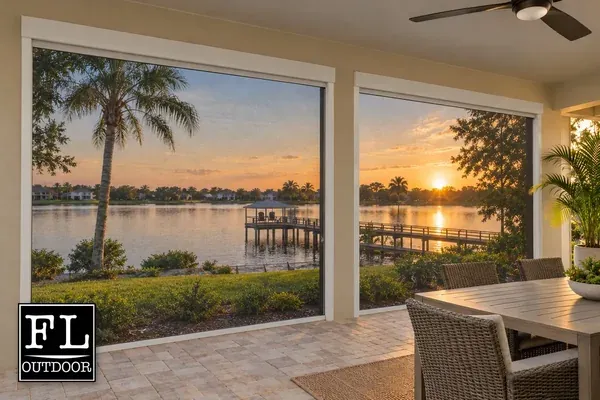
Some patios don't need a wall against the sun. They need a filter. The breeze off the lake should keep coming, the pool should stay in view, and the afternoon light only needs its edge taken off. What has to stay out are the mosquitoes at sunset and, on the bad nights, the no-see-ums you feel on your ankles long before you could ever find one.
That's the work of the light end of the TEXTILENE® range: nano™ 50, 55, 60 and 70. From across the yard they look almost identical. Up close, a few extra strands per inch change everything about them. This is Part 2 of our series on screen fabric.
What are TEXTILENE® nano™ 50, 55, 60 and 70 made of?
The same yarn runs through all four: 420-denier polyester, vinyl-coated, each strand about 0.014 inches thick. What changes is how tightly Twitchell packs it. That one variable controls the shade, the airflow and which insects make it through.
How do the four nano fabrics differ?
Nano 50: the closest thing to no screen at all
Nano 50 is the most open of the four. Its 17 × 14 weave lets half the sun through and most of the breeze, and sitting behind it feels like sitting in the open, minus the mosquitoes. It's a natural fit for pool areas and screened lanais where the view and the air are the point, and for covered patios that are already mostly in shade. It's also the widest of the group, up to 144 inches, and there's a white version for houses where a light finish suits the trim.
Nano 55 and 60: a dimmer switch
Nano 55 squares the weave off at 17 × 17. Nano 60 goes to 17 × 20. Each step takes a little more off the sun and adds a little more body. These two earn their place on openings that catch morning sun or light filtered through trees, where nano 50 feels a touch bright and a heavy solar fabric would be too much. Nano 55 also comes in white.
Nano 70: the no-see-um weave
Then the numbers jump. Nano 70 goes to a 23 × 21 weave, the tightest in the family, and Twitchell labels it for no-see-ums outright. It's the heaviest of the four too, 9.8 ounces per square yard against nano 50's 6.1, and it blocks 70% of the sun. So you get fine-insect protection and real shade in the same fabric.
Why does weave count matter for no-see-ums?
No-see-ums are biting midges. University of Florida entomologists describe them as small enough to pass through ordinary window screen, and they gather near water, salt marsh and mangroves, biting hardest at dawn and dusk. Which is, of course, exactly when you want to be outside.
A screen only stops an insect smaller than its own openings, and every added strand per inch shrinks every opening on the screen. Going from nano 60's 17 × 20 to nano 70's 23 × 21 is the step from a mosquito fabric to a midge fabric. Kip sees buyers miss this all the time: "Nobody stopped to ask about the little tiny bugs that bite, the ones you can't see." If anyone in your house gets bitten at dusk near water, say it at the very first appointment, and check that the fabric on your quote is actually rated for no-see-ums.
How much breeze do I give up with each one?
A decent rule of thumb: the share of sun a fabric blocks is close to the share of breeze it slows. Nano 50 lets roughly half the moving air through. Nano 70 lets through less. It isn't stuffy, but on a still, muggy evening you'll notice.
The usual fix is to stop thinking of the patio as one screen. Put nano 70 on the side facing the water, where the midges come from, and nano 50 or 55 where the prevailing breeze comes in. Every opening is built to order, so mixing costs you nothing in looks.
Which nano fabric fits my situation?
Lakefront, marsh or Intracoastal home with biters at dusk: nano 70 on the water side.
Pool area where you want the view and every bit of breeze: nano 50.
Covered lanai with morning sun on one side: nano 55 or 60 there, nano 50 everywhere else.
Garage door screen for a workshop or home gym: nano 50 or 55, for air without the bugs.
West-facing opening in full afternoon sun: honestly, none of these. That's a job for the 80-to-99 fabrics in Part 3.
Will these fabrics hold up in Florida?
Twitchell's test data speaks to the things Florida homeowners ask about. After 1,200 hours of accelerated sun and weather exposure (ASTM G154), the fabrics showed only trace discoloration. Mildew testing (ASTM G21) showed no growth, helped by an antimicrobial in the coating. Abrasion testing (ASTM D3884) left the core yarn unexposed. They're rated to the CA 117-2013 and CS 191-53 flammability standards and are GREENGUARD Gold certified, lead-free and RoHS compliant.
All four are made in the USA. Twitchell's limited warranty runs 15 years for fixed and operable shading, which covers motorized screens, and 3 years for other uses. Get the fabric warranty in writing alongside the motor, frame and labor warranties; they're separate promises.
Frequently asked questions
Which TEXTILENE® nano fabric stops no-see-ums?
TEXTILENE® nano™ 70, with its 23 × 21 weave, is the fabric in this family Twitchell designates for no-see-ums. Nano 50, 55 and 60 have more open weaves built for airflow and general insect control.
What is the difference between nano 50 and nano 70?
Nano 50 has a 17 × 14 weave, blocks 50% of the sun and moves the most air. Nano 70 is woven tighter at 23 × 21, blocks 70% of the sun, is rated for no-see-ums and weighs 9.8 ounces per square yard to nano 50's 6.1.
Will a nano fabric keep my patio cool on a west-facing wall?
Usually not by itself. Fabrics blocking 50% to 70% of the sun take the edge off, but full afternoon sun on a west or southwest opening generally needs a solar fabric rated around 90% or higher.
Do I lose my view with a no-see-um screen?
A little. The tighter weave dims the view slightly compared with nano 50. Darker colors look more see-through than light ones because they don't glow in the sun.
How long do TEXTILENE® nano fabrics last?
Twitchell backs nano 50, 55, 60 and 70 with a 15-year limited warranty for fixed and operable shading. In its testing they showed trace discoloration after 1,200 hours of accelerated weathering and no mildew growth.
More in this series
If the sun is the bigger problem than the bugs, Part 3 covers TEXTILENE® 80, 90 and nano™ 95, 97 and 99. New to fabric ratings? Part 1 explains how to read a solar screen fabric before you buy. And before you decide, hold a full-size sample of each weave up to your own opening at dusk. That's when the difference shows.
When you're ready:
Sources
Twitchell Technical Products. TEXTILENE® nano™ 50, 55, 60, 70 product sheet, October 2026 (weave, sun blockage, weight, test results, warranty).
University of Florida IFAS Extension. Biting Midges, No-See-Ums Culicoides spp. (EDIS IN626). edis.ifas.ufl.edu
Interview with Kip, owner of Florida Living Outdoor, October 2026.