How to Choose Solar Screen Fabric: The Mesh in the Middle Matters
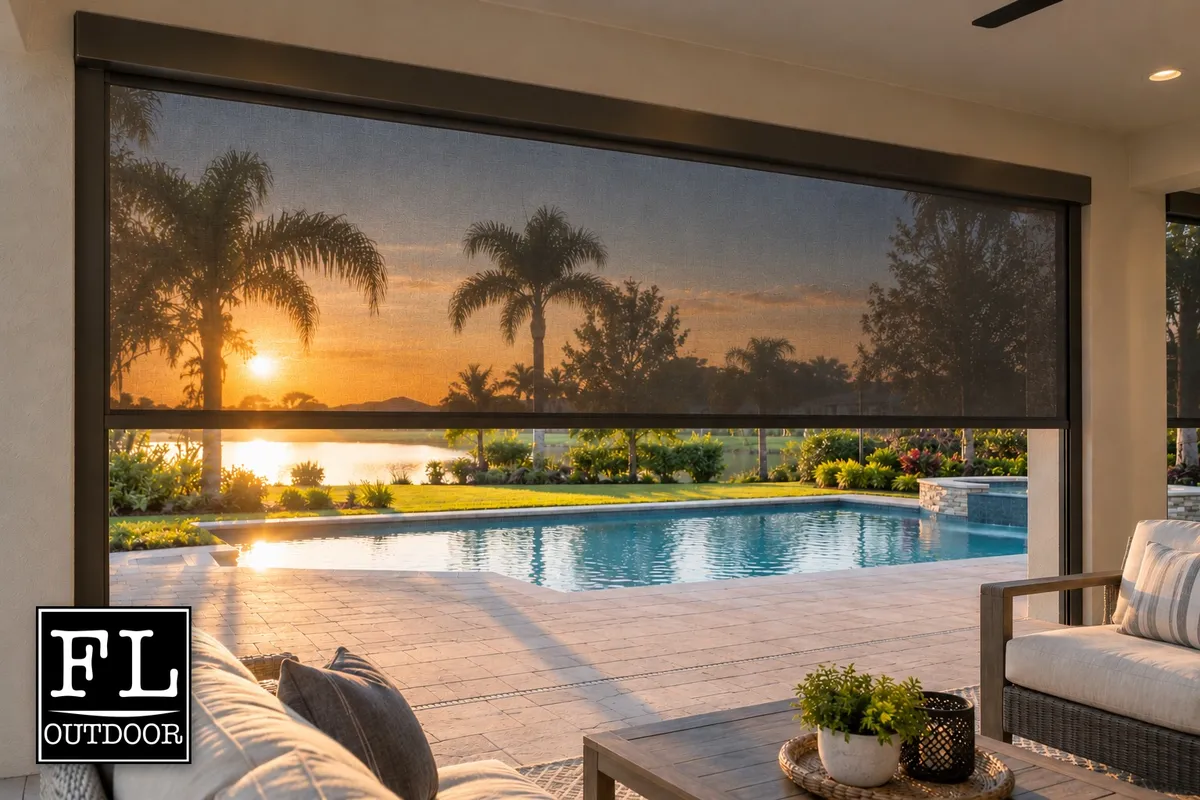
Two motorized screens can leave the same factory with the same housing, the same tracks and the same quiet motor, and still give two families completely different summers. One lanai stays usable until dinner. The other gets abandoned around three o'clock, when the sun swings west and the cushions start to bake. Nothing about the frame explains it. The fabric does.
That's the part of the purchase most people spend the least time on, which is odd, because it's the part you look through every single day. Kip, who owns Florida Living Outdoor, opens every fabric conversation the same way: "What am I asking the screen to do?" This series tries to answer that for you, one fabric family at a time, using the test data Twitchell Technical Products publishes for its TEXTILENE® screen fabrics.
Part 1 is the decoder ring. Spec sheets are full of numbers. Only a few of them change how your patio feels.
Why does the fabric matter more than the frame?
Every motorized screen is built from the same six parts: a housing, a motor, a reel, a weight bar, two side tracks and the screen stretched between them. Five of those decide whether the system runs reliably for years. The sixth decides whether you're glad you bought it.
Eyeglasses are a fair comparison. Put reading lenses in one frame and dark polarized lenses in an identical frame and nobody would call them the same product. A breezy bug mesh and a 99% solar fabric hanging in identical aluminum are every bit as different.
What do the numbers on a screen fabric spec sheet mean?
Sun blockage
The number in the name is usually the share of the sun the fabric stops. A 90 blocks about 90%; the other 10% slips through the gaps in the weave. Kip puts it plainly: "If I have a 90, that means 90% of what's outside stays outside, and 10% comes through." Breeze included. That's why a 99 can feel close on a sticky August night even while it's doing a beautiful job on the heat.
Weave count
Lighter fabrics list their weave as two numbers, like 17 × 14 or 23 × 21. Those are strands per inch in each direction. Pack in more strands and every opening gets smaller, which is the whole difference between keeping out mosquitoes and keeping out no-see-ums. Keep that in your back pocket for Part 2.
Transmittance, reflectance and absorption
Lab sheets split the sun's energy three ways. Some passes through. Some bounces off. The fabric soaks up the rest. The three always add up to 100. That's how a fabric can let only 7% through and still be absorbing 90% of the sun and running warm to the touch, while a white fabric lets 23% through and throws 66% straight back at the sky.
Visible transmittance
This one is about your eyes, not your skin: how much visible light gets through. It sets how bright the space feels and how crisp the pool or the lake looks from your chair.
Solar heat gain with glass
If the screen hangs in front of a window or a slider, look for this figure. It measures how much of the sun's heat makes it through fabric and glass together, and lower is cooler. It's the number that matters to your air conditioner.
Weight and yarn
Ounces per square yard and yarn diameter tell you how much fabric you're actually getting. Thick yarn is rugged and textured. Fine yarn looks smoother and gives a cleaner view. Both can be strong; they're built for different jobs.
Does the color of a screen fabric change how it performs?
Here's the part almost nobody hears in a sales appointment, and it's the most useful thing on the spec sheet: the color can matter more than the percentage.
Twitchell tests its 95, 97 and 99 fabrics in seven colors. Take the 95. In Black/Black, 7% of the sun's energy gets through and the fabric absorbs 90%. In White/White, 23% gets through, but 66% is reflected away. Hang each one in front of a glass door and the white wins on heat gain, 0.25 against the black's 0.38.
Now compare that gap with what you get by stepping all the way up from a black 95 to a black 99. Heat gain drops from 0.38 to 0.36. Barely a nudge. In front of glass, changing the color moves the number about six times more than adding four points of blockage. If keeping the house cool is the goal, argue about color before you argue about 95 versus 99.
Dark still has a strong case, though, and it's about the view. A dark weave doesn't light up in the sun, so your eye slides right past it the way it ignores a black window screen. Sitting on the patio looking out at the water, most people prefer dark. Protecting a wall of west-facing glass, light or two-tone often makes more sense. Two-tones like Black/Grey or White/Sand also tend to get picked to match the trim and the frame, which is a perfectly good reason.
What are the three TEXTILENE® fabric families?
Twitchell's screen fabrics sort into three groups. Parts 2 and 3 take each one apart.
How do I match a fabric to my patio?
Start with what's actually bothering you. Kip hears three complaints more than any others: "Is it the sun when you walk outside at 4 p.m., the bugs that bite at 7 p.m., or packing up your patio furniture?" Then walk your patio with four questions.
Which way does each opening face? West and southwest openings eat the low afternoon sun and usually want 90 or higher. A north side, or an east side under trees, can often stay breezy.
What bites, and when? If you live near water, marsh or mangroves and get chewed up at dusk, that's probably no-see-ums. University of Florida entomologists describe them as small enough to pass through ordinary window screen, so weave count matters as much as shade.
What do you want to see, and who do you want not to see you? A dark color keeps a view crisp. Close neighbors are an argument for higher blockage or a lighter fabric.
How much breeze can you give up? Each step up in blockage trades some airflow for comfort in the sun. Plenty of homes split it: a high-block fabric on the hot wall, something breezier where the wind comes from. Every opening is built to order anyway, so there's no reason all of them have to match.
What should I ask before I choose a fabric?
Which fabric and which color is in my quote, and can I see the spec sheet?
What's the sun blockage rating, and is it rated for no-see-ums?
Will this color give me the view, the heat control or the privacy I'm after?
What does the fabric warranty cover for a motorized screen, and for how long?
Is the fabric wide enough for my opening without a seam?
Can I see a full-size sample, ideally against an opening that faces the same way as mine?
Someone who answers with the spec sheet open knows the product. Someone who says "they're all about the same" has told you something too. For the rest of the decision, from tracks to warranties, see the 10 mistakes homeowners make choosing a motorized screen.
Frequently asked questions
What does a 90 solar screen mean?
A 90 solar screen fabric is rated to block about 90% of the sun's rays and let about 10% through the weave. A similar share of airflow gets through as well, so a 90 feels shadier and stiller than a 70 and breezier than a 95 or 99.
Is a higher percentage solar screen always better?
No. More blockage buys more heat and glare control and more daytime privacy, and it costs breeze and brightness. Which percentage is right depends on the direction the opening faces, the insects you need to stop and how much air you want moving.
Do dark or light screen fabrics keep a patio cooler?
Light fabrics kept more heat out of the house in Twitchell's tests with glass, because they reflect most of the sun's energy. Dark fabrics let less energy through but absorb it, and they give a clearer, lower-glare view, which is why many people still choose dark for seating areas.
What is the difference between solar screen fabric and insect screen?
Insect screen is built mainly to stop bugs and keep air moving, and it typically blocks around half the sun. Solar screen fabric is woven tighter or from heavier coated yarn to block much more of the sun's energy, usually 80% or more, while still keeping most insects out.
Can I use different fabrics on different sides of my patio?
Yes, and it's often the smart move. A high-block fabric on west-facing openings and a breezier fabric on shaded or windward sides is a common combination, since each opening is made to order.
Up next
Part 2 covers the breezy end of the range: TEXTILENE® nano™ 50, 55, 60 and 70 for airflow, bugs and light shade. Part 3 gets into TEXTILENE® 80, 90 and nano™ 95, 97 and 99 for heat, glare and privacy. Whichever way you lean, look at real samples against your own opening, at the time of day that bothers you most. A swatch under showroom lights tells you very little.
Sources
Twitchell Technical Products. TEXTILENE® nano™ 95, 97, 99 Wide product sheet, August 2025 (fenestration properties, specifications).
Twitchell Technical Products. TEXTILENE® nano™ 50, 55, 60, 70 product sheet, October 2026.
Twitchell Technical Products. TEXTILENE® 80 and 90 product sheet, July 2021.
Twitchell Technical Products. TEXTILENE® nano™ 99 product sheet, January 2021.
University of Florida IFAS Extension. Biting Midges, No-See-Ums Culicoides spp. (EDIS IN626). edis.ifas.ufl.edu
Interview with Kip, owner of Florida Living Outdoor, October 2026.